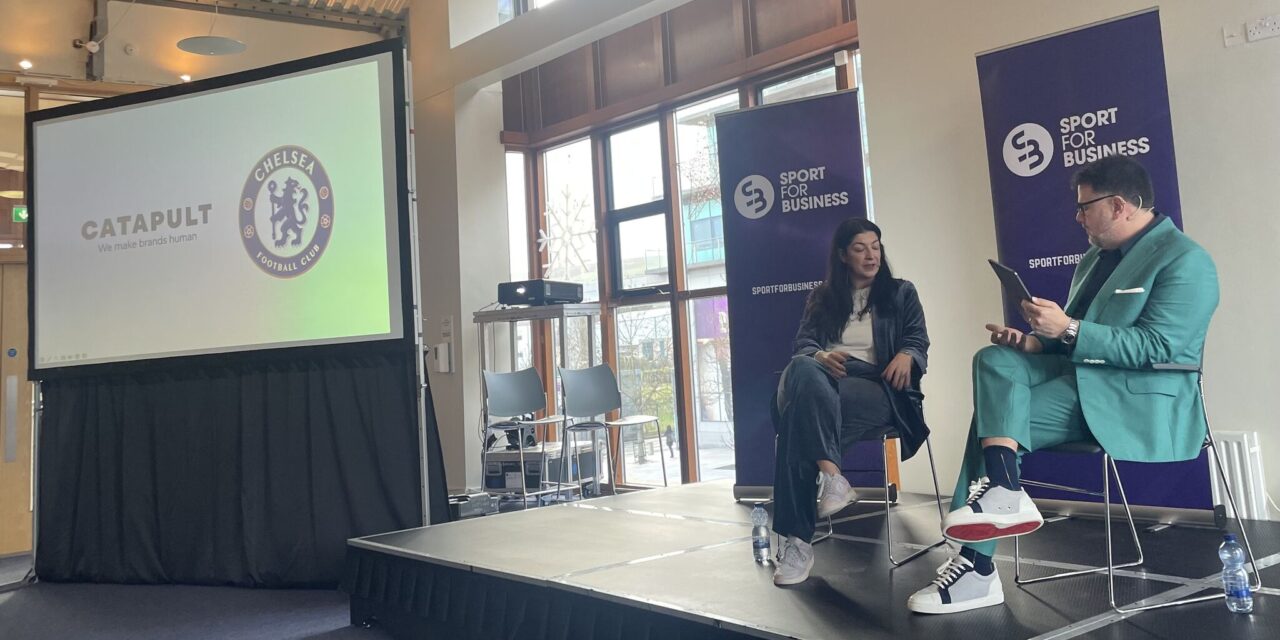
The penultimate session at December’s Sport for Business Women in Sport Conference saw David Davies, Chief Experience Officer at global agency Catapult, sit down with Chelsea FC Women’s Business Operations Director, Nadia Shahrestani.
It was a live case study in how the most successful club side in women’s football is rebuilding the matchday experience, the commercial model and the relationship with fans from the ground up.
Davies began by explaining why an “experience agency” belonged at a Women in Sport conference at all. Catapult, he said, has spent more than 25 years delivering “big ideas and bold ambitions,” using experience as a primary business tool for brands, teams and rights holders. In fan experience, they are “witnessing a seismic shift in fandom in real time,” forcing everyone to move towards experiences that are more personalised, more participatory and more culturally relevant.
Every project is built on insight and measurable value. Catapult’s “Every Moment Counts” framework maps the entire fan journey – strategically, creatively, culturally and commercially – with Davies noting that at events like the FIFA World Cup in Qatar the focus wasn’t just on “creating something fun” but on keeping fans in stadiums longer, boosting concession revenue and turning experience into a real business asset through live data dashboards.
That data-led mindset was the perfect set-up for Shahrestani, who has been at Chelsea since 2005 and now leads operations and commercial growth for the women’s team. The story she told was one of long graft rather than overnight success.
She reminded the room that women’s football did not suddenly appear in 2022. A team founded by women in south-west London has existed since 1968, even before the ban on women’s football in England was lifted in 1971.
That side later evolved into Chelsea Ladies in 1992, but only became formally affiliated to Chelsea FC in 2005. For a long time, the game and the set-up were far from professional.
That context helped explain why, when Catapult first worked on the club’s Player of the Year awards a decade ago, the running order had the men’s team first, then the academy, then the women. A lot has changed. The Women’s Super League only turned professional in 2018; Chelsea Women had not won a major trophy before 2014. Then the club appointed an at the time unknown coach, Emma Hayes, who went on to become the most successful manager in Chelsea history, winning 16 trophies in 11 years. That mantle, Shahrestani said, has now passed to “our amazing manager, Sonia Bompastor,” the only woman to win the Champions League as both player and coach, who promptly delivered an undefeated domestic treble in her first season.
No wonder that today, at the Player of the Year awards, the men’s and women’s teams walk out together, presented in tandem. “We’ve come a really long way,” said Shahrestani, “and that shows why now internally in the club it’s taken in exactly the same way as the men’s team.”
Structural Change
Structural change has followed success. Chelsea Women is now a separate legal entity with minority investment, sitting alongside – not underneath – the men’s club. A “small but mighty” dedicated staff of around 13–14 people work solely on the women’s side, with another half dozen focused on it from elsewhere in the organisation. That independence, she said, gives them the licence to make their own decisions, “be a little bit different, be a little bit bolder, and try things that maybe you can’t do in the men’s game.”
A large part of that difference lies in how the club sees its fans. Shahrestani challenged the lazy assumption that there is one type of women’s football fan. Yes, there are younger, often female fans inspired by the Lionesses, but there are also long-time supporters who have followed the team since the 1990s, and newer followers who arrive via specific players. “You might be a huge fan of Lucy Bronze and not even know that she plays for Chelsea. You see her picture and think ‘I really want to go and see her.’”
The key shift is simple: “It’s not one-size-fits-all.” That insight shapes everything from ticketing to in-stadium entertainment.
Unlike many women’s teams that still sit inside wider club structures, Chelsea Women has a dedicated group whose job is to think about fan experience on its own terms, not in reference to the men. Crucially, they don’t assume they know what fans want – they ask. A women’s fan forum, post-match surveys, an annual in-depth survey and mystery shoppers all feed back into operations. Those conversations revealed one hard truth: supporters did not want the club to simply copy the men’s model, and they did not want gimmicks. They were happy for experimentation up to kick-off, but once the whistle blows “that’s a really serious endeavour for elite athletes and they want us to treat it as such.”
Dialogue
Sometimes, that dialogue involves challenging the fans as well. Tools like clappers, DJs and t-shirt cannons have been introduced carefully, often tested through the forum. At one point the atmosphere had dipped, and the club turned it back on the supporters: “We can do everything up until the point the game starts, but if you think it’s flat, that’s on you.”
The same blend of courage and consultation underpinned one of the biggest decisions: raising ticket prices. When Shahrestani took on the role, a season ticket at Kingsmeadow for 11 games cost £45 for adults and £5 for concessions, equating to as little as 45p a game. The club was losing money on every match, and less than half of season ticket holders were attending regularly. With the help of fan forums, Chelsea increased prices – still keeping tickets between £10 and £20, with concessions at half price – and saw occupancy rise to over 90 per cent. As she put it, “You’re ascribing a value to the best team in the country and some of the most well-known athletes in the world… fandom isn’t just about coming because it’s free.”
The point was also made about avoiding benchmarking and comparison to the Men’s team. “We need to grow Chelsea FC Women in a way that is right for us as a club, for the fans and the players,” said Sharestani.
That independence is even more obvious in digital and commercial strategy. Chelsea Women’s combined social media following is just shy of 11 million, more than 10 Premier League clubs and the most of any women’s team globally. They are the most followed women’s team on TikTok, lead the way in WSL viewing on YouTube, and have launched their own dedicated channel. A specialist team runs those accounts, serving content tailored to their audience, not mirroring the men. “We never even think about the men’s club,” said Shahrestani. “You do you and we’ll do us – we wear the same logo and shirt, but we don’t have to be twins.”

That distinct brand has made Chelsea Women a magnet for innovative partnerships. Shahrestani highlighted a standout collaboration with challenger period-care brand Here We Flo, built around the powerful line “We don’t bleed blue, we bleed…” and a campaign where players took the field in blood-stained shorts to challenge stigma. The creative was backed up by authentic storytelling from players about how periods affect them – or empower them.
At the other end of the spectrum, established brands like Škoda have doubled down on women’s football, turning their first sports sponsorship into the most lucrative back-of-shirt partnership in the league and building activations that range from ferrying fans to the stadium in a bright blue car to “Full Charge”, a content series with players in the carpool karaoke mould.
Across all of it – ticketing, content, community, brand – one theme kept reappearing: the women’s game has both the freedom and the responsibility to design its own future, unburdened by legacy revenue models. Centralised rights income is modest; growth has to be earned. That means building locally – partnerships with groups like Lonely Girls Club and women of colour supporters’ collectives so that everyone can see themselves in the stands – and thinking globally, from pre-season tours to the United States and Australia to becoming “the team that America supports”.
As Sport for Business’ Rob Hartnett noted in his own wrap from the stage, when his niece and nephew in London pressing and pushing to get to Chelsea Women’s games, you know something is shifting – not just in one club, but in the culture of sport itself.
Image Credit: Sport for Business
Further Reading for Sport for Business members:
Read our Sport for Business Coverage of Women in Sport
SPORT FOR BUSINESS Upcoming Events

Sport for Business Podcasts

MEMBERSHIP AND EVENT,
Lidl, Catapult and the FAI and IFA, as well as all the leading sporting and business organisations in and around the world of sport, are among the 300+ members of the Sport for Business community.
This includes all of the leading sports and sponsors, as well as commercial and state agencies, individuals interested in our world, and an increasing number from beyond these shores taking a keen interest in Ireland.
Find out more about becoming a member today.
Or sign up for our twice-daily bulletins to get a flavour of the material we cover.
Sign up for our News Bulletins here.