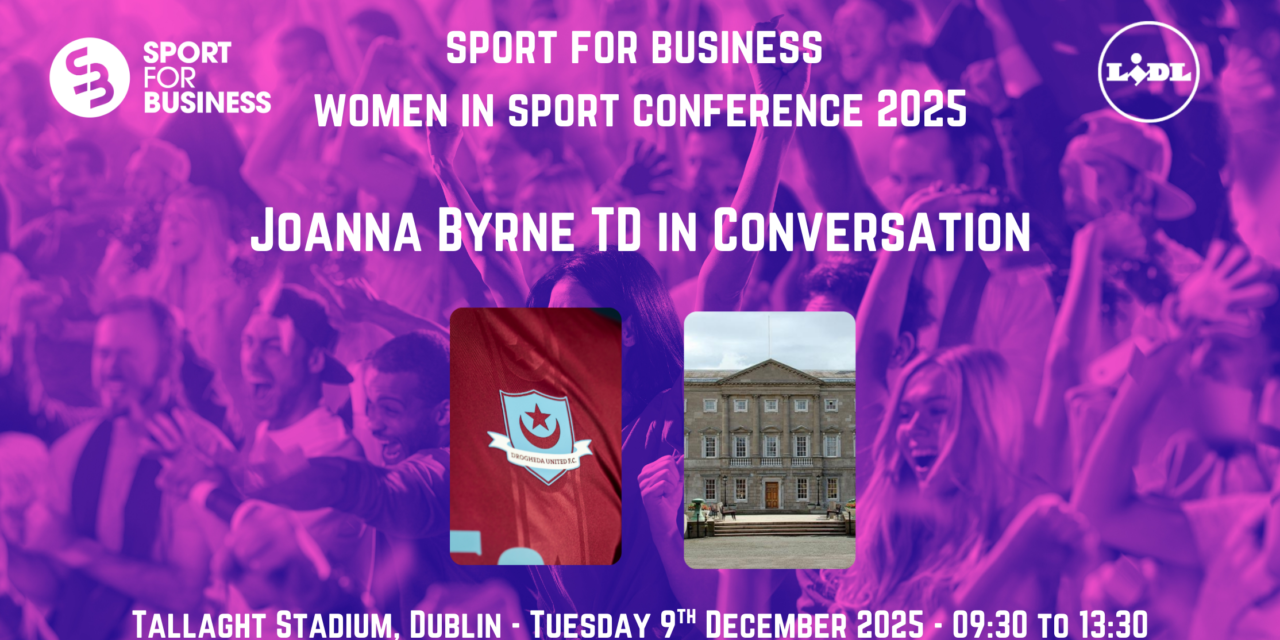
Our closing session of the 2025 Sport for Business Women in Sport Conference was an interview with Joanna Byrne, Chair of Drogheda United and Sinn Féin Spokesperson on Sport.
We covered football, investment, learning to walk on the pitch at United Park, and reaching out to rivals for the good of all.
A great way to finish a great event.
Taking Over as Chair and Finding the Right Investor
Rob Hartnett:
You became chair of Drogheda United Football Club, you’re a local elected councillor in Drogheda, and just over a year ago you were elected as a TD to the Dáil. Because of your passion for sport, you’re also Sinn Féin spokesperson on sport, among other things.
We’re going to talk a little bit of football and a little bit of politics. When I reached out and asked you to come along, you said that any opportunity to promote Drogheda and to promote football in County Louth, you’d jump at it. So thank you for doing that.
Let’s start with Drogheda. It’s been a very special 12 months or so: winning the Sports Direct FAI Cup at the Aviva Stadium, a significant new investment coming in, moving into the professional era, and European football on the horizon. What has it been like for you? It has been a busy year personally, and you’re chair of the club at such an important time in its history.
Joanna Byrne:
It’s actually been a rollercoaster of three years. From the moment I became interim chairperson of Drogheda United, it’s been non-stop.
My predecessor, Conor Hoey, realised the club was at a point where it probably couldn’t continue without external investment. He made a very personal decision to stand down as chairman to focus full-time on seeking and securing that investment, to make sure Drogheda United would be there for the next generation.
The club is ingrained in Conor’s family. His father, Vincent, was our longest-serving chairman. For Conor to step down was huge. At that point, we as a board were really struggling just to keep the show on the road – that’s as blunt as I can put it.
Conor sort of picked me, without me knowing, as his replacement. He approached me to join the board. I’d been involved with the club all my life, but had never sat on the board. Not long after I joined, he started dropping hints: “When I step down, you’ll be taking over.”
He was very passionate that the chair should be someone Drogheda-based, living in the town, Drogheda-born, who wore the crest on their sleeve in everything they did. I think he saw that in me.
I became interim chair for three months before we held an EGM where, as a fan-owned club, I had to be endorsed by the membership. We were in a very turbulent period. Conor was leading the search for external investment and I suddenly found myself in the chair thinking: “How are we paying the bills until we secure this?”
We met – led by Conor – some absolute cowboys. People coming in saying, “How much will it cost us to win the league? How much will it cost us to get European football?”
From outside Ireland, they see ten teams in the top flight and four European spots and think: “If I throw a couple of hundred grand at it, can I get back a couple of million quickly?”
That was scary for those of us responsible for the club’s future. We were saying: this doesn’t work for us. We want long-term commitment, slow and steady progress, and a sustainable model.
It was a rollercoaster of about 18 months before we found Trevella, who now own the club. By the time we met them, I’d met four other potential buyers and Conor had probably met forty. The four I met just didn’t sit well with me. I wasn’t prepared to stand in front of our fans and endorse any of them.
When Conor rang and said, “Keep 29th January free, a group is coming over from America – you’re going to love them,” I was sceptical. There were twelve of them flying in. We had a whole day planned: meeting the board, visiting United Park, seeing the potential site for a new stadium. Conor was so enthusiastic and my heart, at that stage, was on the floor. I was thinking, “Are we ever going to see any hope?”
We went into the morning meeting, hosted by the Chamber of Commerce, and within 40 minutes I was texting Conor across the room: “I finally feel what you’ve been telling me you’ve been feeling for weeks.”
Their morals were right. They talked about long-term investment, sustainable growth, key investment in staff, and transitioning the team from part-time to full-time. It was everything we hadn’t heard from anyone else.
We then went through a due diligence process that was supposed to take four months and ended up taking eight. They did their due diligence on us, we did ours on them. In the end, I was happy to stand in front of our fans and endorse the takeover.
To this day, I’m very pleased to say it’s working very well. Every promise they made, they delivered on – and quicker than they’d committed. They’re all about underselling and over-delivering.
We transitioned our manager Kevin to full-time, then the first team went full-time. We appointed a Head of Academy. We’ve invested in our women’s programme. And our key objective now, which is no secret, is building a new stadium.
It’s fitting that we’re here today in the flagship club of the league, in the best stadium in the League of Ireland. This is what we all aspire to have and we’re making steady progress towards that.
Community, Campaigning and Match Attax Cards
Rob Hartnett:
It’s been a rollercoaster at Drogheda United and for you personally. Last year you contested two elections: the local elections in May and the general election in November.
Friday is a big day for you: answer emails, canvass in the afternoon, then off to a Drogheda match.
Joanna Byrne:
Exactly. I’ve always done that since I went on the council in 2016 – Friday is canvassing and then the match.
Last May, during the local elections, little kids – especially little girls – were coming out to me with their Match Attax cards. We do these cards in the club where kids buy a packet every week, and I’m actually on one of them.
They were saying, “It’s you, Joanna – will you sign my card?” It was really surreal.
By the time of the general election, the timing was perfect with the FAI Cup. The cup final and the election were only a couple of weeks apart. Every house we were going into in Drogheda had claret and blue bunting hanging from the windows and down the driveway.
You’d knock on the door and it was light-hearted and easy – everybody wanted to talk about the football. I had a unique opportunity: on one hand, selling the club – “Get your tickets, bring the kids, bring the family” – and on the other hand saying, “And maybe you’ll consider giving me a vote.”
A lot of people joked: “It depends if you win the cup or not!”
It’s been an eventful few years, a very unique experience. They’re years that will stay with me for the rest of my life.

United Park, Facilities and the Women’s Game
Rob Hartnett:
You’re very much rooted in the community. This is a fabulous stadium and a fabulous club here today – I’m absolutely in love with the League of Ireland. The commercial world backing it is great, and the FAI are doing a wonderful job with Mark Scanlon and his team.
United Park has a special atmosphere. Whenever I go up, I’m invited to the box and I say, “Thanks, but I’ll pass,” and go in with the ultras.
You see this generational thing: the lads with the tattoos waving the big flags, and then their sons – and the occasional daughter – beside them. You know that if I go back in ten years, those kids will be the ones letting off the flares.
You’re also the best team for flares…
There’s that deep connection with the community, but it must be challenging when you’re talking high finance, because football is the people’s sport and also a sport that attracts a lot of money.
You’re on one of the Match Attax cards as chair of Drogheda United, but there aren’t many women on Match Attax cards. Drogheda hasn’t yet fully dived into the women’s game at senior level. Why is that?
Joanna Byrne:
It’s something very close to my heart. When I joined the board, I made a commitment to really focus on developing women’s football.
One of the unique experiences I’ve had was recruiting our first Head of Women’s Football, my schoolfriend Laura Donovan. Anyone involved in women’s football in Ireland knows Laura – her CV speaks for itself. Being able to bring her in to put our first women’s team together was really special.
What’s disappointing is that we haven’t made the progress I would have liked. We committed to an under-17s team for two years, then progressing to under-19s and then into a senior women’s team as quickly as we could. We haven’t gone much further than the under-17s yet.
We’ve now moved into a women’s development team, and John Dunne, our Head of Academy, is working hard on that. But I’ll be straight with you: the biggest barrier has been facilities and infrastructure.
We’ve really struggled with training pitches. Not so much for matches in United Park – or Weavers Park as it is now – but juggling limited training facilities for all our teams. It became such a headache that we moved our senior men’s team to train outside Drogheda, in a fabulous facility in Readypenny. They’ve really immersed themselves in the Drogheda United family – you see them coming in with the gear, their kids buying season tickets – and it’s a brilliant partnership. But it came from necessity.
The main barrier for Drogheda United – not just in women’s football but across the club – is that our facilities are not great to be honest.
United Park is very special to me. My granddad was chairman of Drogheda United several times in the 70s and 80s and was general manager. My mum was a young single mother, so we lived with my granddad when I was born. He used to take me everywhere with him. I actually learned to walk on the pitch in United Park. He’d bring me in, set me down in the middle of the field while he went off to sign cheques and do what men did in those days – and one day I just got up and walked over to him.
So the place is incredibly special to me. The day we get new, state-of-the-art, fit-for-purpose facilities that will enable youth football to grow, women’s football to grow and the men’s team to continue to grow, I’ll probably be chaining myself to the walls of United Park saying, “I don’t want to go.”
It’s a very intimate place for fans. Our supporters bring a unique atmosphere – yes, they bring headaches with fines and flares – but there’s not a person who comes through the gate and doesn’t leave having had a great experience. It’ll break my heart when we have to leave, but for the club to grow – especially in women’s football – we need a fit-for-purpose facility.
United Park, Mental Health and “Head in the Game”
Rob Hartnett:
United Park also had a powerful link to mental health with “Head in the Game Park,” didn’t it?
Joanna Byrne:
Yes. A few years ago there was a documentary on Drogheda United – for anyone who hasn’t seen it, it’s called The Underdrogs and it’s on the RTÉ Player. I was doing an interview in the clubhouse and pointed out the window saying, “I learned to walk out there.” Everyone is always really struck by that. Even our American owners – they were like, “Oh my God, you learned to walk here!”
The naming of Head in the Game Park came from a raffle. The club ran an initiative where businesses and individuals bought tickets – I think they were about €100 each – and whoever was drawn got to rename the ground for a year. I happened to win, probably because I bought more tickets than anyone else.
I initially thought of naming it after the Alzheimer Society because my granddad, who built United Park, died of Alzheimer’s. But “Alzheimer’s Park” didn’t quite have the right ring to it, and I wanted something that would shine a light on the club and do some good, not just be about my granddad’s legacy.
At the time, Dundalk’s groundsman Harry Taaffe had died by suicide. It really shocked the League of Ireland community, particularly in Louth. On the back of his passing, a group of Dundalk fans set up a committee called Head in the Game. Their tagline was “Don’t turn your floodlights off – keep your head in the game.” That always stuck with me.
I approached them and said, “I know you’re Dundalk fans and we don’t get on most days of the week, but I’ve won the chance to rename United Park for a season. Would you be interested?” I thought it would really resonate with football fans and be a great opportunity to open up conversation about mental health around the league.
They snapped my hand off. They said, “We don’t care if it’s Drogheda – in fact, that makes it even better.”
The timing worked out perfectly. It got huge coverage for Head in the Game, which is now a major mental health advocacy group. COVID hit in the same period, so what was meant to be one season ended up being nearly three years of Drogheda United’s ground being called Head in the Game Park.
I think it did a lot of good for relations between Drogheda and Dundalk and a lot of good for mental health awareness in the league. It elevated their campaign several levels. It was a really nice, collegial moment between two clubs in a county that has one of the most intense rivalries in the country.
We’re the smallest county with the two largest towns, which is mad, and both towns are very blessed to have top-flight football teams. I firmly believe Drogheda and Dundalk both belong in the Premier Division.
Balancing Politics and Football
Rob Hartnett:
Let’s move to politics. You were elected representing Sinn Féin, moving from the council into the Dáil, and you were given the opportunity by the leadership to become a front-bench spokesperson on sport.
Was that something you actively sought, or did they look around and say, “Joanna Byrne – she’s the one”?
Joanna Byrne:
Honestly, it’s probably the biggest headache I’ve ever been given – and I say that with affection.
I’ve spent my life trying to keep my politics and my football separate. We’re divided by politics – there are probably many people in this room who don’t share my political ideology, and vice versa – but sport is what unites us, which is really special.
I’ve always tried to keep my politics out of the football club for that reason. I never wanted to tarnish the club with my politics, or my work as an elected representative with football. There are Dundalk fans in my constituency too!
So I kept the two hats very separate and I think I did that successfully – until I got elected to the Dáil. Mary Lou McDonald called me into her office and said, “I’m giving you a front bench brief.” I was thinking, “How am I going to do that?” Then she said, “I’m giving you sport.”
It hit me like a slap in the face: I’m not going to be able to keep these two worlds separate for very long.
Being straight with you, if someone asked me to make a choice, I’d probably always favour Drogheda United and my football. Anyone who knows me knows I’m a huge League of Ireland fan. I have enormous admiration for the League of Ireland office, Mark Scanlon and his team, and all the work they do to elevate our league, especially at times when the FAI might be under scrutiny for the past.
I had to sit myself down and say: you’ve always said you’re a League of Ireland fan, you’ve always said you’d do what you could to help elevate it. Now you have an opportunity to show why you love it and what can happen when investment goes into the League of Ireland – the joy football can bring, alongside the GAA, the IRFU, boxing and everything else.
It’s still a challenge. I want to stand up in the Dáil at every opportunity and roar at the Minister for Sport: “We need more funding because Drogheda United needs a new stadium.” But I have to zip my mouth, keep it general, and fly the flag for the League of Ireland and other sports, and leave Drogheda out of it.
They all know me, though. They know I eat, sleep and breathe Drogheda United. Every time I’m calling for funding for the League of Ireland and academies, they’re thinking, “She only wants that because she wants the Drogs to excel.”
So it’s a challenge, keeping the two worlds separate. But there are times when they can come together for the greater good, and those are the opportunities I need to seize – to show, from where I sit now, what sport can deliver.
Sport, Storytelling and Political Priorities
Rob Hartnett:
From that seat in politics, how good is sport at telling its story?
So many of us live and breathe sport – it’s a huge part of our identity, whether it’s a ball, a bat or a paddle. How good are we at translating that into the language politics understands and can deliver on? Because you’re being battered with housing, health, infrastructure – all incredibly important – but they don’t make us laugh and cry and smile in the same way.
Joanna Byrne:
I don’t think any politician will tell you that sport is top of their agenda – even, if we’re honest, many ministers for sport.
We’re living in a very turbulent time. We have a housing emergency; a long-standing healthcare crisis; a cost-of-living crisis that’s really troubling people who are working. Lots of families with two good incomes are still struggling to make ends meet, to keep food on the table, the lights on, the house warm.
So sport tends to be down the radar when it comes to bread-and-butter issues.
But interestingly, since COVID people’s priorities have changed. During COVID, everything stopped. Routines disappeared. When stadiums reopened, we saw a huge increase in attendances, particularly at the League of Ireland, and people were coming out as families.
The demographics have changed. It’s no longer just men going on their own. It’s men, women and children together, or kids coming with their mums. It’s become a family occasion.
That brought its own challenges for us. When we reopened after COVID and started selling out games – which had never happened before – we suddenly realised we had no female toilets that were fit for purpose. The lads had always been grand with the toilets we had, but now we had women asking, “How do I get around the other side to use the toilets at the clubhouse?”
These were things that had never troubled us before. Suddenly we had to invest in something as basic as decent toilets.
The trajectory has changed. We’ve become a family, enjoyable occasion rather than just the lads going for a few pints and the match. We need to embrace and harness that.
There’s now a huge focus on mental health and wellbeing since COVID. That feeds into the call for funding for sport too. Attendances have shot through the roof in the League of Ireland, but if we don’t have the infrastructure to support current levels and allow further growth, we’re stuck.
So while mental health and wellbeing issues are hard for those suffering, politically they can be used positively to emphasise the case for sport: that we’ve got something that brings joy, brings families together, builds communities – but we need to invest in it.
Image Credit: Sport for Business
Further Reading for Sport for Business members:
Read our Sport for Business Coverage of Women in Sport
SPORT FOR BUSINESS Upcoming Events

MEMBERSHIP AND EVENTS,
The FAI, League of Ireland, Shamrock Rovers, Shelbourne FC, Bohemian FC and Drogheda United, as well as all the leading sporting and business organisations in and around the world of sport, are among the 300+ members of the Sport for Business community.
This includes all of the leading sports and sponsors, as well as commercial and state agencies, individuals interested in our world, and an increasing number from beyond these shores taking a keen interest in Ireland.
Find out more about becoming a member today.
Or sign up for our twice-daily bulletins to get a flavour of the material we cover.
Sign up for our News Bulletins here.