Investment in Local Sports Partnerships (LSPs) has more than doubled since 2018, reaching €12.66 million in 2026, as Sport Ireland continues to shift resources towards community-level delivery in response to rising participation demand and growing social need.
The scale of the increase reflects a strategic recognition that many of the most persistent challenges facing Irish sport — inactivity, inequality and access — are best addressed locally rather than through centralised national programmes.
The return on that investment is evident in participation figures.
In 2025 alone, LSPs delivered 2,211 locally-based initiatives, engaging 577,728 participants, representing a 48 per cent increase since the introduction of the National Sports Policy.
Crucially, nearly 478,000 of those participants came from socio-economically disadvantaged communities, underscoring the role of LSPs as the State’s primary mechanism for reaching people least likely to engage in sport or physical activity through traditional club structures.
Rather than prioritising short-term programmes, the 2026 funding model places a clear emphasis on people, capacity and continuity.
More than €9.5 million of LSP investment is allocated to staffing, including coordinators, programme managers, Sports Inclusion Disability Officers and Community Sports Development Officers.
This reflects an explicit policy judgement by Sport Ireland that trusted local personnel, embedded in communities, are more effective at engaging under-represented groups than time-limited initiatives or national awareness campaigns.
Having Chaired the Dublin City Sports Partnership and worked closely with others, I have seen at close quarters the energy and effort that go into what they do.
The workforce-led approach has also broadened the scope of what LSPs are expected to deliver. While participation remains the primary metric, LSPs are increasingly operating at the intersection of sport, health and social policy.
Programmes targeting older adults, people with disabilities, ethnic minority communities and those experiencing socio-economic disadvantage position physical activity as a tool for improving wellbeing, reducing isolation and supporting preventative health outcomes.
However, growth in both funding and participation has added pressure. As demand increases, LSPs are being asked to act not just as programme deliverers but also as local convenors, connecting clubs, schools, local authorities, health services, and community organisations.
In many areas, LSPs have become the de facto infrastructure for sport and physical activity planning at the county level, with expectations extending well beyond their original remit.
The 2026 investment reflects this evolution. By strengthening staffing capacity and embedding LSPs more deeply within local systems, Sport Ireland is positioning them as long-term enablers of participation, rather than short-term delivery vehicles.
In doing so, LSPs are increasingly framed not simply as sports bodies, but as integral components of Ireland’s broader public health and social inclusion architecture. And that can only be a good thing.

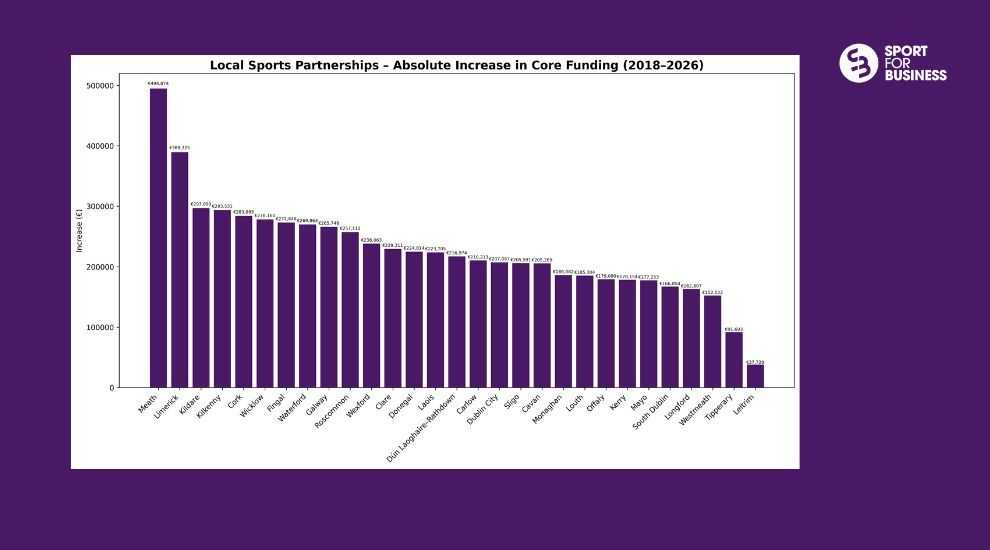
The Local Sports Partnerships funding data illustrates how the expansion of core investment since 2018 has been distributed across the country, both in scale and intent. While larger counties such as Meath, Limerick and Cork account for the biggest absolute increases, every one of the 29 LSPs has seen meaningful growth over the period, reflecting Sport Ireland’s commitment to building national coverage rather than concentrating investment in a small number of hubs. Read alongside percentage growth, the chart shows how funding has been used to strengthen baseline delivery capacity across all counties, positioning LSPs as long-term local infrastructure for participation, inclusion and community health rather than short-term programme vehicles.
Image Credit: Sport for Business
Event Tickets

Upcoming Events


SPORT FOR BUSINESS
Sport for Business is Ireland’s leading platform focused on the commercialstrategic and societal impact of sport. It connects decision-makers across governing bodies, clubs, brands, agencies and public institutions through high-quality journalism, events and insight. Sport for Business explores how sport drives economic value, participation, inclusion and national identity, while holding organisations to account on governance and sustainability.
Through analysis, storytelling and convening the sector, it helps leaders understand trends, share best practice and make better-informed decisions. Its work positions sport not just as entertainment, but as a vital contributor to Ireland’s social and economic fabric.
Find out more about becoming a member today.
Or sign up for our twice-daily bulletins to get a flavour of the material we cover.
Sign up for our News Bulletins here.