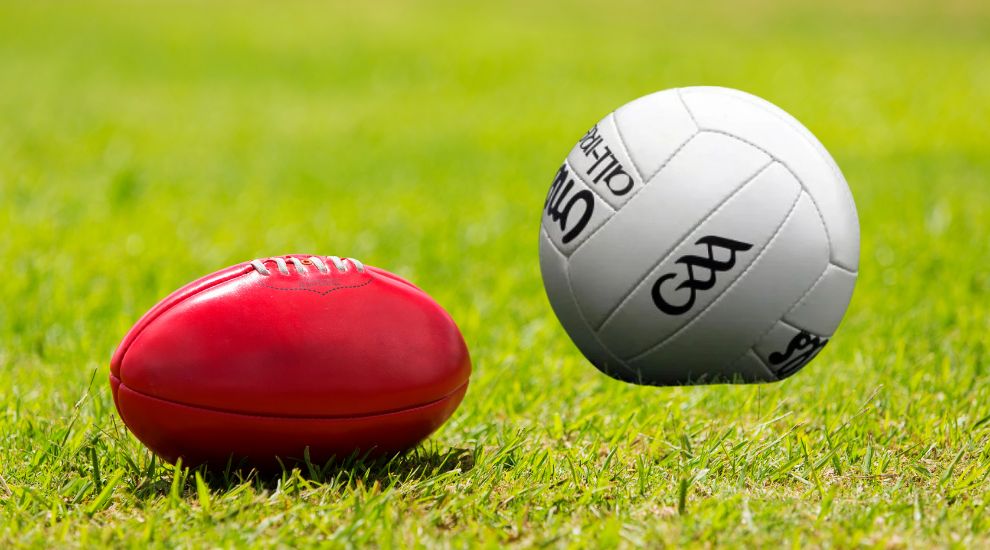

The news overnight that Mark O’Connor is being allowed by Geelong Cats to remain in Ireland for Dingle’s AIB All Ireland Club Final is a positive at a time when the pull of Australia is stronger than ever.
Kobe McDonald is also being spoken of for a run with the Mayo seniors ahead of his heading down under this year.
But what is the overall trend of players growing up through Gaelic Football in both the Men’s and Women’s game and being recruited to play professionally in Australia?
Through the 2025 season, there were 14 Irish-born players in the AFL, with O’Connor’s Geelong Cats including four on their active list, and a record 39 playing in the AFLW.
Six of these were on the Melbourne squad that retained its AFLW title, and five made the All-Australia Squad of 21, the equivalent of the GAA and LGFA All Stars. These included All-Ireland winner Jennifer Dunne, Bláithín Bogue, Niamh McLaughlin, Áine McDonagh and Dayna Finn.
Irish players were now among the very best in the competition. To understand why that matters — and why the flow continues — you have to follow the arc of the athlete’s journey, both female and male.
For Irish women, the transition is often immediate and profound.
Most arrive in Australia on entry-level AFLW contracts worth around AUD $40,000–$60,000. With the Aussie Dollar to Euro conversion rate at around 58% that means a starting salary of between €23,000 and €34,000.
In purely financial terms, that may appear modest, but the reality is that it enables sport to become the primary job rather than something fitted around work, study or travel.
Training sessions are no longer squeezed into evenings. Recovery is not a luxury; it is planned as part of the day, and facilities for fitness and rehabilitation are baked into the daily load.
Within a season or two, the separation begins. Players who adapt — and many Irish players do — move into the AUD $70,000–$120,000 (€40,000 to €75,000) bracket as regular starters.
At this stage, the professional identity hardens. Clubs invest with intent rather than curiosity. Performance data is tracked, development plans refined, and careers actively managed.

Then comes the highest tier. All-Australian selection brings not just recognition, but leverage. Salaries rise again, with the ceiling believed to be around €110,000 in the Women’s game.
This can also be supplemented by ambassador roles, sponsor appearances and leadership responsibilities.
The men’s pathway is different — slower, more precarious, but still compelling, and with a salary base that is double in the early stages and up to four times bigger at the top.
Irish men typically enter the Australian Football League system as Category B rookies, earning roughly AUD $90,000–$130,000 (€50,000 to €75,000) in their early years.
Progression to the next level is harder and the competition deeper with the Men’s game rooted in Australian tradition to a greater extent.
Those who establish themselves can move into the AUD $150,000–$300,000 (€85,000 to €170,000) range as regular squad players. Break into a club’s best 22 and salaries can climb towards two or three times that number
Only a select few ever reach the elite tier, but even mid-level AFL earnings represent a level of professional support, medical care and career planning that simply does not exist within the GAA structure.
In Australia, both men and women operate inside systems built entirely around performance. Nutrition, psychology, recovery, load management and post-career education are fully integrated. Contracts are finite but clear. Expectations are explicit. Careers have shape.
By contrast, the Irish model still relies on an unspoken trade-off: excellence in return for amateur status. Expenses, grants and flexible employment soften the edges, but they do not change the fundamentals. Training remains layered on top of life, rather than the other way around.
For many, that is enough, and the draw of home, with the added sparkle of the big days as a County player is compelling, given that the Australian dream has no guarantees and a high attrition rate.
Sport for Business Perspective
Ireland is now a net exporter of elite football talent, particularly in the women’s game, to a fully professional system. AFL and AFLW clubs are no longer experimenting; they are recruiting strategically, building Irish pipelines and allocating list spots accordingly.
For the GAA and LGFA, this presents both a challenge and an opportunity. Retention pressures will remain, but the visibility of Irish athletes succeeding abroad also enhances Ireland’s reputation as a high-performance talent market.
The challenge now is not about stopping the flow, but about adapting domestic systems so that global mobility and local sustainability can coexist.
Image Credit: Sport for Business
SPORT FOR BUSINESS Upcoming Events



SPORT FOR BUSINESS
Sport for Business is Ireland’s leading platform focused on the commercial, strategic and societal impact of sport. It connects decision-makers across governing bodies, clubs, brands, agencies and public institutions through high-quality journalism, events and insight. Sport for Business explores how sport drives economic value, participation, inclusion and national identity, while holding organisations to account on governance and sustainability.
Through analysis, storytelling and convening the sector, it helps leaders understand trends, share best practice and make better-informed decisions. Its work positions sport not just as entertainment, but as a vital contributor to Ireland’s social and economic fabric.
Find out more about becoming a member today.
Or sign up for our twice-daily bulletins to get a flavour of the material we cover.
Sign up for our News Bulletins here.