This weeks Sport for Business Column in the Sunday Business Post looked at how the sport of rowing can make the most of its moment in the spotlight…

The sport of rowing has a lot going for it in Ireland. We are an island nation, we value our waterways and we love it when a couple of lads with a twinkle in their eye go head to head with giants and come back with precious metal.
Last weekend in the Czech Republic a glorious Sunday morning produced the kind of medal haul that we could normally only dream about.
First Mark O’Donovan and Shane O’Driscoll took Gold. Then Denise Walsh added a silver and then those other O’Donovan’s, Gary and Paul, pulled like dogs and came from what seemed another country to grab their own silver and shorten the gap between themselves and Olympic Gold medallists France.
Better still we were able to watch it live as, fair play to RTÉ, they had pictures, and interviews. The country fell in love with the sport again just as it had in Rio.
Perspective
To put this achievement in perspective, and in context given our occasional flirtation with sports beyond the big three, Irish boxing took home one Bronze medal from the European Championships that took place in Turkey one year after Michael Carruth and Wayne McCullough delivered at the Barcelona Olympics.
The boxing story went from strength to strength, delivering seven of Ireland’s eight medals from the London and Rio Olympics and producing stars who became household names.
The Government weighed in, knowing a good thing when they saw it and money was spent on developing talent, bringing on the best coaches and delivering more and more success.
It was a truly golden era for Irish boxing and the impact is still being felt today.
Irony
There is irony though that just as boxing seems to falter, with questions over governance and performance, that a successor sport should be rising.
Could rowing be on the cusp of a similar extended period in the spotlight of public affection?
There are plenty of reasons to suggest it can, and do it to an even better extent.
Firstly there is the fact that there is already a strong pipeline of talent coming through and with natural progression they can provide the backbone of an Irish team at the next Olympics in Tokyo and the ones after that, likely in Paris and Los Angeles.
Gender Balance
Secondly there is a strong gender balance. Boxing was never so strong as when Katie Taylor broke the mould of it being seen as spit, sawdust and a ‘man’s world.’
Thirdly there is the fact that the rowers leading the charge have charisma and a reputation that already extends well beyond these shores.
The influence of Skibbereen, a small seaside village in West Cork that has produced more talent in the boat than most mid sized countries, will play well with a global audience; appeal to Ireland’s international image as a serious holiday destination and is incredibly charming.
Think of the ways in which NBC, the Chinese networks and the BBC will want to look at the world of sport over the next few years and you can imagine camera crews beating a track out along the N22 from Cork.
Look then at the reputation of rowing on an international level.
Mnagement
A Bain and Co survey of US and UK Olympic medallists between 1972 and 2000 found that 8 per cent of rowers went on to take up senior level management positions in business. That was three times the rate in any other sport.
Those kind of numbers don’t happen by accident. Rowers obviously are a better bet than most when it comes to investment of cold hard cash as well as the hopes of a nation.
There are success stories of how big business has stepped up to support the sport.
In the US BNY Mellon backed the US Olympic Team going into Rio and is a long term supporter of the prestigious Head of the Charles race.
In London, their subsidiary Newton Asset Management backed the University Boat Race, one of the most iconic and blue chip events of British summer sport.
And yet one year after a huge medal haul in London 2012, and after unbroken success and public affection for Redgrave, Pinsent and Cracknell, British rowing was left without a main sponsor.
Economy
They pulled back on investment in the athletes, made them fly economy rather than business class and cut back on whet they could offer indivduals by way of success.
It’s an oft stated fact in sport that winners never do it for the money. But it helps. The O’Donovan’s had a small deal with Nissan which gave them a car and helped them on their own road to Rio. Now they help to sell eggs and will earn a reasonable income from their success and their personality.
But the sport here is still looking for a major backer.
One of the growth areas in business partnerships lies in professional services. Rowing may be niche enough to provide a great story of achievement. It may be on the point of explosion in terms of Irish success at international level. It has all the ingredients to make a great story for a brand that values endeavour to step forward and make it theirs over a long term period.
Private investment will likely encourage greater public interest and public funding and create the kind of golden halo effect for the sport that will see it dominate our ‘other sports’ consciousness for years if not decades to come.
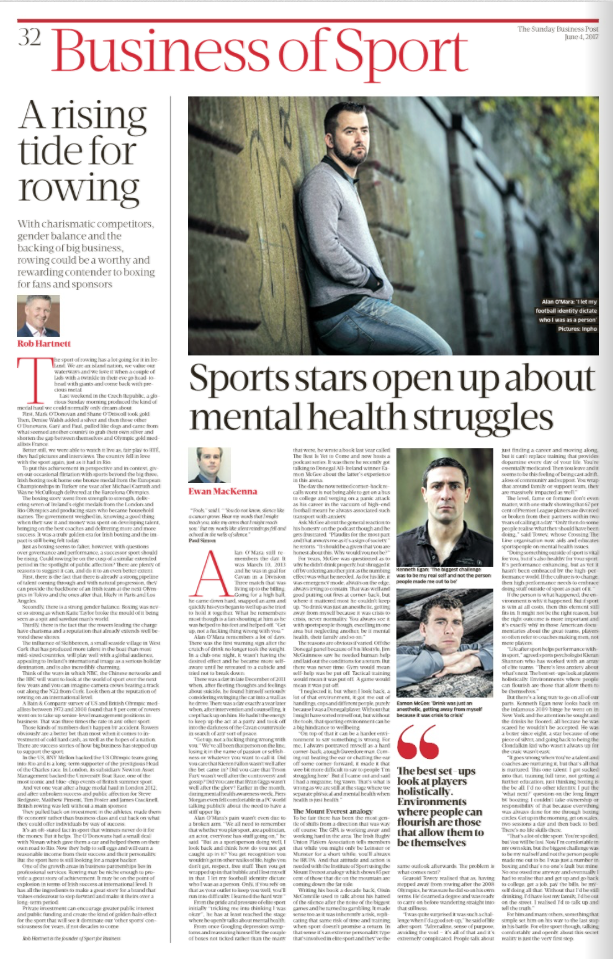
This article was first published in the Sunday Business Post on June 4th 2017.
Rob Hartnett is the founder of Sport for Business, who will be hosting Unleashing Content, a look at the world of media and branded sports content in partnership with RTÉ Sport and RTÉ.ie on Wednesday June 14th.