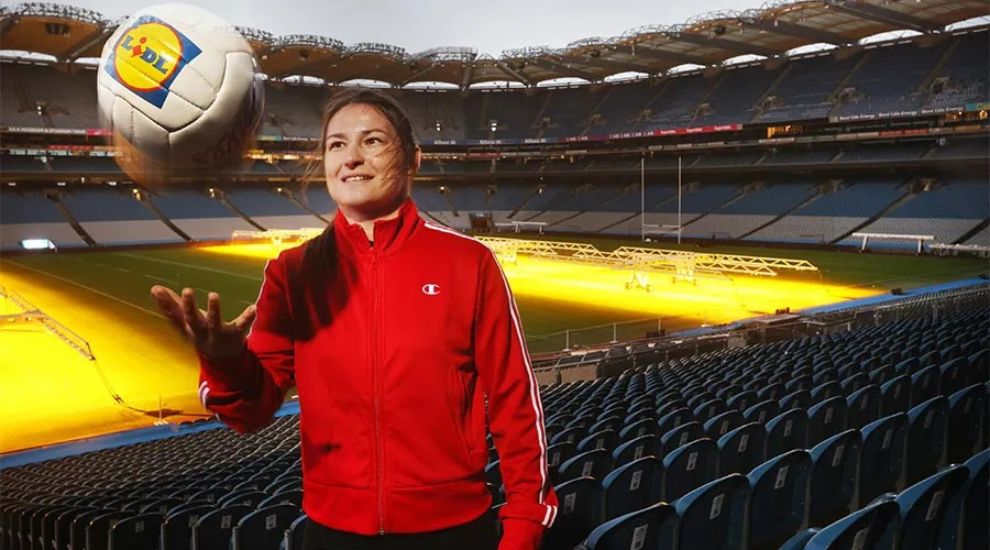
Katie Taylor arrived at the Lidl National League launch in Croke Park yesterday carrying the kind of quiet authority that doesn’t need an introduction — but Marie Crowe gave her one anyway, because some moments deserve to be framed properly.
“It’s not every day we get to be in the company of a history maker… somebody that I think has inspired everybody in this room,” she said, welcoming “Ireland’s greatest female athlete” to the stage in front of an audience that was aware of how special this was going to be.
The occasion was, on paper, about the start of a new season — Division One action about to begin, TG4 cameras ready, counties plotting promotion and survival. In practice, it was about something bigger: what visibility looks like when it’s done with intent, and what it means when a global sporting figure chooses to lend her voice to a domestic game still fighting for fair coverage.
“It’s incredible just to be here and to be able to celebrate women’s sport in general,” said Taylor, Olympic champion and two-division undisputed world champion. “I know how crucial it is to get the backing of companies like Lidl, and it’s critical in the growth of sport.”
It was a neat, understated acknowledgement of the day’s central theme: that investment doesn’t just fund fixtures and finals — it signals that the performances matter, that the athletes belong on the biggest stages, and that the public should be seeing more of them.
Arc of change
Crowe pushed the conversation towards something Taylor understands as well as anyone in Irish sport: the long arc of change, and the grind involved in bending it.
“It must be heartening… when you think of the barriers that you had to break down,” Crowe said, asking Taylor about the path she helped lay for those now benefiting from improved opportunities and evolving attitudes.
“I feel like I’ve been breaking barriers for a very long, long time,” Taylor replied. “I’m well acquainted with prejudice and mindsets around women’s sport from a young age.”
Those battles didn’t begin under boxing’s bright lights. They did so with a football at her feet, in a space where being talented wasn’t always enough to be accepted.
“I probably dealt with it in soccer before I dealt with it in boxing,” said Taylor, recalling playing in boys’ leagues and hearing the sideline commentary that girls’ sport has historically attracted. “Every time I was playing in those games, there were people laughing… shouting things like, ‘take it easy’… until I went in with a two footed tackles.”
Then came the blow of a rule that limited how long girls could play with boys.
“There was a rule in place that girls couldn’t play with the boys above the under-12s,” Taylor said. “I got the age increased… I think that rule is still in place today.”
The right to be there
What followed was a familiar pattern — the need to repeatedly prove her right to be there, over and over again, in each new environment.
“I had to change people’s minds every time I went to a new boxing club,” Taylor said. “That was a constant thing for me as a kid… having to change people’s perceptions of females in sport.”
From that foundation, the conversation moved to the present — and Taylor, as ever, spoke like someone still anchored in routine, even when she’s deliberately stepping away from it.
“My life is great, thank God,” she said, smiling about jet lag, a whirlwind trip, and returning to the United States. Then she admitted something that sounded almost unfamiliar coming from a fighter defined by discipline: she’s taking a real break.
“I think this is the first time I’ve actually taken a break in my whole career,” Taylor said. “When you have 20 years of routine… you nearly have to put in an effort not to train twice a day, six days a week.”
The break isn’t dramatic. It’s walking the dog. It’s time with family. It’s enjoying “the simple life”. But it is, in Taylor terms, still an active choice.
“I’m still in the gym, but just not as intense,” she said. “That’s just part of my life.”
Crowe asked what she loves about training, and Taylor delivered a line that could have been written for any dressing room in any sport.
Discipline and Honour
“In the gym you learn discipline, honour, integrity and courage,” she said. “In the gym you learn how to fail and get back up again.”
When Crowe probed what has kept her going — why her motivation hasn’t dulled across decades — Taylor’s answer cut to the heart of why she has become such a powerful symbol for women’s sport, and why brands and governing bodies want her in rooms like this.
“My motivation is internal,” she said. “I’m not driven by external factors… I always want to get the most out of this life.”
That internal drive, she suggested, was nurtured early — not through hype, but through belief and backing. She spoke warmly about her family support, and how unusual that could be in a system where girls too often fall away because encouragement isn’t as consistent as it is for boys.
“They really backed me and believed in me,” Taylor said. “They made me believe that I was going to do great things.”
There were lighter moments too. Taylor revealed she played Gaelic football as a kid, first with Fergal Ógs in Bray before crossing “to the dark side” to play for rivals Bray Emmets. She laughed at the memory, but the point landed: her sporting identity was never one-dimensional, and her understanding of women’s sport comes from inside multiple codes.
The conversation inevitably returned to legacy — not as a victory lap, but as something Taylor is starting to hold more consciously.
“I think about that word, legacy, an awful lot lately, especially since I’m at the end of my career,” she said. “That’s what legacy is all about — to raise the bar… and open it up for the next generation.”
But the most arresting moment of the conversation came when Taylor spoke about the fight that, in her own mind, carried the weight of far more than a win or a loss.
As Crowe drew her back to the years when women’s boxing was still outside the Olympic programme, Taylor described the sense of frustration that came with chasing an Olympic dream that, structurally, wasn’t even available.
The Dream
“There were definitely times I thought this dream was never going to come to pass,” she said. “I dreamt of becoming an Olympic champion when women’s boxing wasn’t actually included in the Olympic Games. It was like an impossible dream.”
Then came the breakthrough — and the pressure point. Taylor recalled being invited to Chicago for a showcase bout, part of the process of assessing whether women’s boxing should be admitted to the Olympic programme. It wasn’t framed to her as a symbolic exhibition. It was framed as a decision-making moment.
“That was a huge pressure for me. I had to perform that day,” Taylor said. “And I wasn’t just performing for myself. I was performing for every single girl who ever dreamt of fighting in the Olympic Games.”
Her voice, by her own admission, still catches when she thinks about it. The stakes were made explicit in a conversation with a member of the International Olympic Committee the day before she got into the ring.
“I remember that conversation… saying your performance will determine whether women’s boxing will be included in the Olympic Games or not,” Taylor said.
She paused, and the room did too, as she described going back to her hotel afterwards, feeling the responsibility settle in.
“I went back to my hotel room… I’m actually emotional here because I just remember how I felt back then,” she said. “I had this dream and I had to perform.”
It pushed her beyond preparation and into something more personal.
“And I started to pray,” Taylor added. “Because, ‘Jesus, I need you.’”
The Burden of Hope
For a sport that often asks athletes to package themselves as entertainment, it was a rare, unguarded reflection — not on achievement, but on the burden that can sit behind it, especially when you’re carrying other people’s hopes as well as your own.
The outcome is now written into Olympic history: women’s boxing is part of the Games, and Taylor went on to become its defining Irish champion. But what lingered in the room wasn’t the medal count. It was the reminder that structural change usually comes with a price, and that the pioneers often pay it in real time, under real pressure, in moments when there is no margin for error.
If the morning belonged to the LGFA, Taylor’s presence — and that story in particular — gave it added gravity. It linked the everyday fight for coverage and credibility in women’s team sports to the bigger picture: the long, difficult work of changing minds, changing policy, and changing what the next generation believes is possible.
And when Crowe asked what comes next, Taylor offered a line that could define this sporting year — the kind of statement that would light up promoters, broadcasters and brand partners alike.
“I would love to end my career here in Ireland,” Taylor said.
For everyone in the room launching a season that still fights for attention, it was a fitting note to finish on: a global star, still chasing the next moment, still valuing home, and still lending her weight to the belief that greatness exists all around us, it just needs to be seen.
Join us again tomorrow for more on the launch including an interview with Lidl Ireland’s Eimear O’Sullivan


Image Credit: Lidl, LGFA and Sam Barnes, Sportsfile
SPORT FOR BUSINESS Upcoming Events





SPORT FOR BUSINESS
Sport for Business is Ireland’s leading platform focused on the commercial, strategic and societal impact of sport. It connects decision-makers across governing bodies, clubs, brands, agencies and public institutions through high-quality journalism, events and insight. Sport for Business explores how sport drives economic value, participation, inclusion and national identity, while holding organisations to account on governance and sustainability.
Through analysis, storytelling and convening the sector, it helps leaders understand trends, share best practice and make better-informed decisions. Its work positions sport not just as entertainment, but as a vital contributor to Ireland’s social and economic fabric.
Find out more about becoming a member today.
Or sign up for our twice-daily bulletins to get a flavour of the material we cover.
Sign up for our News Bulletins here.