If the opening comments at The Sporting Year Ahead were about bringing people together, the first panel leaned into a truth Irish sport understands better than most: that connection is often sharpened by rivalry.
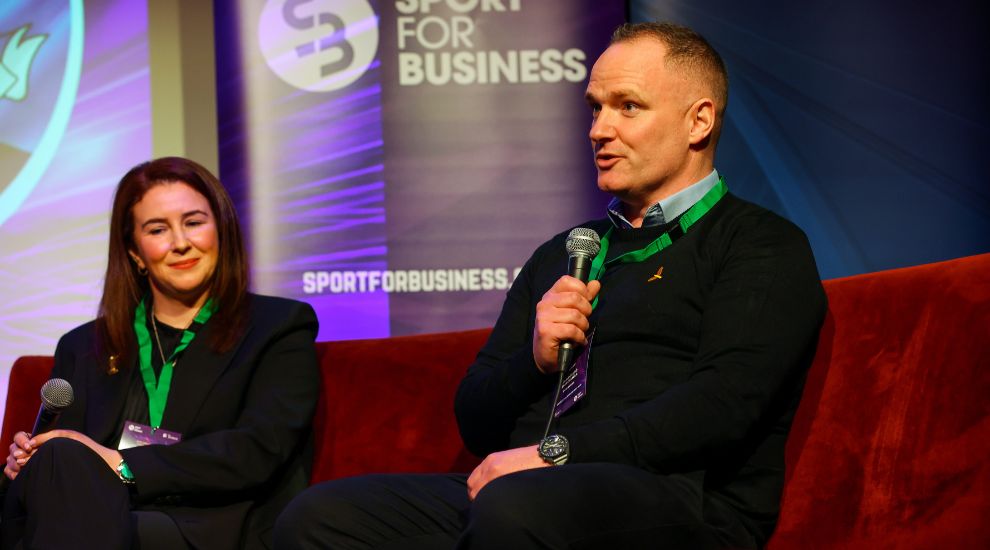
Two of the newest senior commercial appointments in the GAA — Maura Ashe, Head of Commercial with Kerry GAA, and Marcus O’Buachalla, Commercial Director with Dublin GAA — joined Rob Hartnett for a conversation that was playful in places, but loaded with substance about where county commercial strategy is heading.
Ashe described herself as “brand new to the industry” in terms of sport administration, but not new to the mechanics of sponsorship. After 18 years in global media agencies planning and buying media, she shifted increasingly into sponsorship work — “finding the right sponsorship properties for clients, negotiating those deals, assessing the value and how well they worked” — before stepping into a role Kerry has never formally had at this level.
“It’s a blank slate… Kerry GAA [has] huge brand equity, built over generations,” she said, while also acknowledging the central tension that everyone is a stakeholder, everyone has an opinion, and every choice has to land with multiple generations at once.
“You have to modernise the commercial strategy while making sure that my 75-year-old dad still feels part of it.”
That sense of cultural stewardship ran through both speakers, but from different angles.
O’Buachalla came to Dublin GAA after 12 years with Leinster Rugby in communications and media, and five years before that with Pembroke Communications (now Teneo), working on commercial partnerships including Dublin GAA. Overe that time he retained his roots as a member of Kilmacud Crokes and as a commentator on GAA with TG4.
The move, he said, was less “exciting” than “nerve-wracking” — a leap into a different system where professional athletes are not waiting behind a door to be pulled into sponsor activity.
He joined Leinster Rugby on the promise of bringing something of the magic of the GAA into that professional sporting entity. Now he was moving back into the GAA with all of the professional experience of working in an elite sports and commercial environmnet.
“The reality is now that I could walk through a door and there were 70 professional athletes. In the GAA, our players are teachers, nurses, accountants and students. That changes the commercial operating model—and, crucially, what “good” sponsorship looks like.
He praised Staycity, Dublin GAA’s partner now in year three of a five-year term, for leaning into activation built on experience and personality.
O’Buachalla pointed to content and supporter experiences that brought the proposition to life, and highlighted a consistent focus across Dublin’s four-code footprint — men’s football, women’s football, hurling and camogie — as a commercial strength when activated with intent.
Ashe, meanwhile, spoke about what might be one of the most distinctive sponsorship relationships in Irish sport: Kerry Group’s long-term partnership with Kerry GAA, extending beyond the 1991 era of jersey branding into the mid-1980s. She framed it as a partnership shaped by alignment and realism.
“Kerry Group are now primarily a B2B company, and what they want to achieve from it is quite different,” said Ashe. “They’re not just a sponsor, they’re a true partner. They totally understand the demands of the team… they come first before everything else.”
Between the jokes about green lanyards, West Kerry roots, and club rivalries inside county colours, the core message landed: the county’s commercial strategy is no longer simply about selling assets. It is about managing identity and expectations, professionalising without flattening tradition, and building sponsor relationships that understand the amateur reality while still delivering measurable value.
In a year where Irish sport is increasingly challenged on the “why” of partnerships as much as the “what,” Kerry and Dublin’s new commercial leadership feel like a signal of where the GAA intends to go next: clear strategy, strong activation thinking, and deep attention to the community contract that sits behind every deal.
Read More: Opening Comments from Rob Hartnett
Read More: Jarlath Burns in Conversation
Read More: Teneo Delivers Rich Insights
Read More: Launch of the AIG Access Tennis Programme by Tennis Ireland
Read More: Boxing Ireland’s Built Different Rebrand
Read More: Special Olympics Ireland National Games
Image Credit: Sport for Business, Ryan Byrne, Inpho.ie
Secure your place for our next event
Upcoming Sport for Business events


SPORT FOR BUSINESS
Sport for Business is Ireland’s leading platform focused on the commercial, strategic and societal impact of sport. It connects decision-makers across governing bodies, clubs, brands, agencies and public institutions through high-quality journalism, events and insight. Sport for Business explores how sport drives economic value, participation, inclusion and national identity, while holding organisations to account on governance and sustainability.
Through analysis, storytelling and convening the sector, it helps leaders understand trends, share best practice and make better-informed decisions. Its work positions sport not just as entertainment, but as a vital contributor to Ireland’s social and economic fabric.
Find out more about becoming a member today.
Or sign up for our twice-daily bulletins to get a flavour of the material we cover.
Sign up for our News Bulletins here.