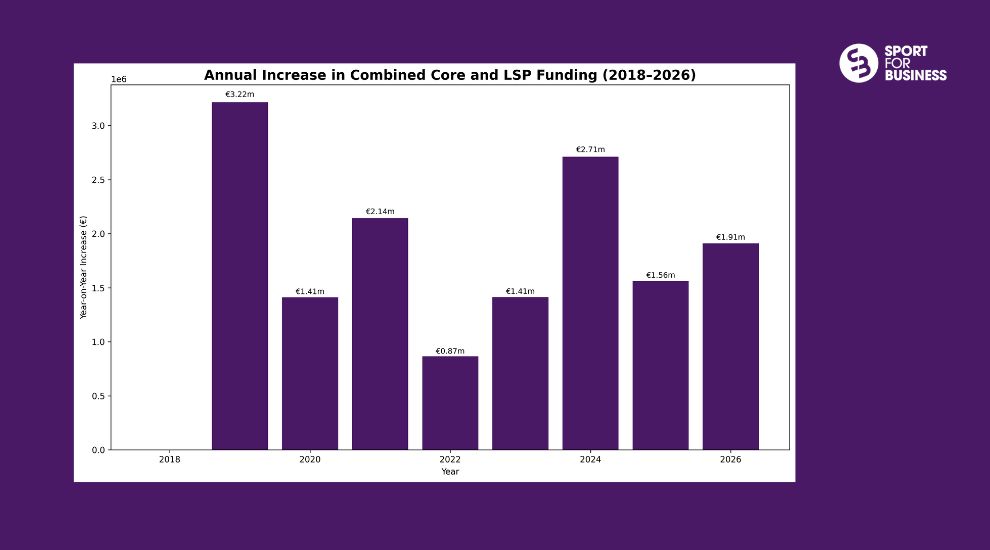
The move towards multi-annual core funding marks one of the most consequential shifts in Irish sports policy since the introduction of the National Sports Policy in 2018.
From 2026, Sport Ireland and the Department of Culture, Communications and Sport intend to use annual allocations as a baseline for rolling multi-year funding cycles, fundamentally changing how sporting organisations plan, staff and deliver activity across the country.
For National Governing Bodies and Local Sports Partnerships alike, the significance lies not just in the quantum of funding, but in the certainty it provides. For much of the past decade, core funding has been confirmed on a year-to-year basis, leaving organisations to manage staff contracts, programme commitments and strategic planning with limited visibility beyond a single budget cycle. While funding levels have risen steadily, the absence of long-term certainty has often constrained ambition and increased operational risk.
Multi-annual funding directly addresses this structural weakness. By allowing organisations to plan across multiple years, it enables more responsible workforce development, longer-term partnerships and more coherent strategic delivery. Roles such as coaches, development officers and inclusion specialists — which are central to participation growth but difficult to sustain on short-term funding — can be embedded with greater confidence. For Local Sports Partnerships in particular, this supports continuity of relationships with communities that depend on trust and consistency rather than episodic intervention.
The shift also reflects a maturation of the sporting system itself. Sport Ireland’s intention to roll out multi-annual funding is explicitly tied to governance, safeguarding and compliance standards. Organisational capability and accountability now matter as much as performance and participation did. In this context, multi-annual funding becomes both a support mechanism and a policy lever, encouraging better governance while reducing administrative churn for compliant organisations.
There are broader public-policy implications as well. Sport and physical activity are increasingly positioned as contributors to public health, social inclusion and community wellbeing, rather than discretionary leisure activity.
Multi-annual funding aligns sport more closely with other areas of public service delivery, where multi-year planning horizons are standard practice. It enables sport bodies to engage more credibly with partners in health, education and local government, who operate on similar planning cycles.
From a value-for-money perspective, the approach also improves efficiency. Reduced uncertainty lowers staff turnover, protects institutional knowledge and allows organisations to invest in systems and capacity rather than constantly re-bidding for survival. Over time, this should translate into better outcomes per euro invested, particularly at the community level where delivery costs are most sensitive to disruption.
Importantly, the introduction of multi-annual funding does not remove oversight. Annual review, performance monitoring and adherence to governance requirements remain central to the model. What changes is the balance between control and confidence — shifting the relationship between the State and sporting bodies from short-term transaction to longer-term partnership.
In that sense, multi-annual funding is not simply a financial reform, but a signal of intent. It recognises that sustainable participation growth, inclusion and performance cannot be delivered on twelve-month horizons, and that a stable, accountable sporting infrastructure is a prerequisite for achieving the wider ambitions set out in national sports policy.
Image Credit: Sport for Business
Event Tickets

Upcoming Events


SPORT FOR BUSINESS
Sport for Business is Ireland’s leading platform focused on the commercialstrategic and societal impact of sport. It connects decision-makers across governing bodies, clubs, brands, agencies and public institutions through high-quality journalism, events and insight. Sport for Business explores how sport drives economic value, participation, inclusion and national identity, while holding organisations to account on governance and sustainability.
Through analysis, storytelling and convening the sector, it helps leaders understand trends, share best practice and make better-informed decisions. Its work positions sport not just as entertainment, but as a vital contributor to Ireland’s social and economic fabric.
Find out more about becoming a member today.
Or sign up for our twice-daily bulletins to get a flavour of the material we cover.
Sign up for our News Bulletins here.