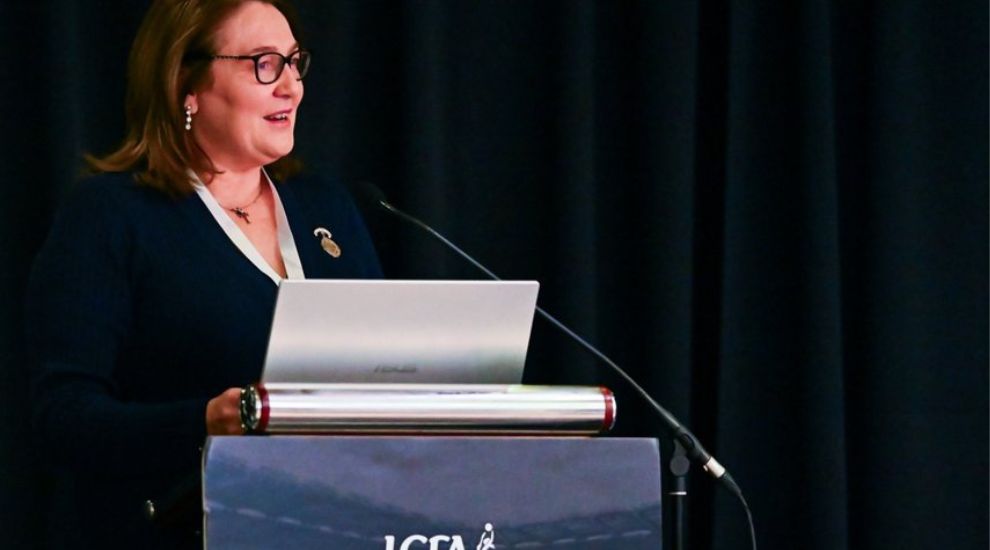

Integration with the Ladies Gaelic Football Association (LGFA) and the Gaelic Athletic Association (GAA) and Camogie Association, alongside rule trials and leadership transition, were among the key themes addressed by LGFA President Trina Murray in her address to delegates at LGFA Congress in Sligo this month.
Murray said the process of integrating the three Gaelic games organisations was about far more than governance structures, describing it as a conversation about identity and the future of women’s Gaelic games.
“One of the most significant journeys we are on together is integration with the Gaelic Athletic Association and the Camogie Association,” she said. “Integration is not simply a structural conversation; it is about identity, opportunity, and unity across our Gaelic Games family.”
The President outlined how the LGFA has begun a series of consultation roadshows involving county boards, club officers, provincial councils, referees and players.
Those discussions, she said, had been “open, robust and respectful,” reflecting both the passion that exists for Ladies Gaelic Football and a determination among members to ensure any future structure protects and strengthens opportunities for women and girls in the game.
“The roadshows are reaffirming something powerful – that our members want clarity, want collaboration, and want courage,” Murray said. “Integration must be shaped by you, our delegates, and by the lived experiences of our clubs.”
She confirmed that the consultation process will continue through the coming weeks as the organisations work towards a potential unified structure for Gaelic games.
Another topic highlighted in her address was the recent trialling of new playing rules within Ladies Gaelic Football competitions. Murray acknowledged that change can create uncertainty but said the early response from the Gaelic games community had been encouraging.
“The feedback from players, coaches, referees and supporters has been energising,” she said. “The trials injected pace, tactical innovation and fresh debate into our competitions. Most importantly, they sparked excitement.”
She said the Association would continue to review the rule trials carefully, using both feedback and performance data to guide decisions.
“Our aim is simple: to enhance the spectacle of Ladies Gaelic Football while safeguarding player welfare and the core values of our game,” she added.
Murray also used the occasion to acknowledge the contribution of outgoing LGFA CEO Helen O’Rourke, who has stepped down from the role after many years of service.
“This Congress also marks a moment of transition,” she said. “Helen brought professionalism, steadiness and deep institutional knowledge to her role. On behalf of the Association, I thank her sincerely and wish her every happiness in the next chapter.”
Delegates were also formally introduced to the organisation’s new CEO, Lyn Savage, who Murray said would bring fresh energy and strategic direction to the Association.
“Leadership transitions are significant, but they are also opportunities,” she said. “I look forward to working closely with Lyn as we continue to strengthen the LGFA’s operations, enhance member supports, and position ourselves confidently for the future.”
Concluding her address, Murray told delegates that the LGFA is entering a period of growth and evolution while remaining focused on the players and communities at the centre of the game.
“Delegates, the LGFA stands at an exciting crossroads. We are growing. We are evolving. We are ambitious,” she said.
“But above all, we are united by a shared love of Ladies Gaelic Football and by a commitment to the women and girls who pull on their club and county jerseys with pride.”
Image Credit: LGFA
ABOUT SPORT FOR BUSINESS
Sport for Business is Ireland’s leading platform focused on the commercial, strategic and societal impact of sport. It connects decision-makers across governing bodies, clubs, brands, agencies and public institutions through high-quality content, events and insight. Sport for Business explores how sport drives economic value, participation, inclusion and national identity, and how your story can be part of ours.
Through analysis, storytelling and convening the sector, it helps leaders understand trends, share best practice and make better-informed decisions. Its work positions sport not just as entertainment, but as a vital contributor to Ireland’s social and economic fabric.
Find out more about becoming a member today.
Or sign up for our twice-daily bulletins to get a flavour of the material we cover.
Sign up for our News Bulletins here.
Upcoming Events