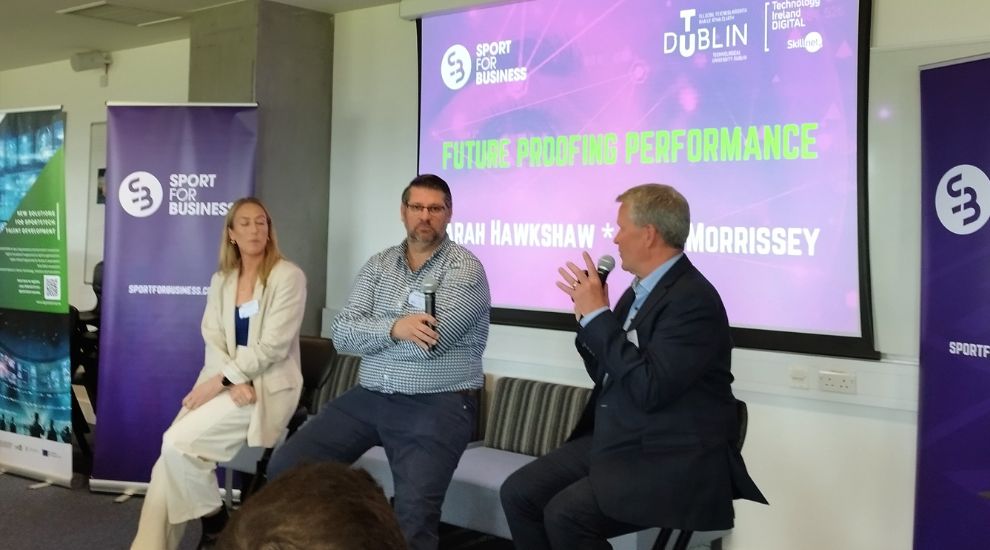
The opening discussion at the Sport for Business Future Proofing Sport event in TU Dublin last week set the tone for a morning that was about more than technology for technology’s sake.
Under the banner of Future Proofing Performance, Irish women’s hockey captain Sarah Hawkshaw and Orreco co-founder and Vice-President Colin Morrissey explored how data, biomarkers, AI and athlete monitoring are changing the world of high-performance sport, but also why the human being at the centre of it all must never be lost.
Hawkshaw joined the event on the morning she was due to fly to the Netherlands for a preparation camp ahead of Ireland’s World Cup campaign, with matches against New Zealand, Spain and Belgium lying ahead later in the summer.
For an athlete operating at that level, the use of data has changed dramatically over the course of a career.
“When I started off, the most you were getting was probably video analysis,” she said. “You were watching entire games, and then GPS comes in and slowly and slowly it’s built more and more.”
Now, the preparation of an elite athlete can include video, GPS, opposition analysis, physiological monitoring, rehab technology, environmental chambers, core temperature monitoring and regular testing of blood biomarkers such as creatine kinase to assess how the body is adapting to training load.
Value
For Hawkshaw, though, the value lies in when and how the information is used.
“My goal is to perform in a flow state where I’m not thinking,” she said. “Brilliant coaches and brilliant support staff have the capabilities to utilise tech and communicate it as a facilitator, but not let it drive the conversation.”
That was one of the strongest threads running through the session. That technology can help an athlete prepare better, recover better, and understand their body better. But if it gets in the way when performance is required, it can become a burden rather than a benefit.
“I don’t want to be thinking about that under pressure,” Hawkshaw said. “When it drives the conversation, you lose that sense of mindlessness that you want to play with.”
Morrissey brought the technology perspective. Orreco’s work focuses on elite male and female athletes, using blood biomarker testing alongside data from GPS, force plates, wearable devices, match data, travel data, and other sources, before layering AI on top to help practitioners interpret what matters.
The challenge, he said, is no longer a shortage of information. It is knowing what to do with it.
Interpretation
“Practitioners have data coming out of everywhere,” he said. “They actually need to be able to interpret that.”
That is where AI is beginning to play a role, not as a replacement for the coach, scientist or practitioner, but as a tool to pull together multiple streams of information and give quicker answers in high-pressure environments. A professional football team playing three games in a week does not have time for long analysis cycles. The value is in getting the right insight to the right person at the right moment.
The discussion also touched on the way technologies developed for elite sport can filter into wider society. GPS is the obvious example. Not long ago, it was the preserve of elite teams. Now, as Morrissey pointed out, you will see people running down the street on a Saturday morning wearing devices that capture information once available only to professional setups.
Blood biomarker testing, wearable data and health insights may follow the same path, though Orreco’s focus remains very much on the professional athlete. It addresses female physiology through the FitrWoman app and FitrCoach platform and highlights one of the most important areas for future development.
Hawkshaw returned to that point near the close of the session. AI is powerful, she said, but many of the models being built are still based on far more male physiology and performance data than female physiology and performance data.
“There’s a lot of information out there on male physiology and male data,” she said. “There probably isn’t enough on females to be able to create AI models, so making sure that we’re not getting lost in that translation is probably for the next couple of years, where we need to catch up.”
It was an important reminder that future-proofing performance is not only about having the best technology. It is about making sure the technology works for everybody.
Overload
The question of overload was another central theme. Many of us now wear devices that tell us whether we are ready, recovered, rested or stressed. At the elite level, those numbers carry more weight but also more risk.
Hawkshaw gave a simple example. If she plays the Netherlands on a Saturday, she does not need a device to tell her on Sunday morning that she is fatigued. She already knows.
“I don’t need that to impact me mentally,” she said. “I have every score, I’m making sure I’m ready for training, I’m optimised, I’m controlling what I can. After that, I don’t need to be fed information to tell me that I’m not ready.”
That does not mean the information is not valuable. It means there is a skill in deciding what the athlete sees, what the coach sees, what the medical and performance staff see, and what is held back.
Hawkshaw called it storytelling.
“There’s a real skill in acquiring that information and what we give and what we don’t, and how we give it,” she said. “Sometimes at half-time in a match, if we’re playing well and things are going well for us, I have no problem with our coach standing up there and lying about a two per cent stat difference.”
It was said with a smile, but the point was serious. Data does not exist in isolation. It has to support belief, confidence, decision-making and clarity. The same number can help or harm depending on the timing, context, and how it is delivered.
Morrissey agreed that interpretation is where the best practitioners stand apart. He gave the example of Orreco introducing blood biomarker testing at Liverpool in 2022, where the first step was not simply to impose a new process. It was to speak to senior players, explain what was being proposed, take the hard questions, build trust, and only then roll it out consistently.
That is a lesson that travels well beyond the Premier League. Athletes are not passive data points. They need to understand why something is being measured, how it will be used, and what benefit it will bring.
The session also looked at the Irish high-performance environment. Hawkshaw made it clear that, from a technology perspective, she does not feel Ireland is lacking compared with bigger-budget hockey nations.
“Technology-wise, no, I don’t think there’s anything there that’s not facilitating us to match them at any level,” she said.
Recovery
The bigger differences, she suggested, may lie in the recovery periods and the ability to maintain high levels of physiological monitoring away from camp. Irish players are spread across clubs in Ireland and Europe, but the ambition within the group is to see themselves as international athletes year-round.
“We look at ourselves as 365 days of the year international athletes,” Hawkshaw said. “We’re not just coming to camp.”
That phrase captured much of what future performance now looks like. It is not only about what happens in the gym, on the pitch, or in the hour before a match. It is about the connection between training, sleep, recovery, travel, physiology, psychology, nutrition and competition.
But it is also about balance.
There was an easy line to be drawn from the morning’s opening reference to the Enhanced Games, and the relief that its Las Vegas staging had not created the wave of credibility some had feared, to the more grounded conversation that followed.
The future of performance should not be about shortcuts, gimmicks or the pursuit of numbers for their own sake. It should be about better preparation, safer training, smarter recovery and more informed decision-making.
The strongest line of the session came from Hawkshaw near the end.
“There’s always an individual behind the data,” she said.
That, in many ways, was the story of the discussion. The future of sport will be shaped by biomarkers, AI, wearables and new layers of analysis that we could barely have imagined a generation ago. But the best of it will still depend on people: the athlete who has to perform, the coach who has to communicate, the practitioner who has to interpret, and the organisation that has to decide what really matters.
The utilisation of AI, rather than its domination, may be the key distinction.
In sport, as in so many areas touched by technology, the question is not whether the future is coming. It is whether we can shape it in a way that keeps the player, the person and the performance front and centre.
 Technological University of Dublin, which partnered with us on this event, as well as Hockey Ireland and more than 40 other sporting National Governing Bodies, is a full member of Sport for Business
If you would like to be part of the Sport for Business community and see your organisation in our content, on our stages, and in the conversation happening every day around the commercial world of Irish Sport, email us today and let’s see what is possible.
Image Credit: Iddo Diamant, TUD

ABOUT SPORT FOR BUSINESS
Sport for Business is Ireland’s leading platform focused on the commercial, strategic and societal impact of sport. It connects decision-makers across governing bodies, clubs, brands, agencies, and public institutions through high-quality content, events, and insights.
Sport for Business explores how sport drives economic value, participation, inclusion and national identity, and how your story can be part of ours.
Through analysis, storytelling and convening the sector, it helps leaders understand trends, share best practices, and make better-informed decisions. It positions sport not just as entertainment but as a vital contributor to Ireland’s social and economic fabric.
Find out more about becoming a member today.
Or sign up for our twice-daily bulletins to get a flavour of the material we cover.
Sign up for our News Bulletins here.