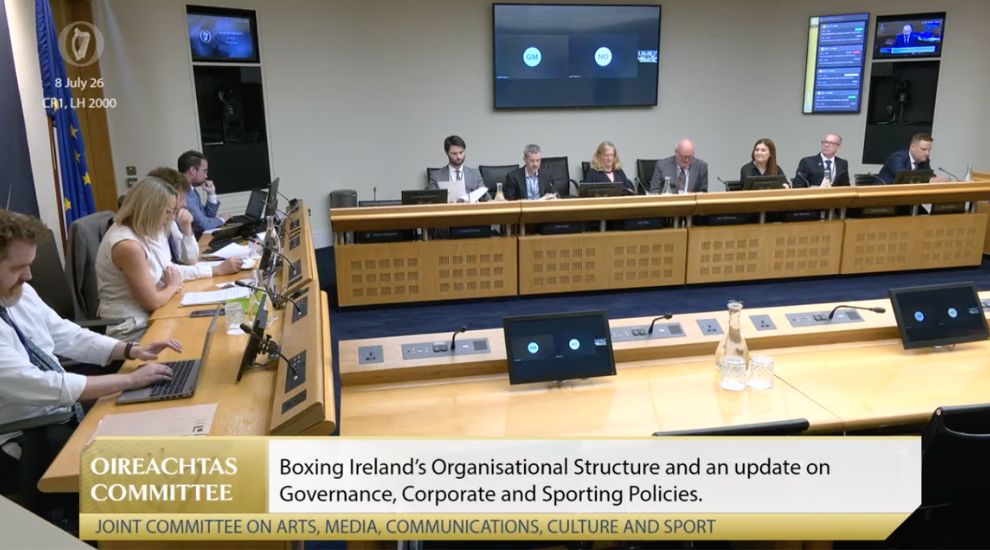
Boxing Ireland’s governance rebuild was described as “a very positive news story” at Leinster House yesterday, as the organisation returned to the Oireachtas Committee on Sport and the Arts following a period of deep scrutiny over how the sport was being run.
Deputy Chair Evanne Ní Chuilinn welcomed teams from Boxing Ireland, Sport Ireland and the Department of Culture, Communications and Sport and the tone of the hearing was notably different from earlier committee exchanges around the former Irish Athletic Boxing Association, now rebranded as Boxing Ireland.
Then, the concern had centred on governance failures, breakdowns in trust, the relationship between the organisation and its grassroots members, and the possibility that public funding could be put at risk.
This week, the message was that while the work is not yet complete, the sport has moved significantly in the right direction.
Joanna Byrne, Sinn Féin TD, said that there were not many organisations that came back before a committee after a “particularly contentious” previous appearance and were able to outline the progress made in such a short period.
Sport Ireland told the Committee that Boxing Ireland has addressed around 80 per cent of the recommendations contained in the McNeice governance review and is expected to complete the remaining recommendations by the end of this year.
The governing body is also working towards full compliance with the Governance Code for Sport, a condition of public funding for National Governing Bodies and Local Sports Partnerships.
Sport Ireland said funding continues to be released to Boxing Ireland on a controlled quarterly basis, subject to enhanced monitoring and reporting. An in-depth governance audit has been scheduled for 2027 to test how the reforms are being embedded in practice.
It will not simply examine whether policies have been drafted or boxes ticked, but whether the governance culture within Boxing Ireland has genuinely changed. Sport Ireland CEO Dr Una May did say, though, that they had confidence in the sport and that the audit was not expected to uncover any failings.
Boxing Ireland President Anto Donnelly told the Committee that the sport’s success must be underpinned by strong governance, modern systems and a culture of continuous improvement.
He said public trust had to be earned and that good governance was about creating an organisation trusted by members, funders and society to make fair decisions, protect athletes, support clubs and steward public money responsibly.
Boxing Ireland has appointed a permanent CEO, performance director and chief operations officer. It has created new governance, policy and operations departments, as well as a commercial and marketing department designed to generate sustainable revenue for the sport.
It has also strengthened safeguarding, integrity, and welfare policies and appointed a dedicated athlete welfare lead, with athlete welfare now positioned as a central pillar of the high-performance programme.
The most significant governance action, however, was the move away from the International Boxing Association and into World Boxing, securing the sport’s Olympic future and aligning Ireland with the new international federation recognised as providing a more stable governance framework.
That decision was taken with the backing of members and was repeatedly cited as evidence of the renewed relationship among the board, the executive, the Central Council, the provinces, and the clubs.
The rebranding from IABA to Boxing Ireland was also seen as more than a cosmetic change. Donnelly said the old identity no longer reflected the sport or its ambitions. Gary Stewart, CEO of Boxing Ireland, said the change helped draw a line under the past and signalled a more modern, progressive organisation.
Stewart said the new brand had helped build trust internally and externally. He pointed to partnerships with Nike, Sting and other commercial partners as evidence that confidence in the organisation was returning.
For Ní Chuillin, the key issue was whether the cultural change was now strong enough to hold.
Boxing Ireland Chief Operations Officer Claire McCauley said the cultural shift had been the hardest part of the process, but also the area where she believed the organisation had moved furthest. She said much of the work now involved clarifying roles and responsibilities between staff, committees, the board and members.
She said rulebooks had sometimes been treated “like Bibles” and that part of the challenge was to modernise structures that were not always flexible enough for a contemporary National Governing Body.
Stewart said he had been “blown away” by the level of support from members since becoming CEO. He said quarterly online town halls, direct attendance at provincial council meetings, and more open communication had helped rebuild confidence.
Donnelly said that when he came into office, there had been suspicion, a lack of transparency and a lack of trust. The vote to move to World Boxing, he said, showed how far the sport had travelled in restoring belief between clubs and national leadership.
Sport Ireland CEO Dr Una May said the organisation recognised the progress made while also acknowledging that organisational development remained an ongoing process requiring continued commitment and leadership.
Paul McDermott, Sport Ireland’s Director of High Performance and National Governing Bodies, said Boxing Ireland had “moved on very significantly” and that the relationship between the organisations was now positive and constructive.
There was also an acknowledgement from members of the Committee that the problems had been serious, and that earlier scrutiny had played a part in forcing change.
But the tone of this hearing was not accusatory. It was one of cautious recognition that one of Ireland’s most important sports has begun to rebuild itself.
Joanna Byrne, TD for Louth and SinnFéin Spokesperson on Sport, said boxing no longer needed the Committee to point fingers as it once did. It now needed support.
For a sport that has delivered so much for Ireland inside the ring, the next test is to prove that its governance outside the ring can match the ambition of its athletes and clubs.

 Boxing Ireland, Sport Ireland and the Department of Culture, Communications and Sport are full members of Sport for Business.
If you would like to be part of the Sport for Business community and see your organisation in our content, on our stages, and in the conversation happening every day around the commercial world of Irish Sport, email us today and let’s see what is possible.
Image Credit: Sport for Business / Oireachtas TV

ABOUT SPORT FOR BUSINESS
Sport for Business is Ireland’s leading platform focused on the commercial, strategic and societal impact of sport. It connects decision-makers across governing bodies, clubs, brands, agencies, and public institutions through high-quality content, events, and insights.
Sport for Business explores how sport drives economic value, participation, inclusion and national identity, and how your story can be part of ours.
Through analysis, storytelling and convening the sector, it helps leaders understand trends, share best practices, and make better-informed decisions. It positions sport not just as entertainment but as a vital contributor to Ireland’s social and economic fabric.
Find out more about becoming a member today.
Or sign up for our Daily Sport for Business Snapshot email bulletins to get a flavour of the material we cover.
Sign up for our News Bulletins here.