The IRFU is looking to property development at Lansdowne Road and new income from data and digital to strengthen the long-term financial foundations of Irish rugby.
The direction is set out in the Union’s 2025/26 Annual Report, which presents a picture of strong demand for international rugby, an expanding sponsorship portfolio and growing broadcast audiences, but also acknowledges the increasing cost of maintaining six professional teams while investing further in women’s and grassroots rugby.
IRFU Chief Executive Kevin Potts makes it clear that success at the international level remains the principal engine driving every other part of the game.
“The strength of our national teams and their ability to compete successfully on the world stage remains central to the success of the wider game in Ireland,” he said.
“Our Men’s National Team, in particular, continues to play a critical role in driving the revenues that sustain rugby across the island, enabling us to reinvest in club game, player pathways, provinces and the Women’s game.”
That revenue supports the connected structure of clubs, schools, provinces and national teams which has underpinned Ireland’s performance on the international stage.
It also allows the IRFU to maintain four competitive provinces alongside the senior men’s and women’s programmes, though the report is candid about the financial pressures attached to that model.
“Sustaining six professional teams, alongside increasing investment in the women’s and grassroots game, presents significant challenges in an inflationary environment,” said Potts.
“Balancing the books in professional rugby is an ongoing challenge globally, and our provinces work tirelessly every day to operate sustainably within this context.”
Financial sustainability will remain a core priority, with the IRFU promising what Potts calls “disciplined, long-term decisions” to protect the game’s future.
Lansdowne Road Strategy
One of the most significant business developments in the report is confirmation that the Union is progressing a long-term property strategy at Lansdowne Road.
The ambition is to establish additional sustainable revenue sources that can operate alongside the more traditional income generated through international matches, broadcasting, hospitality, and sponsorship.
The report does not provide further details, but the IRFU already earns rental income from a portfolio of properties around the stadium and has previously indicated that it is examining how those assets can generate an annual return for the game.
Separate reports have linked the strategy to the acquisition of additional properties and early-stage consideration of hotel and residential development. No defined scheme or timetable has yet been confirmed.
“Looking ahead, we are exploring innovative ways to strengthen our financial position, including progressing our long-term property strategy at Lansdowne Road,” said Potts.
“Our approach is clear — to create sustainable revenue streams that can be reinvested directly into rugby, while remaining focused on our core purpose as custodians of the game.”
It is potentially an important development for the Union, broadening its commercial base beyond a model which remains heavily influenced by the number and profile of home men’s international fixtures in any given season.
The property strategy sits alongside discussions on the future shape of European club competitions beyond 2030 and wider efforts by the IRFU, World Rugby and other leading unions to increase the overall commercial value of the sport.

Strong Commercial Foundations
In his Commercial and Marketing Report, IRFU Deputy CEO and Chief Commercial Officer Padraig Power says the traditional foundations of the Union’s business remain strong.
“The global challenges facing rugby union are ever present, and the costs associated with delivering the game continue to rise,” he said.
“The importance of driving revenue is crucial to our continued success.”
Power identifies broadcast partnerships, match-day ticketing, corporate hospitality and sponsorship as the core financial pillars supporting the game.
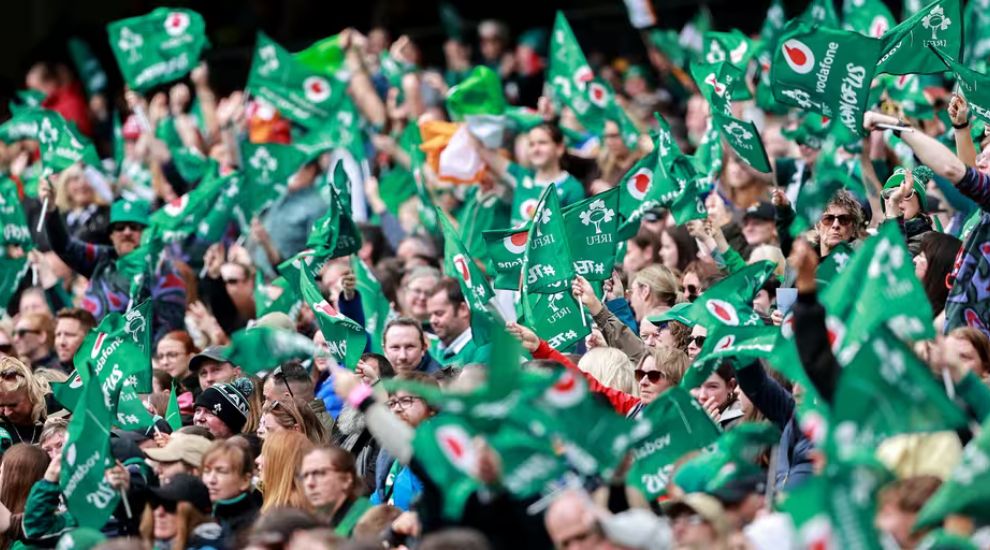
Demand for international rugby remained high throughout the year. More than 61,000 supporters attended Ireland’s game against New Zealand in Chicago, while every home Autumn Nations Series and Guinness Men’s Six Nations fixture sold out.
“Our 10 Year Ticket holders and Patrons Club memberships continue to be oversubscribed and, along with our corporate boxes at capacity, these revenue streams underpin the financial stability of our entire sport,” said Power.
The Union also reports that its revised international ticket strategy generated positive growth during the season.
Sponsorship Portfolio Expands
The past 12 months brought a substantial programme of sponsorship renewals and new agreements.
Aviva extended its stadium naming-rights partnership for a further five years, while Diageo renewed its relationship with Irish Rugby until 2030.
Ballygowan agreed a further four-year term, and DHL also renewed its partnership supporting the Irish national teams.
The IRFU added AG1 as Official Daily Nutrition Supplement Partner across the men’s and women’s teams, Smurfit Westrock as Official Sustainability Partner and Optimum Nutrition as Official Performance Nutrition Partner.
They join a broader commercial portfolio which includes Vodafone, Canterbury, Aon, Bank of Ireland, Energia, PwC, Opel, Lucozade Sport, Aldi and Dove Men+Care.
The principal commercial partnership with Vodafone was renewed in 2024 and will run until at least the summer of 2028.
The first phase of the IRFU’s new sponsorship outreach programme, Project Thrive, is also now fully operational. The Union is working with the four provinces to explore further revenue collaborations and operating efficiencies.
Project Thrive is a coordinated sponsorship outreach programme developed by the IRFU with the four provinces. First referenced last year as a means of future-proofing established revenue streams and unlocking new opportunities, its initial phase is now fully operational. While the precise structure has not been disclosed, it points towards a more joined-up approach to identifying sponsors, packaging commercial rights and creating revenue opportunities across Irish rugby.

Data and Digital Growth
The clearest indication of where the IRFU believes new commercial opportunities can be created comes in Power’s assessment of the next phase of the strategy.
“As we look to the future, our Commercial Strategy remains very clear,” he said.
“We will continue to nurture our fundamental revenue streams, and we will look to develop new ones especially in data and digital.”
The scale of the audience available to support that ambition continued to increase during the season.
The November home internationals generated a cumulative global audience of 8.9 million, with 5.8 million tuning in via live broadcasts. That represented an increase of 21 per cent on 2024.
The Women’s Six Nations game against Scotland at Aviva Stadium attracted 906,000 viewers on Virgin Media, while Irish Rugby now has more than three million followers across its social channels.
The report also records media reach of 5 billion for the Guinness Men’s Six Nations and 2 billion for the Guinness Women’s Six Nations.
The financial impact of the audience, ticketing and partnership growth will become clearer when the IRFU publishes its separate Financial Report later in the year.
That will provide an opportunity to assess how the strength of demand for international rugby, the expanded sponsorship portfolio and the revised ticketing strategy have translated into income, alongside the costs associated with operating and developing the professional and grassroots game.
Sport for Business Perspective
The central commercial message from the Annual Report is one of evolution rather than reinvention.
Broadcasting, ticketing, hospitality and sponsorship remain the foundations of the IRFU’s model. The next phase will focus on adding new layers of income through property, supporter data, and digital products.
The later Financial Report will offer greater detail on the pace and scale of that progress, but the strategic direction has now been clearly established.

 The IRFU, Vodafone, Bank of Ireland, PwC, Energia, Diageo and Aer Lingus are full members of Sport for Business.
If you would like to be part of the Sport for Business community and see your organisation in our content, on our stages, and in the conversation happening every day around the commercial world of Irish Sport, email us today and let’s see what is possible.
Image Credit: Irish Rugby and Inpho.ie

ABOUT SPORT FOR BUSINESS
Sport for Business is Ireland’s leading platform focused on the commercial, strategic and societal impact of sport. It connects decision-makers across governing bodies, clubs, brands, agencies, and public institutions through high-quality content, events, and insights.
Sport for Business explores how sport drives economic value, participation, inclusion and national identity, and how your story can be part of ours.
Through analysis, storytelling and convening the sector, it helps leaders understand trends, share best practices, and make better-informed decisions. It positions sport not just as entertainment but as a vital contributor to Ireland’s social and economic fabric.
Find out more about becoming a member today.
Or sign up for our Daily Sport for Business Snapshot email bulletins to get a flavour of the material we cover.
Sign up for our News Bulletins here.