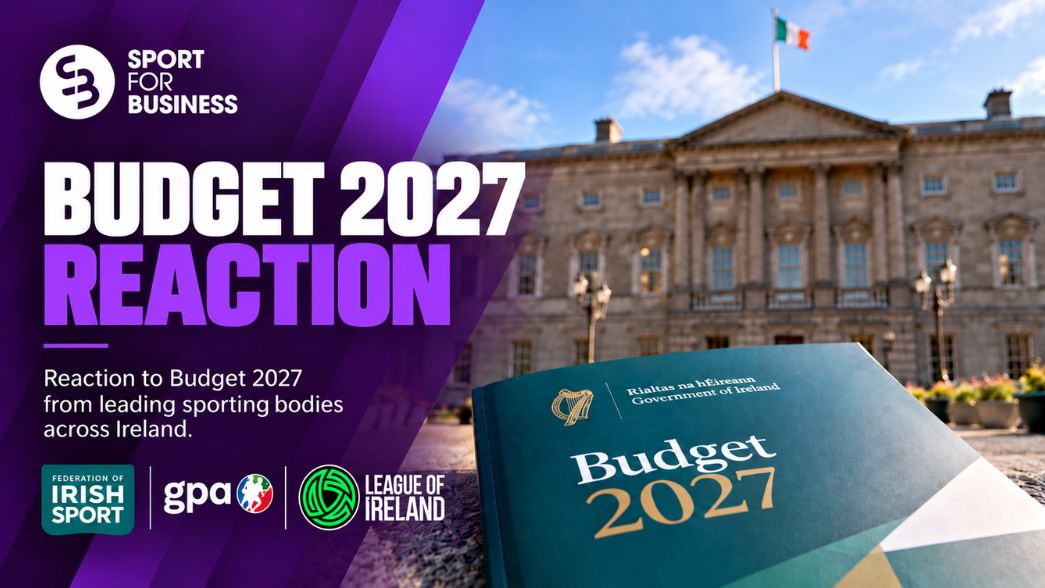
The Federation of Irish Sport has delivered a critical response to the measures confirmed yesterday in Budget 2027. Some within sport were relieved to have gotten an average 5.3 per cent increase, but there was also a sense among some that it was not enough, despite this in a budget that was always likely to be tough given cost of living challenges and multiple demands.
The Federation reaction this afternoon warns that the 5.3 per cent increase in core funding for National Governing Bodies and Local Sports Partnerships will be swallowed up by rising costs and leave many organisations under increasing pressure.
An additional €1.768 million has been allocated to core funding for NGBs and LSPs, alongside specific increases of €1 million for League of Ireland academies, €1 million for the inter-county player support scheme, €1 million for Gaelic Games development with a particular focus on hurling and camogie, and €500,000 for IRFU development programmes. If any of those four specific funding allocations had been more generally applied it would have been much closer to the 10% in the Federations carefully planned and logical budget submission.
But therin lies the challenge. Within the wide world of sport there will always be some who win, and some some who lose; some who catch the breaks and some for whom the ball bounces wrong.
The Federation had called before the Budget for a 10 per cent annual uplift in funding for NGBs and LSPs, together with a three-year commitment that would give sporting organisations greater certainty around staffing and programme delivery.
It makes sense on so many levels.
What emerged though, was an increase just over half that level, albeit higher than other areas within the same Department. We’ll be looking tomorrow at what the lower than expected funding for RTÉ and TG4 mighht mean for sport.
“Budget 2027 has been received with substantial disappointment by our members as it failed to acknowledge the significant challenges NGBs and LSPs face, but more importantly the significant measures delivered by our members this year alone,” said Federation of Irish Sport CEO Mary O’Connor.
“For many of our members, this budget is a missed opportunity. The measures announced in Budget 2027 simply don’t go far enough, amid rising inflation costs and already overstretched resources.”
The Federation argues that the €1.768 million increase will largely be absorbed by the increased cost of doing business rather than enabling any significant expansion of activity.
It says additional investment was required to grow participation, address increasing pressure on the volunteer base and support the professional workforce responsible for delivering sport and physical activity across the country.
Its concern is also about the balance of the allocation.
While acknowledging Government priorities around greater diversity, female participation, sports facilities, high-performance athletes and major international events, the Federation says the Budget undervalues the wider system supporting participation across dozens of sports.
There is a significant policy question contained within that criticism.
Government has put substantial additional money behind clearly defined priorities. League of Ireland academies will receive €4 million in 2027 after securing another €1 million, a 33 per cent increase on the initial €3 million allocation introduced last year. The FAI had sought further investment and has reacted positively to the continuation of what is becoming a multi-year commitment to the academy system.
The academy funding is designed to build more professional environments around the development of young players and to increase the number of specialist roles within clubs.
The Gaelic Players Association has also welcomed its additional €1 million, even though it represents only one third of the €2.8 million increase it sought in advance of the Budget.
The allocation brings Government funding for the inter-county player support scheme to approximately €8.2 million and represents an increase of around €250 per player. The GPA had sought an increase of €700 per player, towards a target payment of €2,500.
That makes the GPA response a qualified welcome rather than an unreserved endorsement, but it is nevertheless markedly different in tone from that of the Federation.
Targeted investment delivers easily identifiable outcomes. An extra €1 million can be attached to League of Ireland academies, player support or a hurling and camogie development initiative and its purpose is immediately clear.
Core funding is less visible but arguably more fundamental.
It pays for the administrators, development officers, participation programmes, safeguarding, governance, compliance and other infrastructure without which much of organised sport simply does not function.
The Department has confirmed total current funding of €121.87 million for Sport Ireland in 2027, while an additional €1.6 million will go towards high-performance athletes ahead of Los Angeles 2028. Some €22 million is also provided for Government commitments around the Ryder Cup in 2027 and UEFA Euro 2028.
Those figures demonstrate that sport continues to attract significant Government investment.
The Federation’s argument is that the distribution of that investment risks creating pressure at the foundation of the system.
It has also returned to the issue of multi-annual funding.
The Federation says Budget 2027 has failed to align the financial model for sport with the ambitions set out in national policy, arguing that organisations cannot confidently retain staff, plan programmes or build sustainable participation without greater certainty beyond individual annual Budgets.
That debate assumes greater importance with the next National Sports Policy currently under development.
Budget 2027 therefore produces two legitimate but different pictures of Government investment in sport.
There is another substantial step towards establishing a professional development system, within League of Ireland clubs.
There is additional recognition of the financial burden of playing at the highest level of amateur sport for the Gaelic Players Association.
For high-performance sport and major events there is continued investment ahead of Los Angeles 2028, the Ryder Cup and Euro 2028.
But for the NGBs and Local Sports Partnerships responsible for much of the everyday delivery of sport and physical activity, the Federation’s message is that 5.3 per cent is simply not enough.
The Federation says it will now seek further clarification from Ministers Patrick O’Donovan and Charlie McConalogue.
The bigger conversation, however, will extend beyond this Budget.
If Government wants participation to rise, volunteering to remain sustainable and governing bodies to meet increasingly demanding governance, safeguarding and regulatory standards, the question is not only how much Ireland invests in sport.
It is also whether enough of that investment reaches the organisations expected to deliver it every day.
The budget is a complex piece of financial engineering. There will never be one that satisfies everyone. Within sport we need to keeping on pressing the case, using solid evidence and doing what we can to persuade. We also need to ensure that those in Government who champion sport and see the benefits, continue to believe and continue to fight.

 The Department of Culture, Communications and Sport, Sport Ireland, the Federation of Irish Sport, the FAI, GAA, and the Gaelic Players Association are among the many sporting organisations that see the value of a Sport for Business membership. If you would like to join them and see your organisation in our content, on our stages, and in the conversation happening every day around the commercial world of Irish Sport, email us today and let’s see what is possible, or sign up straight away from the link below.
Image Credit: Sport for Business
ABOUT SPORT FOR BUSINESS
Sport for Business is Ireland’s leading platform focused on the commercial, strategic and societal impact of sport. It connects decision-makers across governing bodies, clubs, brands, agencies, and public institutions through high-quality content, events, and insights.
Sport for Business explores how sport drives economic value, participation, inclusion and national identity, and how your story can be part of ours.
Through analysis, storytelling and convening the sector, it helps leaders understand trends, share best practices, and make better-informed decisions. It positions sport not just as entertainment but as a vital contributor to Ireland’s social and economic fabric.
Find out more about becoming a member today.
Or sign up for our Daily Sport for Business Snapshot email bulletins to get a flavour of the material we cover.
Sign up for our News Bulletins here.