The FAI National League has been formally launched ahead of its inaugural fixtures this weekend, marking one of the most significant changes to the structure of senior men’s football in Ireland in recent years.
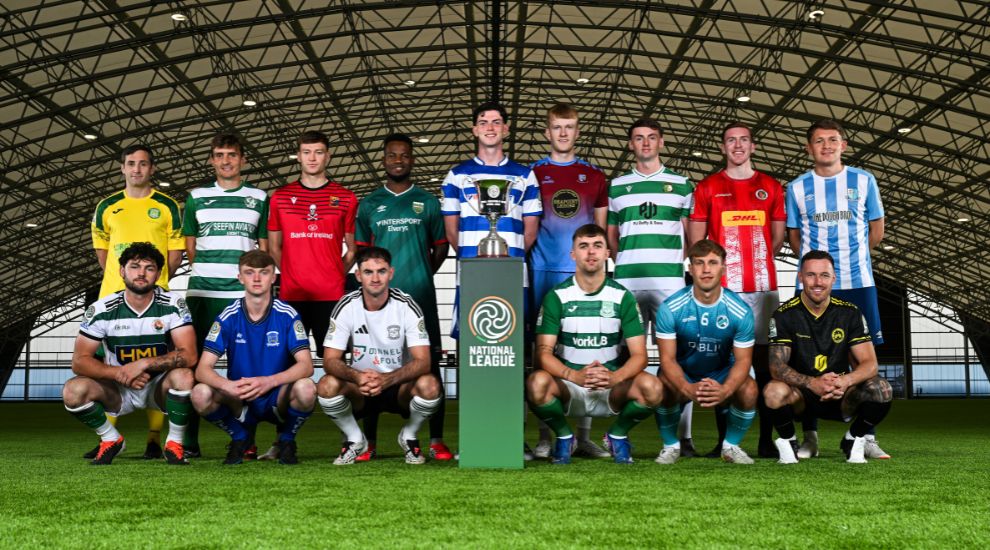
Representatives of the 15 founding clubs gathered at the National Indoor Arena on the Sport Ireland Campus on Tuesday, with the first five games of the new competition taking place on Saturday, August 29.
The National League has been created to provide the missing competitive link between grassroots football and the League of Ireland. From 2027, the intention is for a promotion and relegation pathway to operate between the new competition and the League of Ireland First Division, subject to licensing requirements.
It creates, for the first time, the prospect of a club progressing through the domestic football pyramid from grassroots competition to the League of Ireland on sporting merit.
The opening 2026 season will operate on a shortened format, with the 15 clubs divided into three groups of five and playing each other home and away. The three group winners and the best runner-up will progress to semi-finals, with the first FAI National League Final scheduled for November.
Mervue United against Cockhill Celtic and Bonagee United against Home Farm DCU will open Group One this weekend.
In Group Two, Salthill Devon host Letterkenny Rovers, while Mayo face St Francis in Castlebar.
The sole opening fixture in Group Three will see CK United host Newbridge Town, bringing national-level senior football representation back to the Carlow and Kilkenny area.
The breadth of the competition is an important part of the FAI’s ambition. The founding clubs represent all four provinces and ten counties, with Donegal, Galway and Dublin particularly strongly represented. The 15 were selected following a process which initially attracted expressions of interest from 67 clubs and entities around the country.
“The expansion of the football pyramid is huge for the game here in Ireland,” said Interim FAI National Competitions Lead Garret Higgins at the launch.
“It offers a new highly competitive competition that will give a new standard for footballers to compete in.”
“There’s a lot of excitement and a lot of intrigue about the upcoming season, but having Carlow, Kilkenny, Kildare and Mayo represented in addition to more clubs in Kerry, Galway, Donegal, Waterford, Cork and Dublin only serves to emphasise the passion for football throughout the country.”
“This will be a season of learning but with that comes a great opportunity for these clubs to grow and establish themselves even more.”
“These are the first 15 clubs to step into the National League but we’ve every hope to expand that in the coming years.”
The initial FAI plan envisaged a 20-team National League divided geographically into North and South sections. The truncated 2026 competition is effectively the first stage in building towards that fuller structure from next spring.
Participation brings challenges for clubs around facilities, travel, administration, and the increased costs of operating in a national competition. But it also brings opportunity.
A defined position within a national pyramid gives clubs a stronger proposition around sponsorship, community engagement and player development, particularly in counties and regions without an existing League of Ireland presence.
For Irish football more broadly, the real measure of success will come over the next number of seasons. If the league can grow from its initial 15 members, establish sustainable standards and deliver genuine movement between grassroots and League of Ireland football, this weekend could ultimately be viewed as an important moment in the reshaping of the domestic game.
Sport for Business Perspective
The importance of the National League lies as much in opportunity and infrastructure as in results.
Creating another genuinely national layer of football increases the number of clubs that must think of themselves as sporting businesses: developing commercial partnerships, improving facilities, attracting audiences and volunteers, building stronger digital identities, and establishing relationships with their local business communities.
There is also a significant geographic dimension. Giving areas including Mayo, Carlow, Kilkenny and Kildare a route into the national senior pyramid broadens the footprint of elite domestic football and creates new local markets in which the sport can build support.
The football begins on Saturday. The bigger project is about what these 15 clubs, and those that follow them, can become over the next five to ten years.


 The FAI and the League of Ireland are full members of Sport for Business. Sky Ireland is our Football Coverage Partner.
If you would like to be part of the Sport for Business community and see your organisation in our content, on our stages, and in the conversation happening every day around the commercial world of Irish Sport, email us today and let’s see what is possible.
Image Credit: FAI and Stephen McCarthy, Sportsfile
ABOUT SPORT FOR BUSINESS
Sport for Business is Ireland’s leading platform focused on the commercial, strategic and societal impact of sport. It connects decision-makers across governing bodies, clubs, brands, agencies, and public institutions through high-quality content, events, and insights.
Sport for Business explores how sport drives economic value, participation, inclusion and national identity, and how your story can be part of ours.
Through analysis, storytelling and convening the sector, it helps leaders understand trends, share best practices, and make better-informed decisions. It positions sport not just as entertainment but as a vital contributor to Ireland’s social and economic fabric.
Find out more about becoming a member today.
Or sign up for our Daily Sport for Business Snapshot email bulletins to get a flavour of the material we cover.
Sign up for our News Bulletins here.