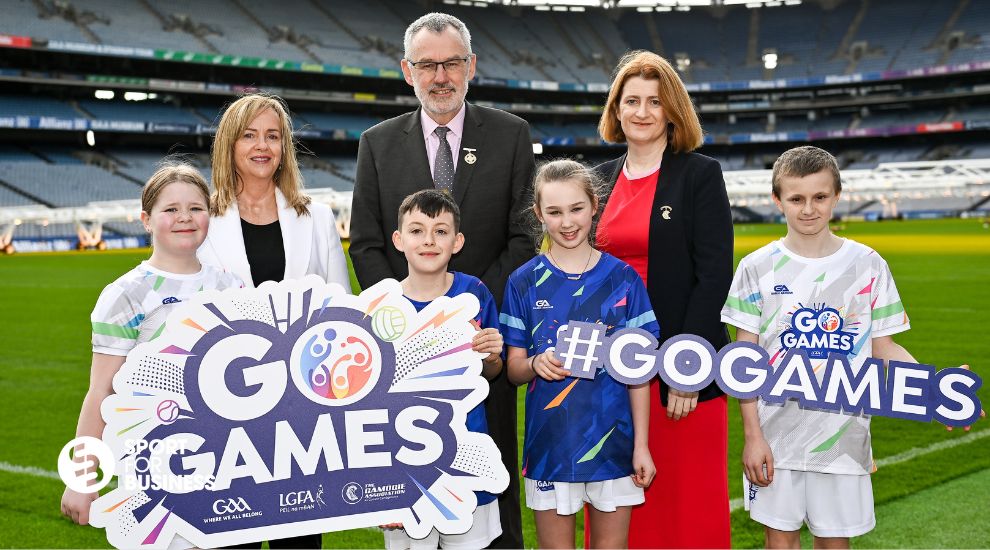
The three Gaelic Games associations have reaffirmed their commitment to the principle of the Go Games model for introducing children to Gaelic and Ladies Football, Hurling and Camogie.
An updated Go Games Policy is being published to nurture a passion for Gaelic games in young boys and girls and to do this through a positive coaching environment of inclusion and to ensure every child has an opportunity to learn and develop their skills.
Go Games are Camogie, Hurling and Gaelic Football for children up to and including 12 years of age, where every child gets to play in every game, for the full game.
The inclusive nature of the Go Games model has been credited as being responsible for significant growth in participation levels since its introduction in 2010.
It is estimated that Juvenile membership in Gaelic Games is in the region of 250,000 young people.
A new Go Games Workshop aimed at coaches and parents of children involved in Go Games is also being rolled out.
The short online workshop will ensure that participants will be able to apply the new Gaelic Games Go Games model effectively in coaching sessions and in running blitzes in line with national policy where games and pitch sizes can be modified to maximise full participation in the games.
Children participate in Gaelic Games for a number of reasons – to have fun, to play with friends, parental encouragement among others. However, a lack of fun, lack of perceived competence and an over-emphasis on competitive outcomes (which usually come from coaches and parents) are major reasons for dropout.
Players can generally learn the basic skills of Camogie, Hurling and Gaelic Football with relative ease. The better players who practise more often, come on faster than those who only participate in collective coaching sessions.
However, players find it more difficult to develop the ability to make the right decisions – when to pass, whom to pass to, where to run in full-sided games. However, through small-sided games the aim is to optimise their decision-making and at the same time enhance their technical development.
The original Go Games policy outlined that there was no provision made to publish scores, to play on a knock-out basis nor to include finals, or to present trophies. Through the relaunch/update of the policy, alongside the GAA, Camogie Association and LGFA are working to ensure there is a greater understanding and compliance in relation to elements of the policy including the non-competitive nature of Go Games.
“We all know there are lots of benefits to children who take part in sport,” said GAA President Larry McCarthy.
“But what should always be at the top of that is the fun and enjoyment that they get out of their involvement.”
“Go Games has been central to the successful rise in participation in Gaelic Games and develops young people and teaches them the skills of hurling and football and camogie.”
“It is the first step in what we want to be a lifelong participation in Gaelic games and ensuring that every child gets a go and that no one is made to feel excluded or unwanted is at the heart of that philosophy.”
“It gives me great pleasure to see the launch of the Gaelic Games Policy and the rebranding of Go Games to include all four codes of Camogie, Hurling, Ladies Football, and Gaelic Football and is a significant step towards inclusivity and universal experiences for children involved in Gaelic Games,” added Camogie Association president Hilda Breslin.
“Our young and emerging players are the future of our sports and it’s vital that they are shown the right path for long-term development,” said LGFA President Micheál Naughton.
“In their young years, and as they develop a love for Gaelic Games, we should ensure that our young boys and girls are given as many chances as possible to participate and play.”