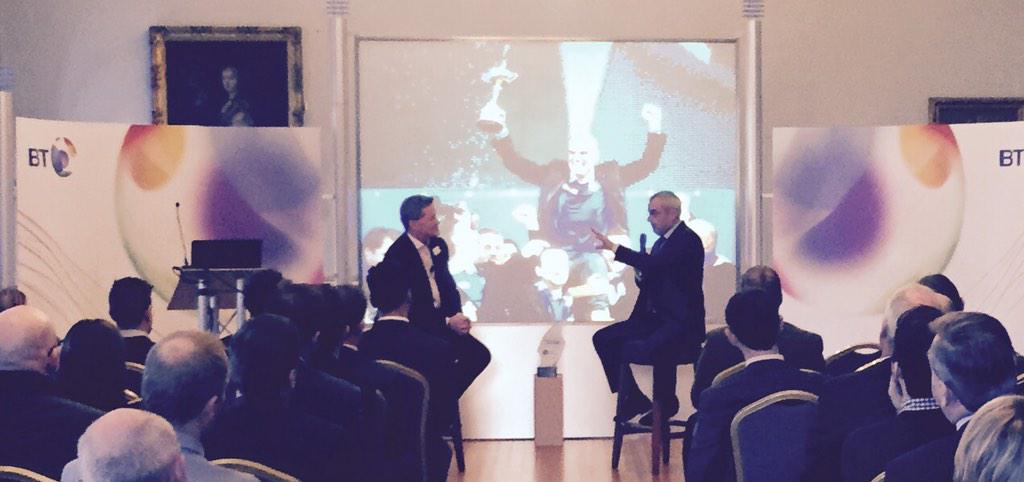
When Paul McGinley sent out his team to compete in last September’s Ryder Cup they were the best prepared of any golf team ever assembled. The detail of his planning is indicated by the fact that he speaks of the 104 week cycle rather than two years.
Speaking in a one-to-one interview at the Business of Sports Science Conference for members of Sport for Business yesterday McGinley gave a detailed and engaging account of how he set about getting the team ready and how each decision was made.
“When it came to team selection we assembled a massive store of data on each player in terms of their form and suitability to Gleneagles.”
Data
“Data and the ability to absorb and analyse it was crucial and the team of statistics and analysis experts we brought together were a vital part of the team.”
You got the sense that as Captain he knew the players better than they knew themselves though he admitted to being careful about how he used that information.
“Nobody feels comfortable if they sense they are being watched and judged on every shot.”
“We had the data but that did not mean we would sit down for a player debrief after every event on the Tour.”
Information
Part of being Captain was knowing what and how to share the information.
The spirit he built in the team was a significant factor not only in the victory but also in why the Ryder Cup maintains its electric allure for players who are operating in an individual sport, who hardly need the money and push themselves far out of their comfort zone to compete.
It also contrasted starkly with the mood in the defeated US camp.
“Tom Watson is a legend of the game and we did use that in reverse to build an ‘underdog’ spirit despite knowing that our players, on any ranking table were a ready match for the Americans.”
“I was just a guy from Dublin who had never won a major but he was Tom Watson, with eight to his name and having captained the US to a win at the Belfry in 1993.”
Allegiance
The allegiance he fired up within the locker room was evidenced by telling a story about dropping Ian Poulter from the afternoon session at Gleneagles.
“I’d said to him that he was likely to play twice that day but it wasn’t happening for him and we had to make the call to switch him out, almost minutes before handing in the team sheets.”
“I needed him to hear it from the management before word spread like wildfire and that was important. When I caught up with him to explain the decision to him personally he first grabbed me in a headlock, and then whispered that I was his Captain and that he was fully behind every decision I made.”
That was a big call from a man who has been defined by the tournament, who single handedly brought us back from the brink in Medinah but who wasn’t on his A game this time. It was the right call but his reaction could have been different.”
Control
McGinley went on to share his view on how the sport had ceded control in terms of technology to the big manufacturers. Changes in balls, clubs and turf agronomy were changing the sport perhaps more than any other and that was a major challenge.
He is now embarked on an Olympic journey to Rio. He will visit the under construction course twice this year, including hopefully to play in the first test tournament.
“The team selection will be based on rankings so that means no pressure around a Captain’s pick. My role will be to help the guys that make it. To give them the best possible information about what they will face and to be by their side when they do so.”
After that no decision has been made on the next chapter of his life. He is 48 and will qualify to play on the Seniors Tour in two years time.
Heart
He will only do so at full tilt though if his heart is fully in it. He is developing a new persona as a management leader and yesterday’s engagements as part of our event and the wider BT Young Scientist and Technology Exhibition will likely lead him further along that path.
It is one he will travel with confidence and one on which he has a lot to offer.
It was a genuine honour to be able to present him to the Sport for Business audience.
Join us through next week for features on our other speakers including Jim Gavin, Patrick Kennedy from Amarach Research, Grant Best from BT Sport and Donal Ryan of Equinome.
Image Credit: Gina Kelly