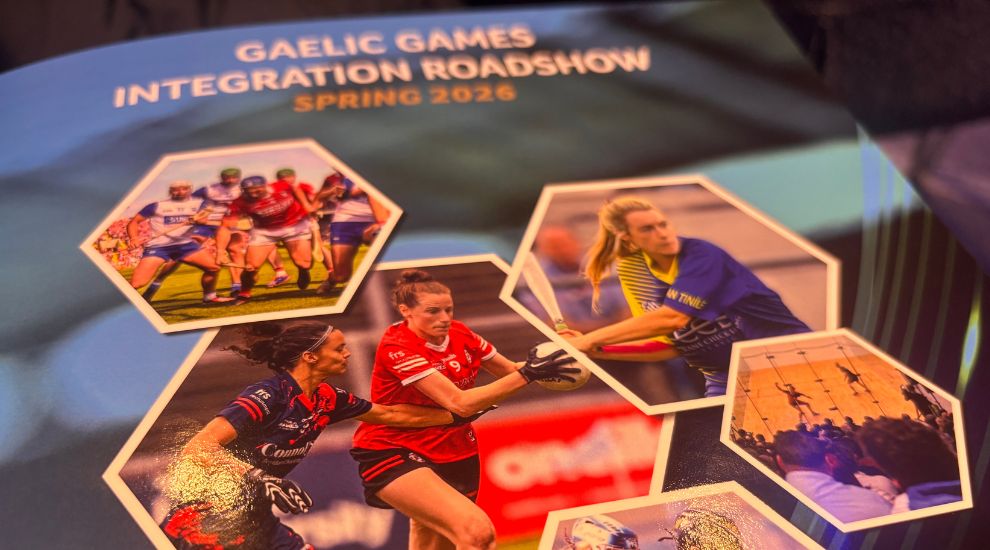

Invoking the founding spirit of Gaelic games and the idea of cairde — friendship — that underpinned it, Mary McAleese played the role of ‘Inspirer – In – Chief’ at last night’s first of four provincial roadshows on integration with a reflection on the original vision of Michael Cusack.
Cusack was born in Carron in County Clare in 1847, Black ’47, the worst year of the Famine when a million people died of famine and disease. Somehow this child survived and created a vision and a plan. He surrounded himself with people who shared that. If they had thought too hard of what they were trying to create they might have worked away but they did not do that.
Instead they created what we have, an organisation that is unique in its local power and influence around the world. Out of belief and faith in each other.
When we spoke to the membership, the idea of an integrated organisation came back as the will of the people. There are fears, it will take financial, emotional, logistical and many more resources but it can be done, and it will be done.
Cusack’s idea, she suggested, was rooted not only in athletic revival but in community — in belonging, hospitality and shared cultural identity. That founding impulse, she said, now finds expression in a new chapter for the games: the creation of a single association for Gaelic Games.
“Integration is not a question of if anymore, nor when. It is about how.”
A Mandate for Change
The journey began formally in 2022 when motions passed at the congresses of the Gaelic Athletic Association, Ladies Gaelic Football Association and Camogie Association committed the three organisations to pursue integration and prioritise a clear and deliberate process.
Those votes, McAleese emphasised, followed years of discussion and increasing collaboration across the bodies — and a growing recognition that the long-term strength of Gaelic games lies in structural unity.
A steering group on integration was established soon after, with McAleese appointed independent chair. Its first formal meeting took place in October 2022.
What followed, she said, has been a thorough and sometimes challenging process, always guided by deep respect for the traditions and identities of each organisation.

Listening and Refining to an Ambitious Timeline.
Consultation has been central to the work.
“We have listened to every conceivable constituency across the country,” she said, outlining engagement with players, administrators, volunteers and supporters. “What has been most striking is the goodwill and enthusiasm across all three organisations.”
The roadshows — one in each province — are designed not only to present detailed proposals but to gather further feedback. The aim is to refine the model before bringing final recommendations to the central councils of the three organisations and ultimately to special congresses.
“It will not be a guillotine process,” McAleese said. “It will be a process.”
It will also be a relatively quick one from here in.

This and three more roadshows will be held before the end of March with further potential refinement being taken on board from each of those, and from the way in which the proposals are socialised in deeper fashion across the units of the association.
That may include the detail being sent to all those who contributed to the initial survey, or indded the full registered membership of each association for comment and feedback.
By July of this year, the structures, Codes of Practice and the One Membership model will be finalised and put to the Central Councils of all three of the organisations, and to those of Gaelic Handball and Rounders.
Motions will be drawn up in August to go before three special congresses to be held in October, with Provincial, County and Club AGM’s again across all three codes, or in a One Club fashion for those 800 clubs already operating in that way, by the end of 2026.
The new structures, outlined in greater detail below, will be in place then by April 2027, and the new GAA as an association will be up and running next year, by the self imposed deadline of 2027, with the first combined Congress held in 2028.
There are some potential speed bumps along the way for this but all of them are transitionary.
For example the GAA will elect a new President-elect to serve a three year term at next weekend’s GAA Congress. Will that term actually be just for one year before being subsumed into the role either as President of the new Association, or Vice President for GAA, as opposed to LGFA or Camogie matters at national level.
The protocol agreed between the GAA and the Gaelic Players Association will also have to roll into a related one with Ladies Football and Camogie ahead of it becoming a single one negotiated between the players and the new unified body over the first few years.
The financial requirements of fundraising and expenditure, previously done separately, will need to be worked out on a unified basis and one of the issues there will be the difference between equality and equity.
Is there a basis at the club level which represents most of the teams playing the games for a base line of equal funding, bolstered by additional sponsorship or fundraising that might be sought at a team rather than a club level?
Does the inter county Men’s football team, playing before a full house at Croke Park start the year with the same level of funding as the inter county Camogie team that might play all of its matches before crowds that rarely get to more than three figures?
These could be the questions that break the idea of genuine unity before it has even begun, if they were allowed to, but the leadership does not propose that they be answered in full before anything else can be agreed.
The Structures
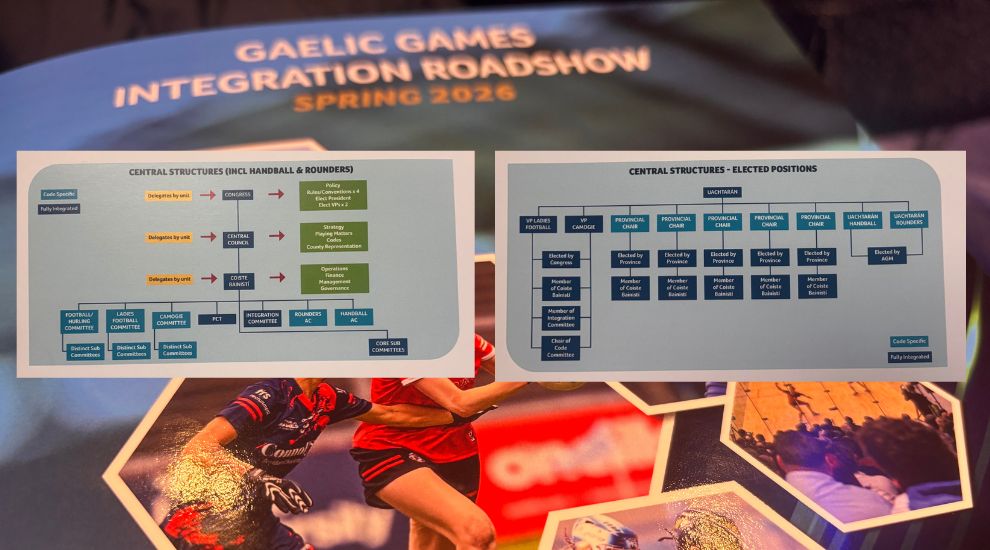
The structures that have been proposed follow broadly the One Club model.
Each County will have a single County Board representing all Gaelic Games.
It will be made up of an elected Chair, and Vice Chairs for each of GAA, LGFA and Camogie, a Secretary or CEO which may be one or two roles depending on size, and a Treasurer. These six or seven positions will be replicated across every county and at provincial level.
There will be an additional six to 12 roles at Executive or Management Committee level, again depending on size and determined by each county, comprising a Coaching and Development Officer, a Communications Officer, Delegates to Provincial and National Councils, a Safeguarding Officer, a maximum two additional dependent on each County’s bye laws, and up to four additional nominees which may be needed to provide rair representation for each code, depending on the make of up the other officer roles.
The proposal lists 15 County Sub Committees, ranging from Competitions and Finance to Youth, Culture, Coaching and County Teams, each of which will have its own terms of reference.
The provincial Structures follow a similar path but with additional representation for Schools and Colleges.
At club level, the proposal lists seven key factors to be considered and implemented.
- The club executive must have overall responsibility for managing the affairs of the club.
- All codes in which a club participates must be adequately represented on the Club Executive.
- Each club could have a sub-committee per code to manage day-to-day running of that code unless the club decides that it is better to combine codes.
- Club finances and fundraising must be administered at Club Executive and not at code level. The executive should ensure and be able to to demonstrate fair allocation of funding to all codes.
- Fair allocation of facilities across all codes must be achieved.
- The overall structure must comply with Association rules and a new Club Constitution which requires preparation.
- Flexibility will be needed on club structures and counties should be allowed determine some variances in club structures via bye-law while still complying with the structure enshrined in rule.
At National level, the structure will be broadly similar with representation secured through a flow up from club to county to province to a national Central Council and Coiste Bainistí as outlined in the image below.
I suggested from the floor last night that there should be a role of VP for GAA to match that in the proposal for LGFA and Camogie so as not to draw the inference that the role of the President will automatically fall to the ‘legacy’ GAA and it was said from the top table that this would be considered.
Single Membership
At its most basic level, it is proposed that there be a single membership with four tiers of Adult, Youth, Child and Social, with a single baseline national fee, paid once a year, that can be added to by each club depending on needs and circumstances.
The registration upwards, at County, provincial and national level, and into a new unified Injury fund will also be singular and administered through an upgraded Foireann system.
Perspective
From parish fields to global communities, Gaelic games have evolved over the last 142 years through vision, determination, courage and cooperation. The road to integration is another chapter in that same story — rooted in heritage, shaped by consultation and driven by a shared belief that unity can secure the best possible future of the games.
As part of Cuala GAA Club I was part of a small group that presented our experience of operating as a large urban club under the One Club Model to the Integration Committee.
That model is the basis for the new structures that were outlined last night in greater detail for the first time.
It can work because it does work at club level.
As a club we do not yet own any of our own pitches but we have access to seven, spread across Dun Laoghaire Rathdown County Council are, and each code finds a way to train and play through the year, at times borrowing, and paying as a club, for floodlit pitches from other clubs and schools, but ultimately making it work.
We deal with the challenges of each section at a section level and then bring it all together at Coiste level for the ‘bigger picture’ stuff and that is also what is envisaged.
There are some who say it is too quick, or too complex and that nothing should be agreed until everything is agreed.
What we have now is a picture of how this will look and work in time, and the first steps needed to maintain progress and momentum towards that.
There is no going back and we should not be afraid that it looks too hard. If human endeavour had been shaped along those lines, we would be lesser than we are.
Image Credits: Sport for Business
ABOUT SPORT FOR BUSINESS
Sport for Business is Ireland’s leading platform focused on the commercial, strategic and societal impact of sport. It connects decision-makers across governing bodies, clubs, brands, agencies and public institutions through high-quality content, events and insight. Sport for Business explores how sport drives economic value, participation, inclusion and national identity, and how your story can be part of ours.
Through analysis, storytelling and convening the sector, it helps leaders understand trends, share best practice and make better-informed decisions. Its work positions sport not just as entertainment, but as a vital contributor to Ireland’s social and economic fabric.
Find out more about becoming a member today.
Or sign up for our twice-daily bulletins to get a flavour of the material we cover.
Sign up for our News Bulletins here.
Upcoming Events