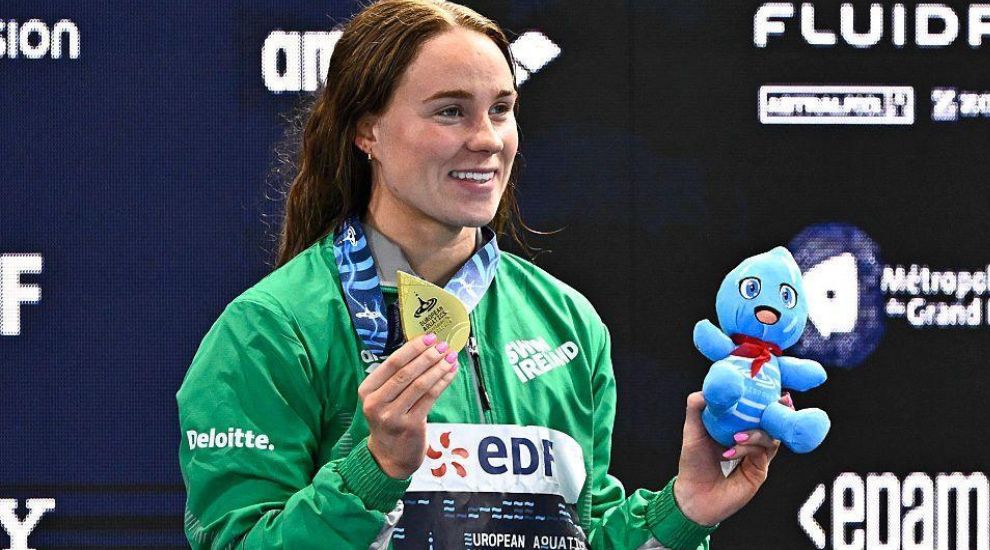
Five medals, two European titles and a succession of Irish records made the swimming programme at the 2026 European Aquatics Championships in Paris another major step forward for Ireland, though the final medal count also highlighted where the next stage of progress must come.
Ireland travelled with its largest-ever European Aquatics team, including 26 swimmers, and returned with five medals from the pool. Ellen Walshe won two golds, while Mona McSharry collected a silver and two bronzes. Between them, the pair delivered every Irish medal of the championship.
For Walshe, Paris represented the championship at which years of potential and major-final experience were converted into long-course international titles.
Her first came in the 400 metres individual medley. Walshe was still second at the final turn but produced the strongest freestyle finish of the field to touch first in 4:34.42, 0.70 seconds clear of Britain’s Amalie Smith. It was her first senior long-course European medal and immediately established the tone for the rest of her week.
She then doubled down in the 200 metres individual medley. Seventh after the opening butterfly leg, Walshe steadily worked her way through the field before again producing the decisive freestyle finish. Her winning time of 2:09.81 was a new Irish record and secured a second European title.
There was almost a third medal. Walshe finished fourth in the 200 metres butterfly in another Irish record of 2:07.40, only 0.19 seconds from bronze. She then combined with Lottie Cullen, Mona McSharry and Grace Davison to take nearly three seconds from the Irish 4×100 metres medley relay record, finishing sixth in 3:57.26.
It amounted to an exceptional week and moved Walshe from being an Olympic and World Championship finalist into the category of proven senior international champion.
McSharry’s achievement was different but every bit as impressive.
The Olympic bronze medallist demonstrated remarkable consistency across all three breaststroke distances. She began with silver in the 100 metres in 1:05.41, behind Britain’s Angharad Evans, before adding bronze in the 200 metres in 2:22.43.
On the final evening she completed the set with bronze in the 50 metres, breaking the Irish record with 29.95 seconds. The margins at that level could hardly have been tighter: Ruta Meilutyte won in 29.93 and Benedetta Pilato took silver in 29.94. Two hundredths separated McSharry from a European title.
Three events and three medals represented a formidable return and, like Walshe, confirmed an ability to reproduce elite performances repeatedly across a demanding championship programme.
There was important progress further down the team as well.
Tom Fannon finished sixth in the men’s 50 metres freestyle in 21.59, only one hundredth outside his Irish record. John Shortt set a national record of 1:55.31 in reaching the men’s 200 metres backstroke final before finishing seventh, while Jack Kelly broke the Irish 200 metres breaststroke record with 2:09.23 on his way to the final.
Danielle Hill, the defending European 50 metres backstroke champion, returned to another European final, while Ellie McCartney also made the top eight in the 200 metres breaststroke. Those performances, together with the women’s medley relay record, offered evidence that the Irish challenge extended further than the five medals.
Daniel Wiffen’s championship provided the clearest example of how even the highest expectations cannot always be fulfilled. The Olympic 800 metres champion finished fourth over that distance in a season’s-best 7:43.30, just outside the medals, and was eighth in the 1500 metres.
The next measure of progress for Swim Ireland’s high-performance programme will be whether the growing number of finalists and record-breakers immediately behind Walshe, McSharry and Wiffen can begin converting those performances into podium finishes.
Paris offered plenty of evidence that this is possible. Shortt and Kelly are lowering national records, Fannon is operating close to European sprint medals, McCartney is establishing herself in senior finals and the women’s relay has moved onto another level.
The headline, though, belongs to Walshe and McSharry.
Five medals from two athletes would represent an outstanding championship in any era of Irish swimming. That it came alongside Irish records, multiple finalists and the largest team Ireland has ever sent to a European Championships makes Paris 2026 another significant marker in the sport’s transformation from occasional international success to sustained high-performance relevance.
 Swim Ireland is a full member of Sport for Business.
If you would like to be part of the Sport for Business community and see your organisation in our content, on our stages, and in the conversation happening every day around the commercial world of Irish Sport, email us today and let’s see what is possible.
Image Credit: Swim Ireland and Sportsfile

ABOUT SPORT FOR BUSINESS
Sport for Business is Ireland’s leading platform focused on the commercial, strategic and societal impact of sport. It connects decision-makers across governing bodies, clubs, brands, agencies, and public institutions through high-quality content, events, and insights.
Sport for Business explores how sport drives economic value, participation, inclusion and national identity, and how your story can be part of ours.
Through analysis, storytelling and convening the sector, it helps leaders understand trends, share best practices, and make better-informed decisions. It positions sport not just as entertainment but as a vital contributor to Ireland’s social and economic fabric.
Find out more about becoming a member today.
Or sign up for our Daily Sport for Business Snapshot email bulletins to get a flavour of the material we cover.
Sign up for our News Bulletins here.