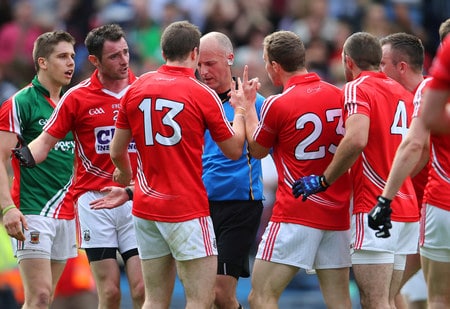
 Sunday’s All Ireland Quarter Final ended with Cork players surrounding and haranguing the referee, Cormac Reilly, after claiming they were misled about the amount of time left. It’s not the first time it’s happened in recent years and when games come down to the tightest of margins it will always be an issue, especially for the losing team.
Cork were magnanimous after the game saying it was not the reason for their defeat. They say they had been told there was ‘a minute or so left’ when deciding to pop over a free for a point and reduce their deficit to one. By the time that had been taken, deliberately, and the ball recovered and kicked out by Mayo, 50 seconds had elapsed and that was 50 seconds longer than the two minutes of additional time which had been flagged.
The referee was within his rights to blow up at that time and so long as the decision is in his hands and on his whistle there will always be room for a sense of injustice, even if just in the heat of that particular literal moment.
Out of Play
Rugby of course plays to 80 minutes and then until the ball goes out of play. It sets up the ability for fans and players alike to know exactly what is needed to keep a game alive, or kill it and it works well.
That said Rugby is a much less fluid game than soccer or Gaelic Football where there are fewer points at which the clock can obviously be stopped to account for additional time. It’s not impossible though. It used to be called ‘injury time’ and a return to that notion would enable a referee to clearly define when play was stopped to allow treatment.
Substitutions have to be acknowledged by the ref as well and similarly the time taken for one player to leave the pitch could again be added simply and without confusion.
The uncertainty over how long an 80 minute rugby match takes might not play so well with the bigger and more global TV audiences that soccer attracts but it could be acceptable in gaelic games where matches are shorter anyway at 70 minutes.
Red Zone
Stopping the clock would then enable a ‘red zone’ after the full time allocation had been played in which possession would determine the end point, and not just the referee’s whistle.
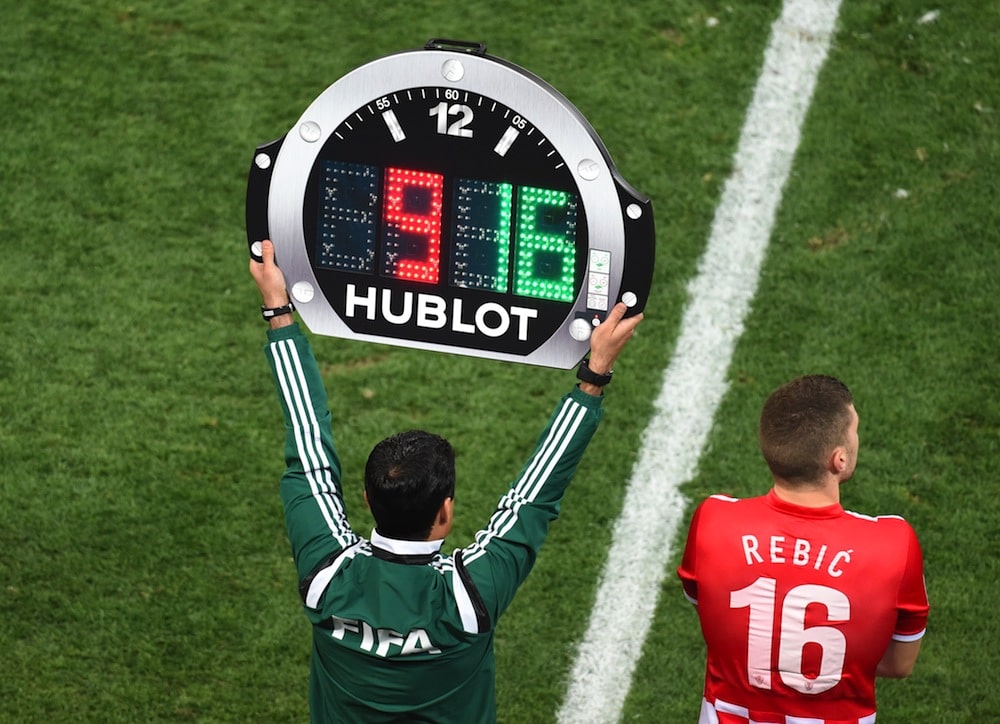 At the World Cup we saw how Hublot activated their sponsorship as official timekeeper by re designing the sideline board for additional time and substitutions into the shape of one of their watches.
The GAA has opened up in game sponsorship through SpecSavers’ branding of the Hawk Eye technology and a similar deal might be possible on the timing side thus turning a negative as we saw on Sunday into a positive for fans, players and sponsors.
Decisions on rule changes are never best taken in haste but such a change would anyway have to be teased out through Congress and in trial format through the Allianz Leagues first but it is food for thought, and hardly something that would raise the ire of any particular group…