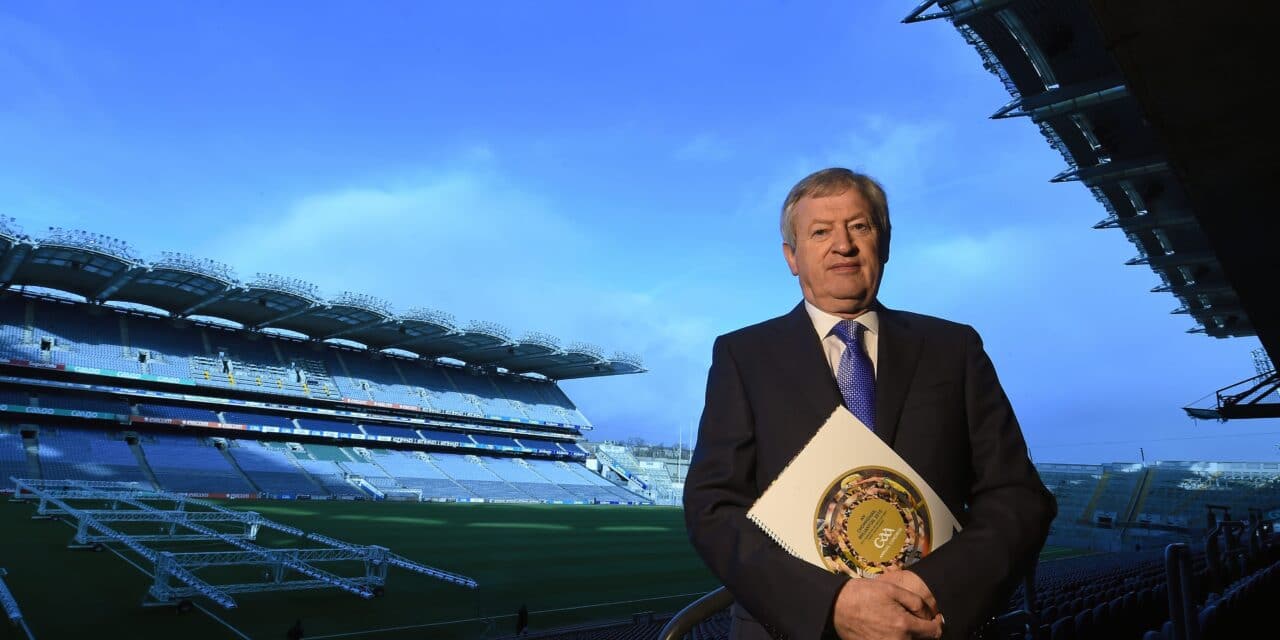
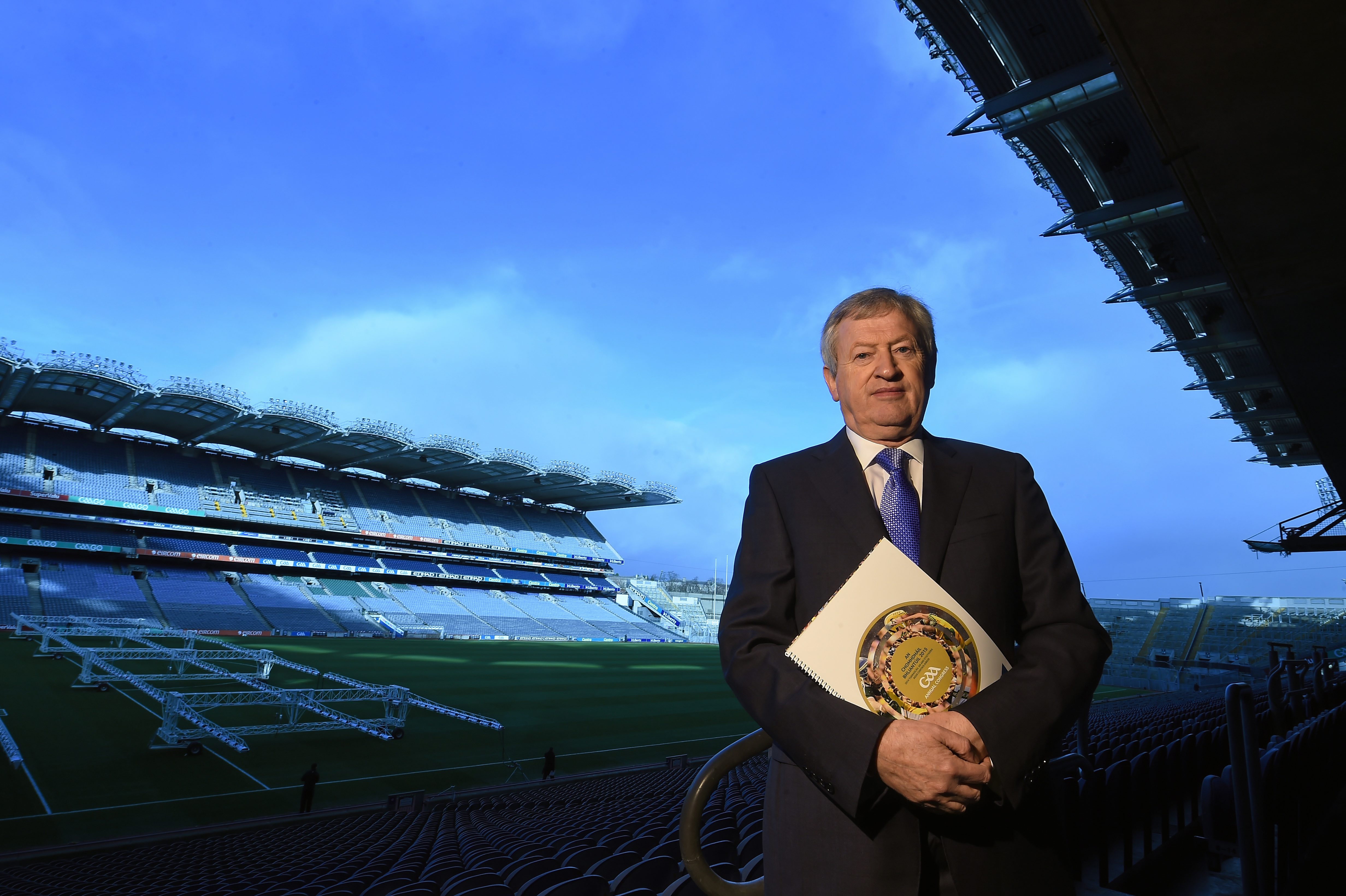
Paraic Duffy, Director General of the GAA has delivered his annual ‘State of the Nation’ address through the publication at Croke Park yesterday of his Annual Report for 2014.
The report runs to 100 pages in all and can be downloaded in full below. He covers a number of areas from player welfare and Garth Brooks to the rule changes that impacted the sport over the past 12 months.
He also talks extensively about broadcast rights and international expansion which we will analyse over the coming days.
Among the most heartfelt passages though is a defence of the commercial activities the Association needs to engage in so as to maintain itself in the face of intense competition.
We republish the specific words below which Duffy uses to counter the claims of ‘commentators’ who consider themselves to be ‘better, purer members’.
There is a real sense of feeling in what he says, and we can only imagine the emotions stirred when the criticism was flying at full tilt rather than now with the benefit of a cooler head.
The dynamic between commercial reality and volunteer basis is one of the things that makes the GAA unique among sporting and cultural bodies. It’s a tightrope and people who want to take things forward will always risk upsetting those for whom every change might be fought and seen as being corrosive to the well being of the games and all they represent.
It is worth bearing in mind that the GAA itself is only four generations old and is competing in a space where society and technology change happens over days rather than decades.
Managing that alone would require the patience of Job and the resolve to carry on of Sisyphus.
Here are Duffy’s own words on criticism of the Corporate GAA…
“Certain commentators, not averse to finding a bandwagon to jump on, and happier with a slogan than serious analysis, got good mileage out of a so-called ‘corporate’ GAA, by which they mean that the priority of the GAA is to make money.”
“This bandwagon, it should be pointed out, was started by some of those opposed to Croke Park concerts. If the charge had any truth in it, it would be a serious matter deserving public discussion. But this is an utterly bogus charge, and a non-issue.”
“As these commentators well know, the GAA is a not-for-profit organisation that generates revenue uniquely in order to fund the Association’s activities.”
“Some of these commentators seem to consider themselves better, purer GAA members than the rest of us, but it’s easy to act the purist when one has only to talk, as opposed to taking decisions in the real world, where the calls on our revenue from our units are enormous and unending, and where we must compete vigorously to maintain the public’s loyalty to our games.”
“Although the facts about GAA revenue sources and funding commitments are easily available to anyone interested in having a genuine debate, it seems that they need re- stating. Over 80% of GAA income is distributed to clubs, counties and the provinces and there are the once-off big projects for which we have to find the funding.”
“Currently, these are the redevelopments of Páirc Uí Chaoimh and Casement Park, but we are also funding the GAA development at the National Sports Campus at Abbotstown, as well as Centres of Excellence in many counties. And that is only in Ireland; because we have a responsibility to our clubs and supporters living abroad, we are funding the redevelopment of our facilities in Ruislip and are developing the Shannon Gaels and Rockland grounds in New York.”
“The GAA is not, of course, the sole funder of these projects, but these are, nonetheless, hugely expensive projects for us, for which the funding has to be found by the Association. In addition, we need constantly to improve our facilities in grounds throughout the country.”
“Gate receipts represent the single biggest GAA revenue source, but this income is not nearly adequate to meet the funding demands we face.”
“It is a simple reality that we need the income derived from concerts, sponsorship, broadcast rights and other events. The false impression is created by some commentators that the GAA could fund its developments and compete with its sporting competitors by relying solely on gate receipts.”
“It must be remembered that the GAA does not have the lucrative revenue sources of international competitions, such as World Cups, available to soccer and rugby in Ireland. Equally, the marketing opportunities that such competitions present to the FAI and IRFU means that the GAA must allocate greater funds to market its games; for indigenous games, it is not an easy task, nor a cheap one, to maintain its visibility and promote its games against international competition.”
“Croke Park, too, as a concert venue has to compete with other stadiums. And the wider context of all of this is increased competition for what has been, in recent recession years, reduced revenue sources and a big reduction on Government funding.”
“The commentators who criticise us might like the GAA to drastically cut the funding of improvements in our grounds and facilities, the commitment to our exiled supporters, the player-welfare initiatives, the training and mentoring of our officials, the promotion of our games, the provision of full-time coaches (I could go on), but in the real world, where one has to take responsibility and make decisions, the GAA will continue its not-for-profit mission to fund its games and look after its members and supporters.”
Among other points to note in the report, Dublin has now been overtaken by North America as the ‘County’ with the second most clubs, behind Cork, and that Britain has more clubs than any other Irish county.
The number of people attending Championship matches in 2014 was 1,541,309, up 3.5% on the 1,489,205 who attended the previous year.
 Read the full report here
Image credit: Sportsfile