The new ‘Cold War’ between Russia and the West over athletes doping is shining an uncomfortable light on the use of Therapeutic Use Exemptions for athletes.
The hacking of the World Anti Doping Agency by a Russian group is producing a daily release of medical records of athletes at the highest level.
Mo Farah, Bradley Wiggins, Serena Williams and Rafa Nadal have been among the first wave and while they and their relevant sporting bodies insist that no anti doping violations have been broken, the court of public opinion is proving somewhat more jaundiced.
70% Asthmatics
A UK study in 2014 found that 70% of the British swimmers in its high performance programme suffer from some form of asthma. This is against a national average of less than 10%. The reason put forward in defence is that the chlorinated atmosphere in which they spend so long training triggers the condition.
Similarly the Kent University report found that 30% of the members off Team Sky suffer the same complaint and this is down to a form of exercise induced asthma as opposed to the classic allergy triggered variety with which we are more familiar.
Casual Suspicion
Figures as high as those cast a casual suspicion among the general public though over Team GB’s record breaking performance in the swimming pool at Rio.
There is no historical record of whether this incidence has increased over the years or whether it has always been this high.
The suspicion is exacerbated by the fact that it is being brought into the public domain as part of a seeming revenge mission for the findings against Russian authorities in relation to a state sponsored programme that foreshadowed the Olympic Games.
There is a fine balance here between the privacy needs of individuals and the critical importance of restoring faith in sport at the highest level.
Sport Ireland, which runs the Irish anti doping programme is recognised as one of the leading agencies in the ongoing fight against the use of performance enhancing drugs. The Sport Ireland policy on Therapeutic Use Exemptions is published in full below, and is publicly accessible on the Sport Ireland website.
Publish for Transparency
If we are to take the claim seriously to want to lead the world though is there not a case for Sport Ireland, in partnership with the athletes, publishing the TUE’s sought pre or post testing in a move towards total transparency.
They are exceptions after all, not a way to enhance performance that is ‘more legal’ than taking drugs in a darkened room away from the testers.
It would lay down a marker that Ireland has nothing to hide and restore a global reputation that has suffered some damage over recent Olympic Games by positive tests.
Sport for Business is part of the team of founders of the One Zero Conference taking place in Dublin next month. Lance Armstrong is one of the keynote speakers and will be asked his own views on the use of Therapeutic Use Exemptions.
Here is the Sport Ireland policy on TUE’s from its own website:
Therapeutic Use Exemption (TUE) Policy
Following an amendment to the Irish Anti-Doping Rules by the Council on 6th April 2010, the Irish Sports Council has established a Therapeutic Use Exemption (TUE) Policy based on the level that an athlete competes at; the level an athlete competes at determines whether the athlete needs to apply to the Irish Sports Council or their International Federation for a TUE, and if applying to the Irish Sports Council whether the athlete must apply for a TUE before using a prohibited substance (a Pre-Test TUE) or has the option of applying for a TUE retroactively following a positive drug test (a Post-Test TUE). Use the TUE Flowchart to ascertain if you the athlete need to apply to your International Federation or to the Irish Sports Council, and also if you must apply for a Pre-Test TUE or a Post-Test TUE.
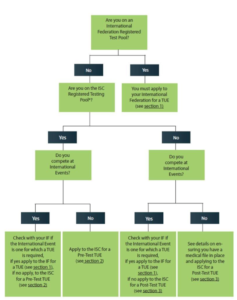
*The Registered Testing Pool is a pool of top level athletes who are subject to both in- and out-of-competition testing, who must meet whereabouts requirements of the ISC. The RTP is agreed with the sport annually, and individual athletes are informed in writing of their inclusion in the RTP.
Section 1: Applying to your International Federation (IF) for a TUE
Under the WADA Code Article 4.4 “Athletes who have been identified as included in their International Federation’s Registered Testing Pool may only obtain therapeutic use exemptions in accordance with the rules of their International Federation. Each International Federation shall publish a list of those International Events for which a therapeutic use exemption from the International Federation is required.”
If the flowchart suggests that you should apply to the IF for a TUE, contact the Anti-Doping Officer of your sport or contact the International Federation directly to find out if the International Events you compete in are on the list requiring you to apply to the International Federation for a TUE. A list of IF contacts is available at www.irishsportscouncil.ie/Anti-Doping.
Section 2: Pre-Test TUE
If the flowchart suggests that you should apply for a Pre-Test TUE BEFORE you take the medication – follow the section below titled ‘How to apply for a TUE’. You should not take the prohibited medication until you have received a Certificate of Approval.
In the case of a medical emergency where medical personnel need to administer medications immediately, contact the Irish Sports Council/ International Federation as soon as possible afterwards to seek advice on making a TUE Application for this emergency treatment.
Section 3: Post-Test TUE
If the flowchart suggests that you can apply for a Post-Test TUE, this means that following a drug test, if the lab reports an Adverse Analytical Finding (AAF), i.e. a prohibited substance is found in your sample, the Irish Sports Council will contact you to offer you the opportunity you to make a TUE application for the substance within specified timelines. All athletes are urged to ensure that their doctor keeps their medical file** up to date at all times, therefore you will be in a position to make this application if required.
If you are unable to prove through your TUE application that you were using the Prohibited Substance or Prohibited Method for a legitimate therapeutic purpose, the AAF will stand and the National Governing Body will start proceedings for a Disciplinary Hearing as per the Irish Anti-Doping Rules. If the TUE Committee reviews the medical file and is satisfied that you used the Prohibited Substance or Method for a legitimate purpose, the AAF is not pursued and no action is taken against you.
How to apply for a TUE
Allow at least 30 days prior to your next competition in order to allow sufficient time for the TUE Committee to make a decision on the application.
You should not take the prohibited medication until you have received a Certificate of Approval except in a medical emergency where you should contact the Irish Sports Council/ International Federation immediately.
Download a TUE form from www.irishsportscouncil.ie/tue or request a form from the TUE Secretariat – phone: 00353-1-8608818, email: tue@irishsportscouncil.ie
If a permitted medication can be used to treat the medical condition, the prescribing doctor must provide clinical justification on the TUE form for the requested use of the prohibited medication.
The PRESCRIBING doctor must complete and sign the TUE Form which should be accompanied by a medical file**
All TUE applications MUST be accompanied by a medical file* reflecting current best medical practice to include:
A complete medical history
Copies of all relevant examinations and clinical notes (for example, if you reference a clinic visit in a letter or summary, you must include a copy of the clinical notes taken during the visit)
Copies of laboratory results/reports, and imaging studies
Exact name, speciality, address (including telephone, e-mail, fax) of examining physician. For asthma TUE applications, the medical file should also specifically include:
A comprehensive report of the clinical examination with specific focus on the respiratory system
A report of spirometry with the measure of the Forced Expiratory Volume in 1 second (FEV1)
If airway obstruction is present, the spirometry will be repeated after inhalation of a short acting beta-2 agonist to demonstrate the reversibility of bronchoconstriction
In the absence of reversible airway obstruction, a bronchial provocation test is required to establish the presence of airway hyperresponsiveness.
Submit the TUE Application Form and Medical File by post, fax or email (scanned copy). The TUE Application will be considered by the TUE Committee which consists of several medical professionals. The Committee will make a decision to grant or reject the TUE Application based on TUE Guidelines published by the World Anti-Doping Agency.
You will be informed of the outcome in writing where the ISC will issue either a Certificate of Approval or Notice of Rejection. The outcome will also be forwarded to your National Governing Body, and where applicable your International Federation and/or WADA. The Certificate of Approval will have an expiry date and it is the responsibility of the athlete to reapply for a TUE where necessary. Please Note: The Certificate of Approval is only valid for the substance(s) listed in your Certificate and should your treatment, dosage or situation change, you must contact the TUE Secretariat of the Irish Sports Council immediately as you may need to reapply for a new TUE for the change of treatment or change of dosage.
Declaration of Use Policy
WADA have removed the requirement for a Declaration of Use from 01 January 2011; however athletes are reminded that they should declare all medications and supplements taken in the 14 days prior to drug testing on the Doping Control Form at the time of testing.
Note: Abbreviated TUEs, which were used under a previous system are no longer valid – you should check the current status of the medication and apply for a TUE where necessary.