 On Friday the FAI and Sport Ireland published the Report of the Independent Review Group established to look into its governance and management.
The publication took place at FAI Headquarters on the Sport Ireland Campus and was led by the Independent Chair of the Review Group Aidan Horan and the president of the FAI Donal Conway.
The media conference was fractious once the assembled journalists were advised that there would be no questions permitted on the status of John Delaney within what is hoped to be bright new dawn for the Association.
That is understandable given the likely contractual and legal negotiations that are understood to be going on around his long term position but it is inconceivable that he will have a role to play within the new structures outlined as part of 78 individual recommendations.
There was a strong whiff of Brexit coverage around some of the language used to describe the next stage of how the Report needs to be steered through the FAI itself.
It has been agreed by the Board of the FAI but now needs to be adopted in full or rejected by the AGM of the FAI in Meath at the end of July. That’s similar to the UK Government having negotiated Brexit but then failing to get it through the Westminster Parliament.
Over there a simple majority was all that was needed but still one that has proved impossible to achieve.
For the FAI they require a two-thirds majority of the 2016 delegates who will be in the room.
FAI President Donal Conway said there was “no Plan B” which also sounds eerily familiar.
In his introduction to the report Aidan Horan wrote that “A fundamental good governance is the concept of checks and balances and the separation of powers, and that is supported by having clarity of roles and responsibilities so that there is no role confusion between those who occupy governance and leadership positions in the organisation whether at Board, Council, Committee or Management level.”
He goes on then to suggest that “This report calls for serious reflection and determined action by those who have the authority and power to support and endorse these recommendations.
The first stage in this was to get the FAI board onside and that has mostly been achieved in that the seven remaining Board members unanimously do support it.
The loss of Schoolboys Football Association Chair John Earley, who resigned from the Board last week once it became clear that his Association would no longer have a guaranteed seat at the top table, is an indication though of the choppy waters that lie ahead over the next five weeks to the AGM.
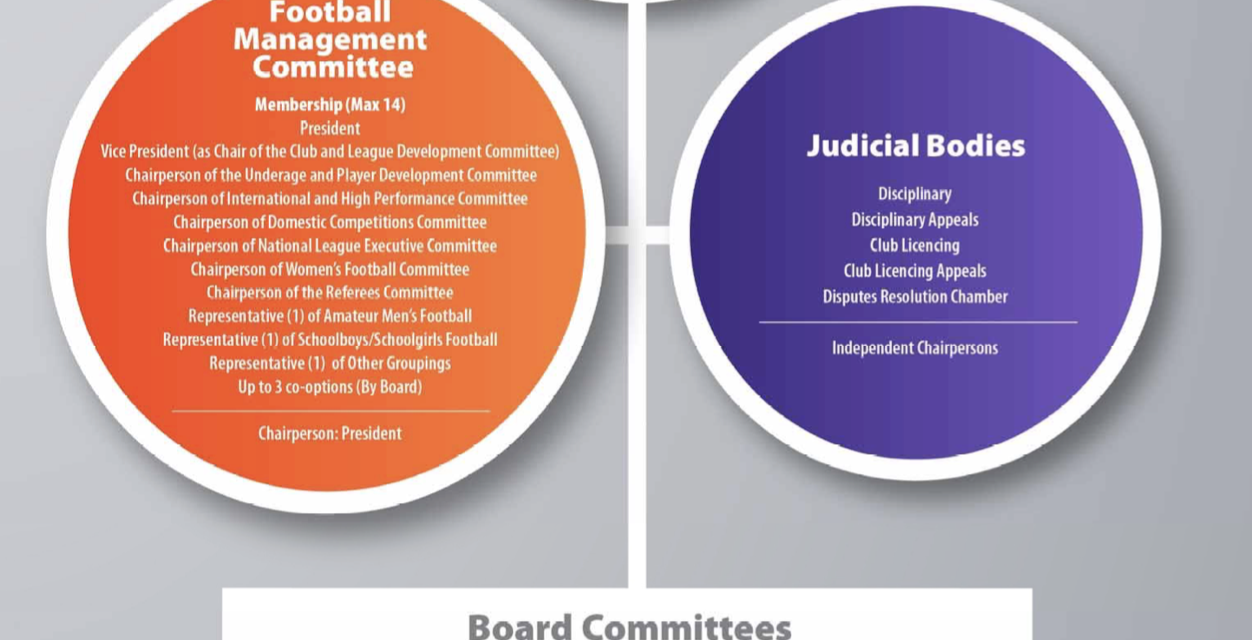
The recommendations include a streamlined Board of twelve, a minimum of four of which need to be from both genders and four of which are to be independent directors, sitting on top of a Football Management Committee that will become the main representative element of the new governance regime and five Judicial Bodies looking after licensing and disciplinary matters.
There will be three sets of Board Committees numbering 12 in total. The Chairs of the three national committees looking after the National League, Women’s Football and Referees will all sit on the Football Management Committee. So too will the chairs of the Football Committees charged with Underage and Player development, International and High performance, Domestic Competitions and Club and League Development.
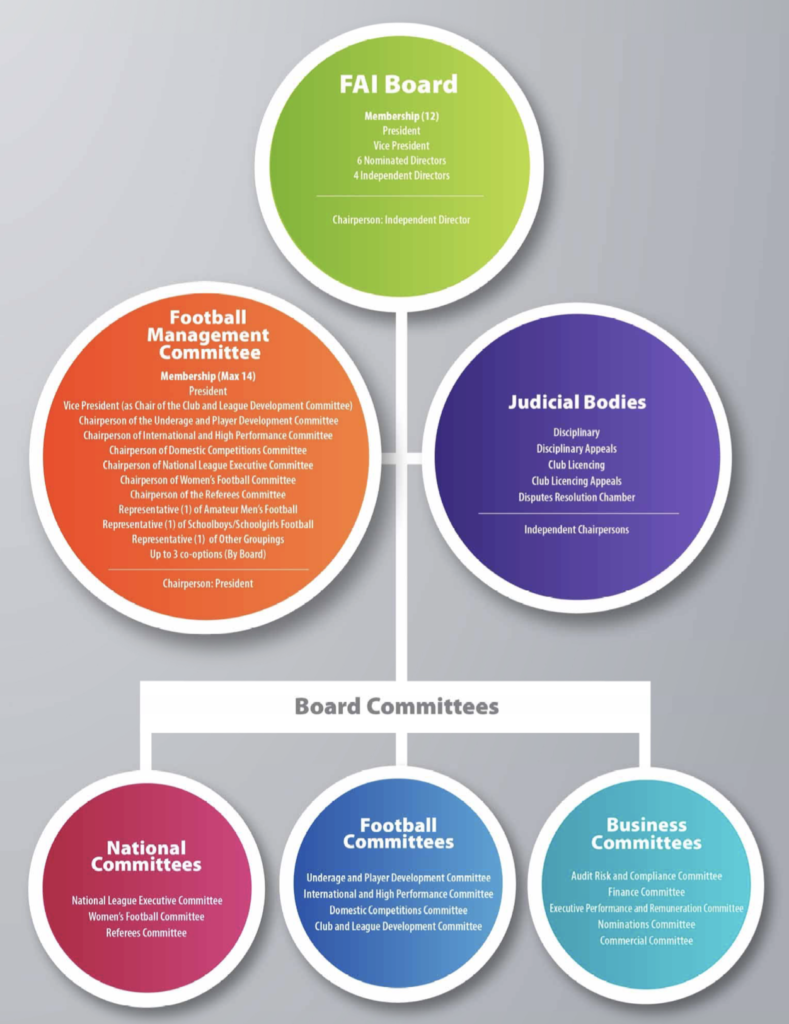
In terms of a structure on how to run a sport with 400,000 participants around the country, it is one that makes sense.
The problem lies in the fact that in order to create a new structure, no matter the level of common sense around it, you have to break up some of the ways in which it has been managed before.
Some of those who have had ‘power’ through a place on the board will lose that place. Others who are being given representation at Committee level have already suggested they want more. Whether some of this is posturing in order to seem tough within their own constituencies or whether they would be willing to reject the proposal will only become clear over the coming weeks.
Those who wish it to be adopted, to begin the process of re-establishing trust, and funding, from Government and Sport Ireland, will no doubt have a ‘House of Cards’ style war room established at FAI HQ in order to make sure that the majority of delegates is secured.
The final Appendix of the report usefully lists who the 206 delegates to the AGM in whose hands the report now lies are going to be.
92 come from Junior Men’s Football spread between the different Associations and Leagues. 43 represent Women’s Football at Adult and Underage level. Each of the 20 clubs in the SSE Airtricity League has a representative and there is one from the Women’s National League.
Schoolboys Football makes up 36, with a further four from each of Schools and Universities, two from the Defence Forces and three from Referees.
The Football for All programme which seeks to reach out to disability and disadvantaged groups, and is the one most likely to suffer from withheld government funding has one representative to the AGM.
Donal Conway said that he and the Board would be meeting with as many of the delegates face to face as they could.
There is unlikely to be much scope for negotiating anything special for any one group in order to secure a vote or a block of votes so the agenda of the future is there for all to see.
A part of the conversation will be the threat of what happens if the reforms are rejected. Suggestions that Government money will be gone through Sport Ireland but also potentially through Capital Grants will hold sway. The genuine threat that sponsors will exit if reforms are not seen to be in train will also have an impact.
Again it comes down to similarities with Brexit. Is there a better deal to be had on an individual basis that won’t upset the overall balance? Is there a way in which Government can be persuaded that change should be more gradual and more internal? Is there a way that UEFA and FIFA can be called on to allow football to sort out its own issues without being suggested what to do externally?
A serious study of those questions should return an acceptance of the need for a reboot on how the sport is governed.
This is a roadmap on how that should look over the next three years. There is nothing in it that would not be standard at most organisations. Some of the recommendations are to be introduced straight away, some pushed back over two to three years.
If it is not accepted, the implications are massive. That could go all the way up to FIFA deciding that Ireland is not operating in a manner that is acceptable to it and that it be removed from international competition.
There’s a lot on the line for the 206 pairs of hands in which the future now rests.



Image Credit: Inpho.ie