 On Thursday November 8th the Sport for Business Members’ round table programme will look at the issues surrounding broadcasting and sport. It is clearly an area that is of vital importance not only to the funding of sport but also to its appeal for commercial partners and its hold over the general public.
Ahead of the gathering of smart minds to look at the future we thought it would be good to look back at the history of sports broadcasting and present today six early milestones that show the central role which sport has played in the medium of our age.
1920 – The first live broadcast of a sporting event on radio allowed listeners to hear Jack Dempsey knock out Billy Miske in a heavyweight bout at Benton Harbour, Michigan. Over 11,000 saw the fight live but that was a fraction of the audience that heard it. This was the only fight in more than 100 that Miske was knocked out in.
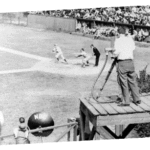
1939 – Television entered the scene with the broadcast of a college baseball game between Columbia and Princeton (pictured). NBC paid $3,000 for the right to experiment and they broadcast to 400 homes that were capable at the time of receiving the signal. It was done against a background reported in the New York Times Business section where dealers were giving up on sales of TV’s to an indifferent public and concentrating on radio sales instead. Princeton won the game 2-1 after 11 innings.
1948 – The first post war Olympic Games was held in London and was known as the austerity games. It was also the first to be televised, albeit only within the host nation. The Olympic Committee were pleased that the BBC were willing to take this step and it was only at the broadcaster’s insistence that a fee of 1,000 Guineas was paid over for the rights. The cheque was reportedly never cashed.
1955 – We live our life in colour but it was less than 60 years ago that the first sports broadcast in colour took place. Ironically enough it was in a sport where colour was less an issue than most, tennis. The occasion was a Davis Cup tie played on grass at Forest Hills in New York and Australia ran out convincing 5-0 winners over the US hosts with Lew Hoad and Ken Rosewall the stars of the winning team.
1962 – The first satellite television broadcast showed what the future was likely to hold with a speech of President John F Kennedy followed by highlights of a baseball game between the Philadelphia Phillies and the Chicago Cubs.
1966 – The most famous line of television commentary was uttered by BBC commentator Ken Wostenholme at the conclusion of the 1966 World Cup Final at Wembley. Geoff Hurst was making his way towards goal and the completion of his hat trick when Wostenholme said “Some people are on the pitch. They think it’s all over.” There was then a magical pause before Hurst crashed the ball into the roof of the net and the commentary was memorably completed with the words “It is now.”
[http://youtu.be/RPV6exMUmUs]
Tomorrow we will highlight another six milestones on the path to the sports broadcast world we know today.
View all the latest news on the commercial side of Irish sport
Find out more about how Sport for Business can be of benefit to you
Subscribe today for the free Sport for Business daily news digest
6 milestones in sports broadcasting