Welcome to the fifth article of The Sports Economy series.
The first edition of The Sports Economy series explained the basis of the official Irish economic statistics for measuring employment in the sports and recreation sector.
We found that there are different definitions of employment and discussed three sources of data, the Labour Force Survey, the Annual Services Inquiry and the Census – each with different data collection methodologies. We were able to make useful observations nonetheless such as for example that Irish sports employment growth outperformed total employment in the recent 2015 to 2018 period.
Eurostat, the statistical agency of the European Commission has recently published up to date (2019) sport employment statistics for each EU Member State according to a specific definition of sport…
‘Employment in sport includes sport-related occupations in the sports sector e.g. professional athletes, professional coaches in fitness centres, non-sport occupations in the sports sector, e.g. receptionists in fitness centres, and sport-related jobs outside the sports sector, e.g. school sport instructors’.
This is a broader coverage of direct ‘Sport’ employment than has hitherto been discussed and used in Ireland.
The Eurostat statistics facilitate an examination of trends over time and international comparisons on a consistent methodological basis.
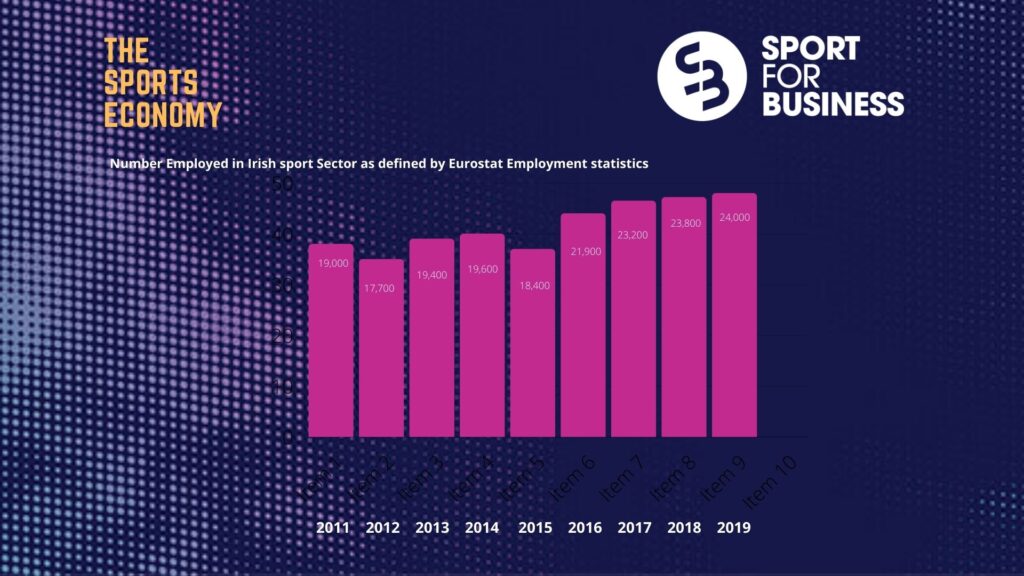
According to Eurostat figures Sport Employment in Ireland was 24,000 in 2019.
Irish sport employment has risen year on year from 2015 onwards.
The low point in numbers was 2012 at 17.7K jobs and there were large increases in 2013 and 2017.
The low point in numbers was 2012 at 17.7K jobs and there were large increases in 2013 and 2017.
Irish sport employment has oscillated relatively narrowly around 1% of total employment from 2011 to 2019. Indeed, if measured to one place of decimals the share range is 1% to 1.1%.
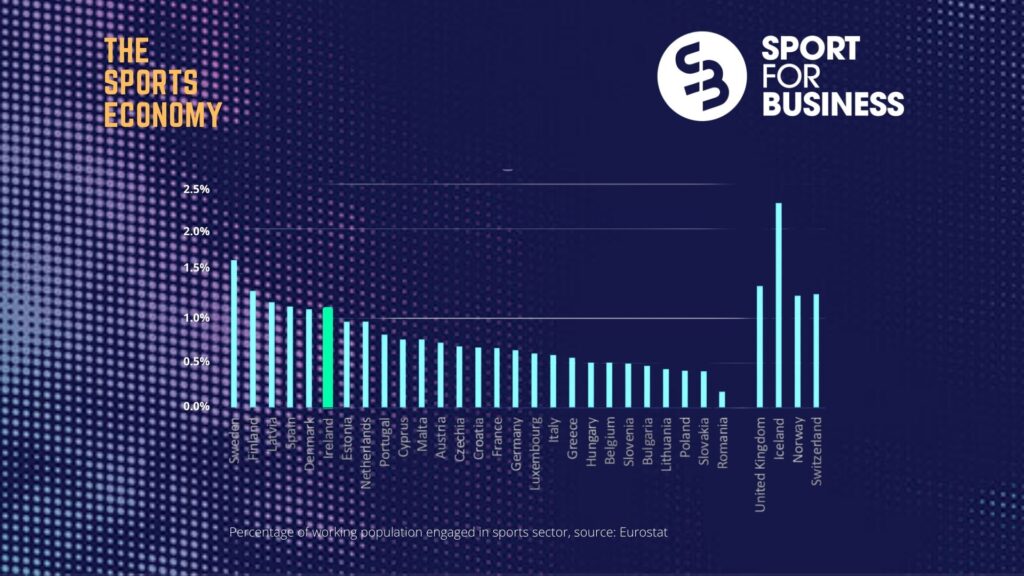
Comparative to EU peers, sport is a relatively high employer in Ireland at 1.1% of total employment.
In the league table of percentage shares, we ranked 6th of 27 EU countries in 2019. The EU average was 0.7%.
Four non-EU countries of UK, Iceland, Norway and Switzerland are shown for further context and all are significantly higher than the EU average.
For EU countries, in 2019 the sport employment shares ranged from 1.65% in Sweden to 0.18% in Romania. Looking further back, Sweden and Finland have been placed first and second for each of the past seven years (2013-2019).
Ireland has actually performed even better in the sample period. In other years Irish rankings were 3rd in 2017, 2016 & 2013, 4th in 2018 & 2011 and 5th (2015 & 2012).
In the last edition of the Sports Economy, we also showed that Ireland’s public expenditure on sport and recreation, as a percentage of total public expenditure, was the second-lowest in the EU.
Given the relatively low amount of public funding, it may appear surprising to see Ireland perform so strongly in terms of relative sport employment. Conversely, Bulgaria, the only country to have a lower proportion of expenditure on sport and recreation than Ireland in 2018, also rank toward the bottom for sport employment share of total employment.
The public sector is of course only one of several sources of sport finance. Other sources provide resources to support sport activities and sport employment and include sponsorship, participation fees, gate receipts, advertising and other sources of commercial and non-commercial income.
The absence of a strong correlation between public expenditure share and employment share may reflect the different roles of public support in overall financing as well as the different definitions of sport and recreation expenditure and sport employment.
Nonetheless, despite the multitude of other factors at play the figures presented above suggest that Ireland is reasonably efficient at turning a relatively low proportion of public funding for sport and recreation into a relatively high proportion of sport employment compared to EU peers.
This would also give significant hope that the increase in public funding announced in 2020 and the longer-term commitment to that as part of the National Sport Policy will have an even greater impact in this area of employment.
Another Way of Looking
In the following, ‘expenditure’ refers to ‘share of total public expenditure on sport and recreation’ and ‘employment’ is ‘share of total employment constituting sport on the Eurostat definition shown at the beginning of this article’. There are clear limitations in comparing two sets of numbers that do not carry the exact same definition of sport, and there is a definite need for a deeper analysis of the issue, but the insight gained from the following, very simple, exercise is valuable nonetheless.
Our basic calculation method is as follows,
- We have rankings for all 27 EU countries for both expenditure and employment. A reasonable initial expectation, ideally subject to deeper analysis, would be that a country should perform somewhat equally in both rankings.
- To identify if a country diverges, either positively or negatively, from the above assumption we can compare the two sets of rankings and calculate the differential between the two, i.e. our ‘divergence index’ is expenditure rank minus employment rank. For example, if a country ranked 1st in expenditure but 27th in employment this constitutes a score of -26, the worst score achievable. Conversely, a country that came 27th in spending but 1st in employment scores +26, the highest score achievable.
- We can then rank the scores of all 27 EU countries to understand the relative success of translating this element of finance into employment.
The Eurostat expenditure data runs from 2007 to 2018. For 2018, Ireland scores +22 as our ranking for public expenditure share is ‘26th’ and employment is ‘4th’. This differential score is the highest positive differential for all 27 EU countries for that year.
The above example compares 2018 expenditure with 2018 employment. In economics we often see a delay between an economic action and a consequence so it may be more robust to use lagged values of expenditure as a current year’s employment level might be more causally linked to previous levels of expenditure instead of the current year’s.
For this reason, I also compared 2019 employment for all 27 EU countries with three, five and seven-year lagged average levels of expenditure. For example, the 2019 level of employment for each country is compared to the average expenditure proportion for 2016-18, 2014-18 and 2012-18. In the resulting three comparative models Ireland scored ‘20’, ‘19’ and ’19’ respectively. In all three models the Irish scores were again the highest of all 27 countries and we, therefore, ranked in 1st in our simple ‘divergence index.’
At the other end of the scale, Hungary, which has a high proportion of public expenditure on sport (2.3% annual average for 2016-18, 1.8% average for 2014-18 and 1.5% for 2012-2018) ranked lowest of the 27 countries because employment levels in sport did not rank highly (20th of 27) despite the public expenditure outlay.
Summary
In summary, when looking at the historical data, we can see that sport constitutes a relatively important source of employment for Ireland versus EU peers and that Ireland’s sport employment performs better than predicted by the share of public expenditure going to sport and recreation.
We can also conclude that in the years leading up to Covid, Irish Sport employment increased significantly by 35.6% from 2012 to 2019. In the next edition of this series, I will take this discussion further and investigate the level of job loss within the sport sector because of the Covid pandemic.
 Conor Foley has a business degree from Trinity College Dublin, an MSc in finance from DCU and is a Chartered Financial Analyst. Over a 12-year professional career, Conor has experience of advising clients such as institutions, charities and bodies in the areas of global strategy, project management, asset allocation and financial structure. Conor will be working with Sport For Business to produce The Sport Economy, a regular piece, offering insights from the domestic and international sporting worlds of finance, economics and business, aims to bring Sport For Business members lessons and information from around the world to aid you in your strategy, financial affairs and business decisions. Conor has worked in leading financial institutions both at home and abroad and is committed to the growth and development of professional and amateur sport in Ireland.
Sport for Business Partners
[logo_carousel_pro id=”51608″]