 Latest figures released in Britain suggest that women remain very much underrepresented on the governing bodies of publicly funded sports. Only 26 out of 57 Boards surveyed meet the minimum expectation of 25% representation and six sports boards do not have any representation at all.
“We don’t want extra women on sports boards just to make things fairer,” said Sue Tibballs, Chief Executive of the Women’s Sport and Fitness Foundation, a public body set up to make a positive difference to women’s sport.
“The lack of diversity makes it harder for them to give elite sportswomen the support they need – as well as damaging participation at grassroots level. It is particularly shocking that after the Olympics and Paralympics, six sports boards still don’t have a single woman represented on them.
“The lack of representation of women on the UK’s sports boards is a real problem and means that sports are missing out on the benefits that diverse leadership teams can bring. It also makes it less likely that sporting bodies fully understand what it takes to unlock the potential of women’s sport in all aspects of their business including participation, sponsorship and media profile.
“2012 was an incredible year for women’s sport, and it is disheartening that this hasn’t been reflected in an increase in the number of women on sports boards.
“This is not an insurmountable challenge. We just need an extra 56 women to ensure every sport reaches the 25% minimum target. But we must also be clear that 25% is only a starting point, sports need to step up and commit to this agenda, and dramatically increase the gender diversity of their leadership teams across their organisation for the benefit of our elite sportswomen, the good of the grassroots and the health of our nation.”
The involvement of women at senior levels within Irish sport will be a key theme at The Business of Women’s Sport Conference taking place on Thursday June 20th, hosted by Sport for Business and UCD Smurfit Business School.
One positive for Ireland as we approach the conference is that representation on the Irish Sports Council is much better balanced than the survey reveals to be the case in Britain.
15 of 26 staff at the Sports Council are women and four of the eleven board members.
Frances Kavanagh, Susan Ahern, Ginny Elliott and Sheila O’Flanagan are the four who play a key role in managing the governance of the Sports Council in general but also ensuring diversity of leadership.
The Business of Women’s Sport will bring together 150 leaders from sport and business to question why less than 1% of commercial support for sport is directed towards Women’s sport and to explore the advantages of business getting involved at a time when internationally interest in women’s sport is rising rapidly.
We will have three key panels of business leaders, sports marketing experts, and sports participants to explore key issues; and break out sessions among the attendees to create the right level of energy in terms of building women’s sport to the level it should be, and doing so quickly.
There will be research into some of the factors why women’s sport has been a poor relation for too long and a number of new initiatives to inspire change that really will make a difference.
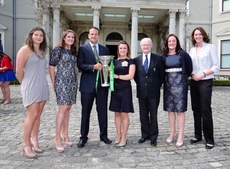
The potential of Women’s sport in Ireland was highlighted on Friday when the Government formally recognised the success of the Irish Women’s Rugby team and their Grand Slam success with a reception at Farmleigh.
The talk there from Minister Leo Varadkar and Captain Fiona Coghland was not of basking in the glow of a job well done but of this being the beginning; of World Cups and Olympics at one end of the scale and encouraging young girls to take up and stick at sport from an early age at the other.
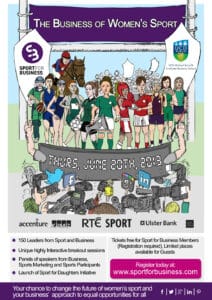 Attendance at The Business of Women’s Sport is free for full members of the Sport for Business Community and there is an early booking rate of €195 (plus VAT and Charges) for guests up to May 31st. To find out more click here or contact us today if you would like to be involved.
Women and Leadership in Sport