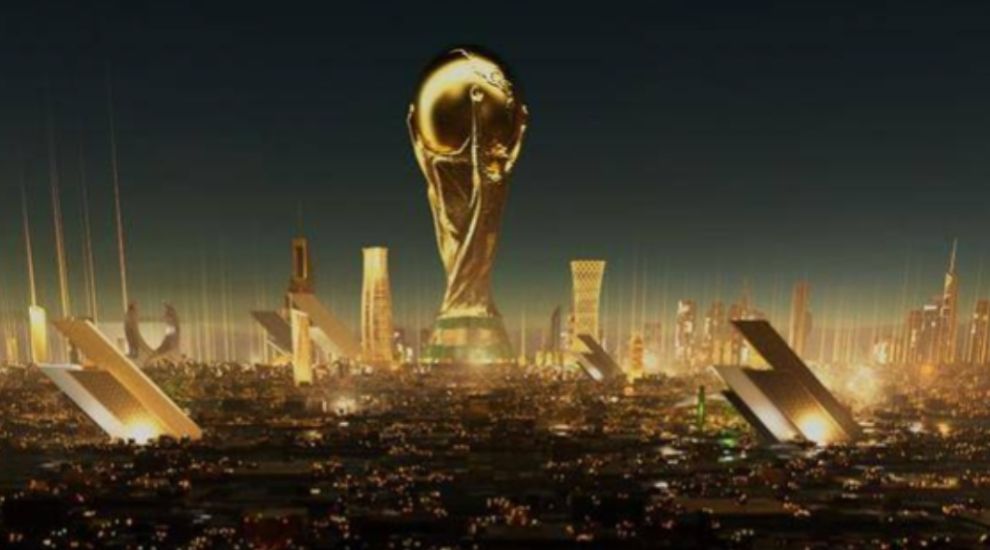
World Cup Finals are special. They are the one moment in our busy lives when it feels the whole world is united and focused on one patch of grass and the 22 players on it.
That is what FIFA will always tell us, and why football really is the world’s most popular sport.
It is far from always being perfect, or even close to it, but in those moments when M’Bappe tried to wrest the neutral’s dream result from Messi and Argentina; when the greatest player we have ever seen proved it again on the biggest stage; and when the final goal of a memorable tournament was scored to secure a degree of immortality, it was as close as sport gets.
Right to the end, this tournament reminded us that it was though about more than football, with Messi being cloaked in a traditional bisht or cloak, and clung to by Gianni Infantino as he moved towards the final act of a lengthy coronation.
It was of course in so many ways so different from the World Cups of our youth and our lifetime.
Christmas tree lights twinkling in the corner of your eye watching a penalty shoot-out to determine the Champions of the world, that was a first, and most likely last.
From Football To Change
How can we justify the $220 Billion spent on infrastructure and the hundreds or thousands of lives that were lost in the construction of a desert mirage?
Will there be any change to the laws and actions of a country that so few ever knew about before they were awarded the World Cup?
Well first if there are changes, they will come from the will of the people within that country. There is a greater chance that will happen as a result of being opened up to world scrutiny and comment like they could never have really imagined.
In eight of the countries taking part in the World Cup Finals, it is illegal to be gay. 23 percent of the World’s population lives under that same restriction, not just the three million citizens of Qatar.
It was much higher. It was only in 2018 that India decriminalised same sex relationships, in 1997 that China did and in 1993 that the Republic of Ireland did.
So in those vaunted days of our own sporting history, of 1988 in Stuttgart and in Italia ’90, it was illegal to be gay in Ireland.
The world changes but not in every place at the same pace and the hope has to be now that some of those changes of allowing greater individual choice will come about in Qatar and across the Middle East, as they did in Ireland less than 30 years ago.
The Condemnation of Others
There has never been a religion and a belief system that has been more misunderstood, mistrusted, and dismissed in our Western World than that of Islam.
The fear and loathing of Qatar was more about the Arab world than one state within it. Islam is a religion which is four hundred years younger than Christianity. It is called to account for elements we disagree with but our own history of the crusades, the inquisition and a lot closer to home the abuse scandals enabled by our own dominant faith are conveniently put in a different box.
Sportswashing has for a decade been an open factor within the awarding of rights to certain countries or regimes. It was defined in the Oxford English Dictionary only in 2018, but the power of sport as a distraction or a means to curry favour dates back to the games of the Ancient Greeks and the Roman Emperors reliance on bread and circuses to keep the masses distracted.
There are still no doubt those who argue that sport and politics should not mix but sport is so powerful an emotional, societal, community and economic force that it cannot be divorced from the way we organise our lives.
Culture Clashing
It is right that when the uncomfortable truths of different parts of the world culture clashing like we have seen in the build up and the tournament in Qatar, we should not look the other way.
But it is also right that we should not accept for sport to be treated to a higher or different standard to other areas of life.
We cannot condemn the middle east because it hosts sporting events but still accept that without its oil resources, we would be paying many multiple times more for our energy.
And in four years time we cannot similarly condemn the United States for gun crime and reproductive rights restrictions but at the same time sing along to Disney classics.
Everything is connected and change can never be the responsibility of one area of our life.
It is impossible to tell how history will treat this tournament, whether it will bring about greater respect for human rights over money, or whether like Russia in 2018, Argentina in 1978 or many more that we will always turn our morality spotlight to the next event and move on.
For the Argentinians dancing in the streets of Buenos Aires, for the children around the world witnessing their first World Cup Final and for Lionel Messi and his teammates, this was a World Cup in football tems that will be remembered across generations.
Sometimes joy itself can be the spark for change. Perhaps that is all we can hope for or take from the last month in Qatar