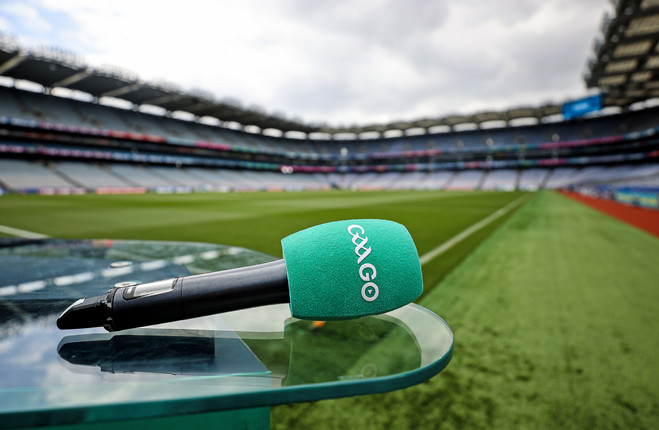
It is reported in today’s Irish Examiner that the Competition and Consumer Protection Commission is investigating the expansion of GAAGo to provide domestic as well as international pay-per-view broadcast of Gaelic Games, as emerged at Wednesday’s Oireachtas Committee meeting into the future of sports broadcasting.
The Joint venture between rights holder and media has been approved back in 2017 and was advised of the substantial changes during Covid that led to it broadcasting games in Ireland, a development which then hastened it becoming the secondary rights holder in the domestic market for the current cycle of media rights that commenced this season.
The Commission said in a statement to the Irish Examiner that “Earlier this summer the CCPC opened an enquiry into GAAGO when it became apparent that the activities of the joint venture may have been extended beyond those notified to and cleared by the CCPC in 2017. The CCPC has pro-actively engaged with the GAA and RTÉ on this matter.”
The remit of the CCPC is to ensure that consumers do not have their rights to a competitive market infringed by the dominance of one particular group.
On Sport for Business we wrote yesterday that “We do not know if there has been any form of complaint made about the extended number of live games now being made available to GAA viewers, or whether the paywall of GAAGo is seen as in some way more odious than that of Sky Sports or eir Sport that have shown games for over a decade.”
That is a fair reflection on whether this could be seen as negative in terms of consumer choice.
The last time that games were broadcast free to air in their entirety from the Championship was in 2013.
TV3 (now Virgin Media) had been the secondary broadcaster for six years before losing out to Sky Sports.
Setanta Sports (subsequently eir sport) had been broadcasting games from the Allianz League, behind a paywall, since 2005 so the GAA has been in the middle of the changes that have shaken up sports broadcasting for nearly two decades.
The CCPC has the right to stop a service but that seems highly unlikely as the number of games being shown under the current rights deal is substantially higher than had been the case. 42 games have been streamed as opposed to 14 under the Sky Sports deal. Consumer choice has therefore increased.
It also has the right to impose conditions and while the GAA Director General was very clear about the independence of the Central Competition Control Committee that decides which games are played when and therefore which games fit into the RTÉ and the GAAGo package of rights, it may seek some greater clarity on this division of games.
Of course, there will never be a perfect answer. Kerry fans and elected representatives were upset this year about Kerry only appearing once on free-to-air, next year it might be another county. Generally, the greatest upset is after a game has proven to be an ultra-competitive and exciting contest. If everyone knew which games would be the best entertainment in advance, then that would be more of a Netflix series than real sport, and the squeezing of a lot of high-profile games into a shorter window, to allow for a far greater number of important games featuring 95 percent of the playing population at club level to be given space, is inevitably going to mean choices have to be made.
This should not be seen as an existential threat to GAAGo. It is in an enviable position to expand its proven expertise and systems to other sports and other jurisdictions, as it has already done through URC.TV and LOI.TV.
When the English Premier League makes the inevitable switch to individual match payments and its own broadcast service, GAAGo, an idea hatched eight years ago to serve the Irish diaspora, will be taking a look at the tender documents and seeing itself as a live contender to be part of that solution.
The GAA is no more responsible for patchy broadband in rural areas or for technical literacy among an older cohort of the population than its naysayers are responsible and able to roll back the advances of technology and the changes in the way the broadcast of sports has developed.
That is a change that goes all the way back to the first live radio broadcast of sport by Marconi himself from New York Harbour with the 1899 America’s Cup sailing contest. From radio to TV, colour to streaming, the world changes, and the choice available to fans is expanded.
We cannot see a way in which a consumer protection body would want to stand in the way of that.