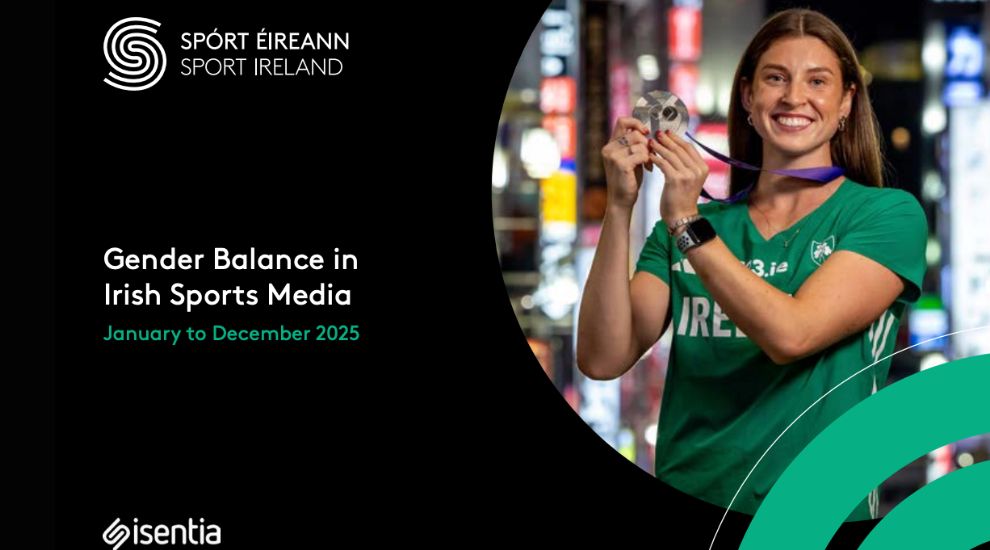

Sport Ireland has published the most comprehensive study to date on gender balance in Irish sports media coverage, revealing that women’s sport continues to receive a significantly smaller share of national coverage.
The research, conducted in partnership with media intelligence and data technology company Isentia, analysed sports news output across 2025 and forms part of Sport Ireland’s work under the visibility pillar of its Women in Sport Policy.
Among the key findings, the report shows that just 18 per cent of all Irish national sports news coverage focused on women’s sport during the period analysed.
This may appear low but it could be a touch overstated based on occasional snapshot research conducted by Sport for Business. On one Saturday in February of this year, one of Ireland’s principal ‘legacy’ newspapers published a 20 page weekend sports supplement with the only reference to Women being a sidebar story on Gaelic Games integration.
We will publish another snapshot look later this month to keep the pressure on media publishers to do things right. Our snapshot does not however, have the breadth of this research and it’s wider look at media is to be applauded.
The study also found that 75 per cent of all national sports news coverage concentrated on just five sports, highlighting the dominance of a small number of codes within Irish sports media.
In radio programming, 22 per cent of sports coverage focused on women’s sport, indicating slightly stronger representation compared to overall news coverage, though still significantly below parity.
Patrick O’Donovan, Minister for Communications, Culture and Sport, said the research provided important insight into the visibility of women’s sport.
“This is an especially important piece of research and it’s great to have it out during Women in Sport Week,” he said.
“Our female sportspeople continue to achieve wonderful things, both nationally and on the world stage. There’s lots there to report on and celebrate. More must be done to bring all these remarkable stories to greater prominence. The Government, as it has done before, will continue to champion women’s sport.”
Charlie McConalogue, Minister of State with responsibility for Sport and Postal Policy, said addressing the imbalance would require a broader cultural shift.
“Women’s sport continues to receive far less coverage than men’s, despite exceptional performances and achievements at home and abroad,” he said.
“Achieving genuine gender balance in sports media will require a system-wide approach tackling deeply ingrained and outdated perceptions. The idea that women’s sports lack viewership is often used to justify low coverage, when studies show that promoted properly they can attract significant audiences.”
The report found that women’s sport coverage reached its highest level in August, coinciding with major events including the opening of the Rugby World Cup and the finals of the All-Ireland Camogie Championship and All-Ireland Ladies Football Championship.
Sport Ireland Chair John Foley said the findings illustrated the continuing visibility gap faced by female athletes.
“The figures tell a story that no one in Irish Sport can ignore,” he said.
“They show us how far the gap still is between the visibility our women athletes receive and the value they bring to Irish sport. We’re all aware of the great triumphs enjoyed by Irish sportswomen recently, but success is only one part of the story. Visibility is the other.”
Sport Ireland CEO Úna May highlighted the role of media organisations in helping to drive change.
“The media is crucial in creating the conditions for balanced coverage,” she said.
“At Sport Ireland we’d like to acknowledge the many positive steps they’ve taken so far. It’s also a suitable time to call for a renewed commitment to build on these findings and aspire to global leadership in gender-balanced coverage.”
The research also examined the most visible athletes and teams in Irish sports media during the year.
Among the 20 most visible athletes, three were women — Kate O’Connor, Sarah Healy and Leona Maguire — while two women’s national teams, the Ireland women’s rugby union team and the Republic of Ireland women’s national football team, featured among the 20 most visible teams.
Across radio sports programming, football remained the most covered sport, reflecting its deep-rooted place within Irish sporting culture and its influence on media visibility. It would be interesting though to break out how much of this coverage was devoted to the English Premier League.
Consistent with the wider news analysis, football, rugby union and Gaelic football were the most frequently covered sports on radio, accounting for 56.4 per cent of all analysed stories.
Nora Stapleton, Director of Strategic National Governing Body Programmes and Women in Sport Lead at Sport Ireland, said the findings offered a clear evidence base for future action.
“These findings can support a clear direction for action,” she said.
“Sport and media organisations can work together to increase the visibility of women’s sport. While media companies play a crucial role, Sport Ireland recognises that achieving genuine gender balance in sports media requires a system-wide approach.”
“Everyone from Government to National Governing Bodies, coaches, managers, venues, event promoters and the public can all have a part to play in creating the conditions for balanced coverage.”
Image Credit: Sport Ireland
ABOUT SPORT FOR BUSINESS
Sport for Business is Ireland’s leading platform focused on the commercial, strategic and societal impact of sport. It connects decision-makers across governing bodies, clubs, brands, agencies and public institutions through high-quality content, events and insight. Sport for Business explores how sport drives economic value, participation, inclusion and national identity, and how your story can be part of ours.
Through analysis, storytelling and convening the sector, it helps leaders understand trends, share best practice and make better-informed decisions. Its work positions sport not just as entertainment, but as a vital contributor to Ireland’s social and economic fabric.
Find out more about becoming a member today.
Or sign up for our twice-daily bulletins to get a flavour of the material we cover.
Sign up for our News Bulletins here.
Upcoming Events