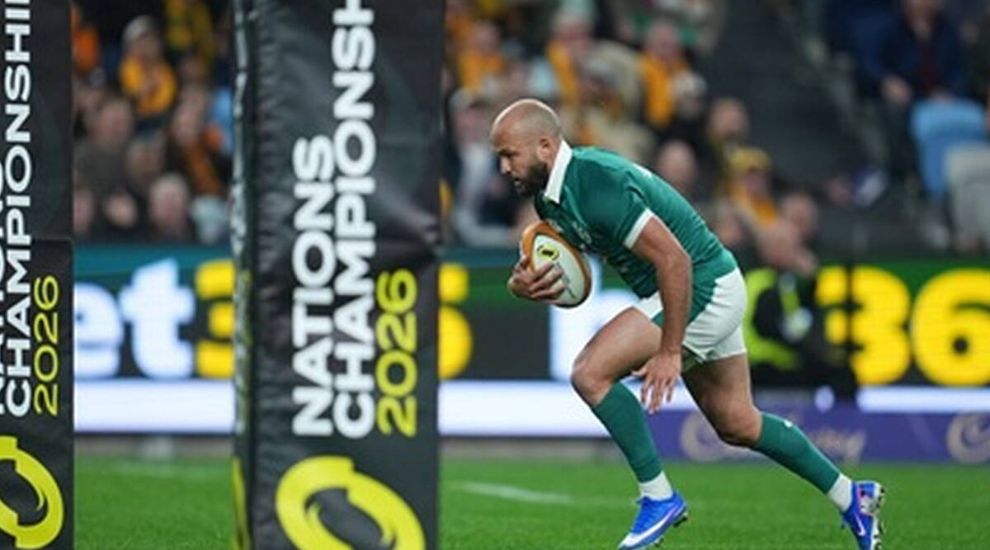
The sport was compelling, and the result for Ireland was a winner, but the most striking commercial image from the opening weekend of rugby’s new Nations Championship was not a logo, a launch film or a title sponsor activation. It was the lack of one.
Qatar Airways had been expected to be unveiled as the title sponsor of the new competition, in what has been widely reported as an £80 million deal. Instead, the competition began without that naming-rights partner in place, with reports indicating that the airline remains committed in principle but that contracts have not yet been signed. The reason given is not rugby, but geopolitics, with senior figures in Qatar understood to have judged that this was not the right moment to launch a major global sports sponsorship amid continuing instability in the Middle East.
So this does not appear to be, at least for now, a sponsor walking away from the tournament’s value. It looks more like a sponsor pausing the optics of celebration.
Even so, the delay is awkward. The Nations Championship has been positioned as one of the most important structural changes in rugby for a generation: a new biennial competition bringing together the Six Nations sides with the SANZAAR nations, Japan and Fiji across July and November windows, before a Finals Weekend to decide the champion and the balance of power between hemispheres. The competition’s own public pitch is clear: “Where Hemispheres Collide,” twelve of the biggest rugby nations, and a format designed to make every result matter.
Noticable Absence
For a new tournament, the first weekend is not only a sporting launch. It is a brand launch. That is why the absence of a title sponsor is noticeable. The first broadcast graphics, the first media cut-through, the first ticketing campaigns and the first social moments are normally when naming rights begin to bed in. Instead, rugby has launched the property first and must now add the commercial crown later.
The contrast with Qatar Airways’ support of the FIFA World Cup could hardly be sharper. In football, the airline has been anything but quiet. Qatar Airways renewed its FIFA partnership through to 2030 as FIFA’s Global Airline Partner, covering the FIFA World Cup 2026, FIFA Women’s World Cup 2027 and FIFA World Cup 2030. It has also launched FIFA World Cup 2026 travel packages including flights, hotels, transfers and match tickets, putting the sponsorship directly into the customer journey.
More recently, the airline unveiled a special-livery aircraft for the FIFA World Cup 2026, featuring exterior branding and cabin dressing designed around the tournament. That is not a sponsor hiding in the background. It is a sponsor turning the aircraft itself into a moving billboard.
That tells us something important. Qatar Airways is not retreating from sport. It is not retreating from major global rights. Nor is it shy about using sport to sell destinations, travel and premium experience. The FIFA relationship is open, loud and integrated. The rugby relationship, by comparison, is presently invisible.
There are two ways to read that.
The optimistic reading is that the Nations Championship has secured the right partner, but at the wrong geopolitical moment. On that basis, the next likely window is November, when the competition moves into its northern hemisphere phase and toward Finals Weekend. Reports suggest that November is now the most likely time for Qatar Airways branding to appear, with the wider arrangement expected to run until 2032 and include hosting rights for Qatar at future finals.
The more cautious reading is that unsigned contracts remain unsigned. Until the deal is formalised, rugby does not have the full security of the money, the brand association or the long-term destination partnership. That does not mean the tournament is financially weak, but it does mean that one of its most valuable commercial pillars is not yet in place.
Financially Solid
The immediate financial position still appears solid, and this is where the support of ITV in the UK and Virgin Media here in Ireland matters. ITV has positioned the Nations Championship as a major free-to-air property in the UK, bringing the tournament to ITV and ITVX across 42 matches and seven weekends. ITV’s own commercial messaging presents the competition as a platform for “major sponsorship opportunities” as well as a new international rugby property capable of creating appointment-to-view moments.
In Ireland, Virgin Media Television adds another important layer of security and visibility to the tournament. Virgin Media is the exclusive free-to-air home of the Nations Championship in Ireland and has committed to showing all 42 fixtures from each edition of the tournament in 2026 and 2028. That includes Ireland’s July away fixtures, November home fixtures at the Aviva Stadium, and Finals Weekend in London.
That is not a minor detail. Between ITV in the UK and Virgin Media in Ireland, the competition has strong free-to-air backing in two of rugby’s most valuable broadcast markets. It means the new tournament is not being launched as a niche pay-TV product. It will be visible, accessible and commercially legible to mass audiences from the start.
This softens the immediate impact of the Qatar Airways delay. Matches can be played, broadcasters can sell advertising, fans can buy tickets, and unions can bank the wider benefits of a more structured international calendar. The Guardian has reported that the competition has been underwritten by media rights deals with 80 global broadcasters, reducing the likelihood of immediate financial difficulties in the absence of a title sponsor.
But there is a difference between being financially functional and being commercially complete.
A title sponsor of Qatar Airways’ scale would have added validation. It would have told the market that this was not simply a rebranded set of July and November Tests, but a genuine global tournament with premium international backing. It would also have created an obvious bridge between rugby, travel, destination hosting, hospitality and elite international sport.
That is why the delay is reputationally awkward, even if it is not yet financially damaging. Rugby can point to ITV, Virgin Media, TF1 and other broadcast partners as proof that the tournament has a real platform. It can point to sold inventory, fixture certainty, and the competitive appeal of the north versus the south. But it cannot yet point to the one commercial partner whose brand was expected to sit over the door.
Next Steps
The next measures are therefore clear. First, the organisers need to secure the Qatar Airways contract, sign it, and announce it, ideally well before the November matches rather than on their eve.
Second, they need to integrate the sponsor quickly into the product: broadcast graphics, stadium branding, digital content, travel packages, hospitality, and Finals Weekend storytelling.
Third, they need to clarify the longer-term picture for finals hosting, because destination certainty is part of the commercial proposition.
Fourth, they need to use the July window to produce hard audience data for the rest of the market.
That last point may prove decisive. If ITV and Virgin Media deliver strong audiences, if Ireland’s fixtures carry momentum, and if the wider tournament produces compelling rugby, the title sponsor delay may soon look like a timing issue rather than a structural weakness. The property’s value will be easier to defend if the first wave of broadcast numbers shows that supporters have bought into the idea.
If the pause drifts, however, the questions will become sharper. An £80 million title sponsorship is not cosmetic. It is part of the competition’s value architecture. Losing it, reducing it, or allowing it to remain unresolved into the November window would cast a commercial cloud over a tournament trying to establish itself as the new centrepiece of the global rugby calendar.
For now, the best judgment is that the delay remains reputationally awkward but not commercially fatal. Qatar Airways’ very visible support of FIFA shows that the airline still believes in global sport as a marketing platform. ITV and Virgin Media show that rugby’s new tournament has a strong free-to-air base to build on.
The Nations Championship has launched. Its next commercial task is to ensure the sponsor who was not there at the start is unmistakably present by the time the title is decided.
 The IRFU is a full member of Sport for Business.
If you would like to be part of the Sport for Business community and see your organisation in our content, on our stages, and in the conversation happening every day around the commercial world of Irish Sport, email us today and let’s see what is possible.
Image Credit: Virgin Media
ABOUT SPORT FOR BUSINESS
Sport for Business is Ireland’s leading platform focused on the commercial, strategic and societal impact of sport. It connects decision-makers across governing bodies, clubs, brands, agencies, and public institutions through high-quality content, events, and insights.
Sport for Business explores how sport drives economic value, participation, inclusion and national identity, and how your story can be part of ours.
Through analysis, storytelling and convening the sector, it helps leaders understand trends, share best practices, and make better-informed decisions. It positions sport not just as entertainment but as a vital contributor to Ireland’s social and economic fabric.
Find out more about becoming a member today.
Or sign up for our Daily Sport for Business Snapshot email bulletins to get a flavour of the material we cover.
Sign up for our News Bulletins here.