Ireland completed another outstanding World Rowing Championships in Amsterdam yesterday, returning from the Bosbaan with three medals – one gold and two silver – and further evidence that the country’s High Performance rowing programme remains firmly established among the strongest in the world.
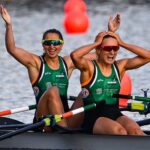
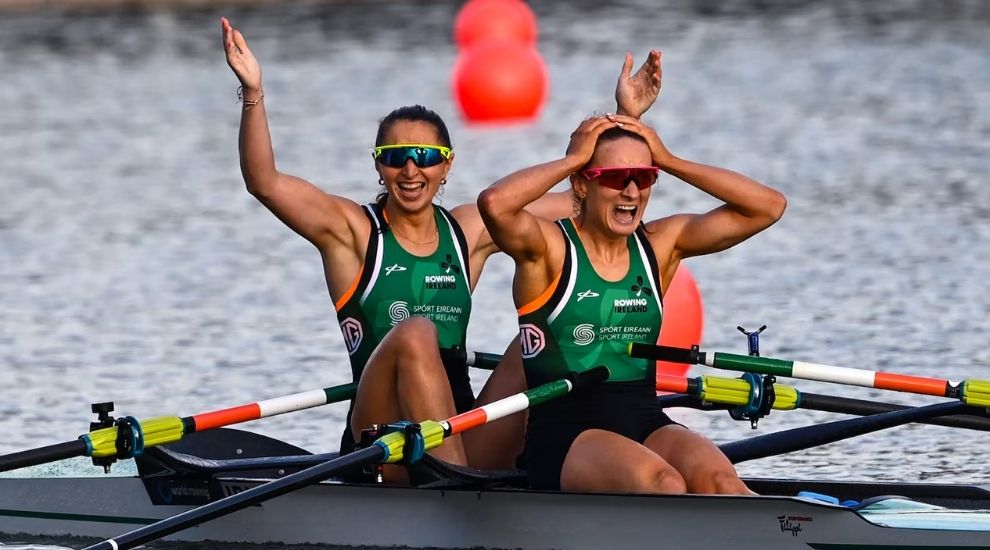
Mags Cremen was at the heart of an extraordinary weekend, winning World Championship gold alongside Zoë Hyde in the Women’s Double Sculls on Friday before returning to the podium on Sunday with Konan Pazzaia to claim silver in the Mixed Double Sculls.
Fiona Murtagh completed the medal haul with a superb silver in the Women’s Single Sculls, surrendering the world title she won in 2025 but finishing ahead of reigning Olympic champion Karolien Florijn in one of the strongest fields of the Championships.
Ireland had travelled to Amsterdam with 24 athletes across nine boats and with Rowing Ireland stressing beforehand that medals were not the only measure of success.
With qualification for the Los Angeles Olympic Games beginning at the 2027 World Championships in Lucerne, Amsterdam was positioned as an important opportunity to test new crews and establish where Ireland sits internationally.
Three medals, including a world title, represent an emphatic answer.
Cremen and Hyde Strike Gold
The highlight came on Friday when Cremen and Hyde produced a thrilling victory in the Women’s Double Sculls.
The Irish crew had signalled their form earlier in the week, winning both their heat and semi-final, the latter in 7:09.17, almost three seconds ahead of Italy.
The final was another matter.
Racing against a strong Dutch combination on home water, Cremen and Hyde remained in contention as the Netherlands established the advantage. Ireland was still behind entering the closing stages but produced a brilliant late charge to overhaul the Dutch and take the World Championship title.
It was a significant step forward for a combination that had taken bronze at the opening World Cup event of the season in Seville and finished fourth at World Cup III in Lucerne.
Both athletes had previously won World Championship bronze medals in different combinations in 2022, but Amsterdam delivered a first senior World Championship gold for the partnership.
For Ireland, it was another reminder of the depth that has developed within a programme capable of evolving crews while continuing to deliver medals at the highest level.
Murtagh Digs Deep for Silver
There was more to come on Sunday.
Fiona Murtagh arrived in Amsterdam as defending World Champion in the Women’s Single Sculls and faced a formidable final containing Britain’s European champion Lauren Henry and Dutch Olympic champion Karolien Florijn.
Murtagh did not get the start she would have wanted and was sixth through the opening 500 metres.
From there, however, she began working her way back into contention.
Henry moved clear to win in 7:15.93, but the battle for silver developed into a superb contest between Murtagh and Florijn.
The Irish rower produced a powerful final quarter to close down the Dutch Olympic champion and crossed in 7:18.04, 0.80 seconds ahead of Florijn.
It continued a remarkably consistent season for Murtagh, who had already won bronze at World Cup I in Seville and silver at World Cup III in Lucerne.
To follow a World Championship title with silver twelve months later is a significant achievement, particularly given the calibre of opposition now assembling for the event as the LA 2028 cycle begins to gain momentum.
Cremen Back on the Podium
Less than an hour after Murtagh’s medal, Cremen was back racing for another.
This time she partnered Konan Pazzaia in the Mixed Double Sculls, an event Ireland had won in 2025 through Cremen and Fintan McCarthy.
Cremen and Pazzaia attacked the final from the outset and remained in the medal positions as the Netherlands pairing of Roos de Jong and Simon van Dorp established themselves at the front.
The Dutch ultimately won in 6:15.80, but Ireland had to withstand a serious late challenge from the United States for silver.
Cremen and Pazzaia lifted their rate to 44 strokes per minute in the closing stages and held on, finishing in 6:22.34.
It gave Cremen the remarkable personal return of two medals from two World Championship finals – gold with Hyde and silver with Pazzaia.
McCarthy Takes on a New Challenge
There was also considerable interest around Fintan McCarthy’s first World Championships campaign as an openweight single sculler.
The double Olympic champion has moved into very different territory following the removal of lightweight rowing from the Olympic programme.
He came agonisingly close to reaching the A Final, finishing fourth in his semi-final, before taking fifth in Sunday’s B Final in 6:46.07.
That placed him 11th overall in the world in his first season competing internationally in the openweight single.
Building Towards Los Angeles
Ireland’s wider team contained a deliberate mixture of established internationals and developing combinations.
Imogen Magner and Natalie Long raced in the Women’s Pair, Ross Corrigan and Nathan Timoney in the Men’s Pair, while Ireland was also represented in the Men’s and Women’s Fours and Quadruple Sculls.
Rowing Ireland had been explicit before racing began that Amsterdam was about more than medals.
Nine crews were selected as part of an examination of Ireland’s options ahead of 2027, when the World Championships in Lucerne will begin the qualification process for Los Angeles 2028.
That makes the medal return particularly encouraging.
Ireland leaves Amsterdam with a World Championship-winning Women’s Double, a Women’s Single Sculler who has now won gold and silver at successive World Championships, and another medal in the developing Mixed Double discipline.
It also leaves McCarthy established in the openweight single and with a much broader group of athletes who have experienced World Championship racing.
Sport for Business Perspective
The challenge for any successful High Performance system is moving from a golden generation to sustainable excellence.
Amsterdam offered encouraging evidence that Ireland is doing precisely that.
Cremen and Hyde’s gold was achieved by a combination still developing at international level. Murtagh demonstrated that she remains among the world’s elite single scullers. Pazzaia stepped from the Men’s Quad into a World Championship medal-winning mixed combination, while McCarthy has embraced the challenge of effectively starting again in one of rowing’s toughest disciplines.
There is also a broader value to Irish sport.
Rowing has become one of Ireland’s most reliable international medal sports while retaining a strong connection between clubs, athletes and the national High Performance system. Every World and Olympic medal strengthens the sport’s profile, creates new heroes, and provides additional value for the public and for the commercial investment supporting the programme.
The 2026 World Championships were never the ultimate destination. The more consequential test comes in Lucerne next year when Olympic qualification is on the line, followed ultimately by Los Angeles in 2028.
But three medals from Amsterdam – gold for Zoë Hyde and Mags Cremen, silver for Fiona Murtagh and Cremen and Konan Pazzaia – represent a very strong staging post on that journey.
Ireland went to Amsterdam to find out where its High Performance programme stood.
It came home with three World Championship medals and plenty of reasons to be confident about where it is heading.
 Rowing Ireland are full members of Sport for Business. AIB are partners of our Gaelic Games coverage.
If you would like to be part of the Sport for Business community and see your organisation in our content, on our stages, and in the conversation happening every day around the commercial world of Irish Sport, email us today and let’s see what is possible.
Image Credit: Rowing Ireland

ABOUT SPORT FOR BUSINESS
Sport for Business is Ireland’s leading platform focused on the commercial, strategic and societal impact of sport. It connects decision-makers across governing bodies, clubs, brands, agencies, and public institutions through high-quality content, events, and insights.
Sport for Business explores how sport drives economic value, participation, inclusion and national identity, and how your story can be part of ours.
Through analysis, storytelling and convening the sector, it helps leaders understand trends, share best practices, and make better-informed decisions. It positions sport not just as entertainment but as a vital contributor to Ireland’s social and economic fabric.
Find out more about becoming a member today.
Or sign up for our Daily Sport for Business Snapshot email bulletins to get a flavour of the material we cover.
Sign up for our News Bulletins here.