Children and Sport Conference Puts Young Voices Centre Stage
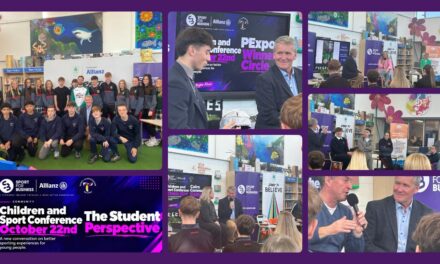
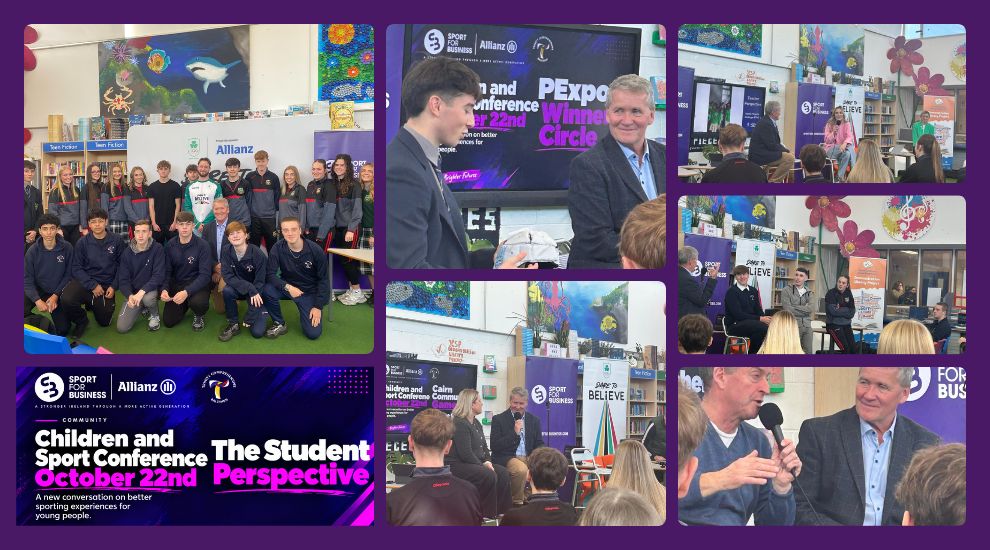
The third Sport for Business Children and Sport Conference, supported by Allianz, took place at Trinity Comprehensive School in Ballymun on Thursday morning, bringing together students, teachers, sports organisations, Olympians and leaders from across Irish sport to consider one central question: how can we make sport work better for children and young people?
Holding the conference in a school, rather than a traditional conference venue, changed the dynamic from the outset.
Students were not simply the subject of the conversation. They were in the room, on stage and part of it.
That was deliberate, and we have been building towards it.
Too often, adults design programmes for young people in meeting rooms, then present them to children as a finished product. The morning in Ballymun was meant to turn that around: to listen to teachers, to those delivering sport and physical education, but above all to young people themselves about what keeps them involved, what pushes them away, and what they would change.
PE Has Changed – But There Is More to Do
Dr Frances Murphy, recently retired Associate Professor at DCU Institute of Education and one of the country’s leading voices on physical education, opened the morning by looking at the past, present and future of PE in Irish schools.
Her core argument was that school remains the one place that can reach every child.
Sports clubs do remarkable work, but participation outside school depends on factors including geography, family circumstances, finance, transport and the confidence to walk through a club’s door. PE in school does not have the same entry requirements.
Murphy stressed that the purpose of PE has broadened considerably. It is no longer simply about fitness or finding the children who are already good at games. Quality PE should develop physical skills, confidence, and social connection while exposing children to enough different activities that they have a realistic chance to discover something they enjoy.
She also sounded a note of caution around sporting organisations entering schools. Their expertise can be invaluable, but the best model is one in which coaches support teachers rather than replace them.
Murphy warned that more time alone does not guarantee better outcomes.
Quality, teacher confidence, and appropriate training remain critical.
She called for greater support for teachers during their undergraduate education and afterwards, stronger attention to PE lessons within education policy, and greater recognition by parents of the value of physical education.
One simple question captured the point: how often does a parent ask, “How is my child doing in PE?” at a parent-teacher meeting?
She argued that responsibility is shared among education, teachers, parents, and sporting organisations, although the Department of Education inevitably carries overarching responsibility for PE as a school subject. Perhaps next year’s Conference target will be to have the Department in the room as well.
Open the Doors and Make Things Easier
Few people embody the “just make it happen” philosophy more enthusiastically than Trinity Comprehensive PE teacher and PE Expo driving force Paddy O’Reilly.
Trinity was one of the early adopters of examination PE, and O’Reilly believes the introduction and development of Leaving Certificate PE has transformed the subject’s standing in schools.
His challenge to Irish sport was also practical.
Schools want their students to participate, but overlapping sports calendars can create significant disruption. Greater coordination between National Governing Bodies would make it easier for schools to support multiple teams and activities without repeatedly pulling the same students from class.
The wider discussion moved to another issue which Sport for Business has highlighted over many years: opening school facilities to communities outside school hours.
Across Ireland, sports halls, gyms, pitches, and other facilities are heavily used during the school day but underused in evenings, weekends, and holidays, while nearby sports clubs struggle to find places to train.
O’Reilly argued for removing unnecessary complexity and creating incentives for schools willing to become genuine community sporting hubs.
The experience in Dún Laoghaire-Rathdown, where local authority investment has created shared school and community facilities, was cited as evidence that communities can create practical solutions locally without waiting for an enormous national programme.
The principle is straightforward: use what we already have better.
What Young People Actually Want
The students’ voices mattered most in the morning.
Jamie, Kyle and Emily spoke about football, Gaelic games, rugby and their wider experiences of sport.
Again and again, one word emerged: friends.
Competition mattered. Improvement mattered. Playing on good teams mattered. But participants repeatedly identified the relationships sport created as one of the strongest reasons for staying involved.
The discussion also exposed a structural problem Irish sport continues to create for teenagers.
Young athletes are often encouraged to play several sports at a young age, only to face scheduling clashes and rising demands as they enter their mid-teens. Training requirements grow, matches clash, and participation becomes more serious.
Eventually, they are told to choose.
Jamie described wanting to continue playing both Gaelic football and soccer but finding that the commitment required at a higher level effectively forced a decision.
The challenge for sport is whether pathways can become flexible enough to let young people enjoy more than one activity for longer.
Students also made it clear that coaches should ask them what they enjoy.
Sessions don’t always need to get easier, but they should stay engaging. Game-based training, variety, and simply asking players for their views can have a huge impact on whether they want to come back next week.
Perhaps most importantly, young people spoke about the difficulty of stepping back once sport becomes competitive.
Dropping from a first team does not simply mean competing at another level. It can mean leaving the friends and social group which made participation worthwhile in the first place.
Sporting structures need to understand that.
Community Games and the Value of Belonging
Gráinne O’Shea of Cairn Community Games broadened the discussion beyond school and formal sports clubs.
Community Games recorded 172,000 participants in 2025, supported by more than 10,000 volunteers, with opportunities across sport, art, culture, handwriting, quizzes, and other activities.
Its strength is that participation doesn’t start by asking whether a child is already good enough.
There is room to try something.
It also offers a pathway through local, county, regional and national competition for those who want it.
The organisation will celebrate its 60th anniversary in 2027 and intends to place renewed focus on Dublin, where Community Games first began.
O’Shea also highlighted the importance of teenagers returning to help younger participants, with leadership programmes bridging the gap from participant to volunteer.
It reinforced one of the morning’s messages: young people are not only recipients of sport. They can become coaches, leaders, organisers and role models much earlier than we sometimes imagine.
The Power of the Person Behind the Medal
A major element of the morning was the launch of new independent research into the Olympic Federation of Ireland’s Dare to Believe programme, supported by Allianz.
Olympian Róisín McGettigan, one of the driving forces behind Dare to Believe, explained how the programme uses Olympic values, curriculum material, movement breaks, online interaction and school visits from Olympians and Paralympians.
Since its launch, the programme has worked with more than 70 athlete ambassadors and delivered hundreds of school visits across the country.
But new research from Dr Eimear Kelly provided something particularly valuable: evidence of why those encounters matter.
Many assume sporting success automatically inspires participation.
The evidence is much more complicated.
Research on major events such as London 2012 and Sydney 2000 has not shown a simple link between Olympic success and increased participation across the population.
The medal itself is not enough.
Kelly’s evaluation of Dare to Believe found that two factors were particularly important: relatability and accessibility.
Young people connect when the extraordinary athlete becomes an ordinary person.
They remember where the athlete grew up, the school they attended, the setbacks they experienced, when they first tried their sport and sometimes even tiny points of connection such as sharing a first name.
Meeting the athlete in person matters, too.
The programme works best when a school prepares beforehand, students understand who is visiting, and the encounter feels part of something larger rather than a celebrity appearance lasting an hour.
The research covered 213 visits across 30 counties during 2024 and 2025 involving 43 athlete ambassadors. Demand substantially exceeds capacity, with only around one in ten applications currently resulting in a visit.
Identified impacts included increased belief that goals were achievable, a greater understanding of resilience and, in some cases, indications of changed behaviour.
Students spoke about deciding not to quit, practising more, or simply going to training on days when they might previously have stayed home.
The research also found an impact on athletes themselves. School visits gave them perspective on the intensity of high-performance sport and helped them develop an identity and story beyond competition.
From Watching an Olympian to Becoming One
That evidence came to life through Irish Olympic canoeist Noel Hendrick.
As a teenager, Hendrick travelled to London 2012 and watched an athlete who would later become his coach.
Years later, he qualified for Paris 2024 at the same London venue where he had watched those Olympic Games.
His story also carried another important message.
Hendrick did not grow up being exceptional at every sport. He tried plenty, joked about finishing last in Community Games athletics, and only gradually found canoe slalom.
Around 15 or 16, the sport really captured him.
For young people surrounded by narratives about early talent and development pathways, that matters.
Sometimes the right sport has simply not been found yet.
Students as Innovators
Sport for Business has long supported the PExpo, and the next session brought this year’s award winner, and a potential entrant for next year, to the stage.
PE Expo award winner Evan presented his work on an improved rugby scrum cap, inspired by his own injuries and concerns about concussion.
His project examined not only protection but also why players choose not to wear protective headgear, with comfort, appearance, and individualisation all part of his design thinking.
His next ambition is to investigate how sensors might eventually combine impact reduction with concussion detection.
Fellow students Kyle and Cillian presented an early-stage coaching and analysis application which turns spoken match commentary into performance analysis, coaching recommendations and potential training exercises.
Their ambition is eventually to generate meaningful information quickly enough to inform a half-time team talk.
It was an appropriate way to finish.
The morning focused on adults asking what children need.
It ended with children showing adults what they might build.
Five Commitments From Ballymun
The next stage for Sport for Business will be to turn the discussion into action.
Before leaving, students were asked to identify their favourite sport, a sport they would like to try, and one thing they believe adults could do to make sport better.
Those responses will help shape five commitments emerging from the 2026 Children and Sport Conference.
Some themes are already clear:
Listen before designing. Young people need a genuine voice in the sporting experiences created for them.
Protect variety for longer. Make it easier, not harder, for teenagers to stay involved in several sports and different activities.
Make school and community facilities work harder. The spaces already built across Ireland can play a much bigger role in community sport.
Invest in the people who create positive experiences. Teachers, coaches, volunteers and athlete role models all need support, training and the confidence to engage children properly.
Never confuse elite success with participation. Medals inspire, but connection, friendship, fun, belonging, and relatable stories turn inspiration into action.
That final distinction may have been Ballymun’s most important lesson.
For those of us involved in governing, funding, sponsoring and organising sport, success is often measured in medals, memberships, participation statistics or commercial return.
For a child, the measurement can be much simpler.
Did I enjoy it? Did somebody listen to me? Did I feel I belonged? And do I want to come back next week?
Those are questions worth building the future of Irish sport around.



 If you would like to join the Sport for Business community and see your organisation in our content, on our stages, and in the daily conversation around the commercial world of Irish Sport, email us today and let’s see what is possible.
Image Credit: Ronan Treacy
ABOUT SPORT FOR BUSINESS
Sport for Business is Ireland’s leading platform focused on the commercial, strategic and societal impact of sport. It connects decision-makers across governing bodies, clubs, brands, agencies, and public institutions through high-quality content, events, and insights.
Sport for Business explores how sport drives economic value, participation, inclusion and national identity, and how your story can be part of ours.
Through analysis, storytelling and convening the sector, it helps leaders understand trends, share best practices, and make better-informed decisions. It positions sport not just as entertainment but as a vital contributor to Ireland’s social and economic fabric.
Find out more about becoming a member today.
Or sign up for our Daily Sport for Business Snapshot email bulletins to get a flavour of the material we cover.
Sign up for our News Bulletins here.