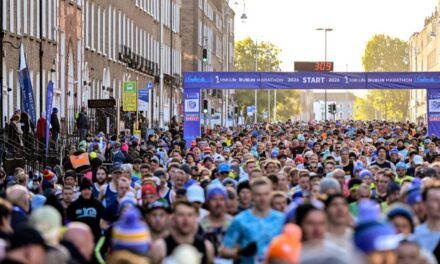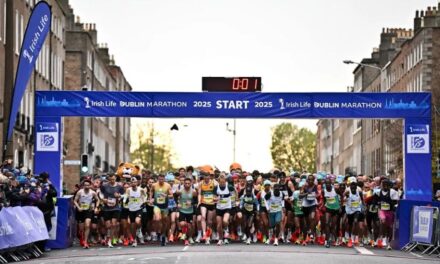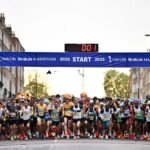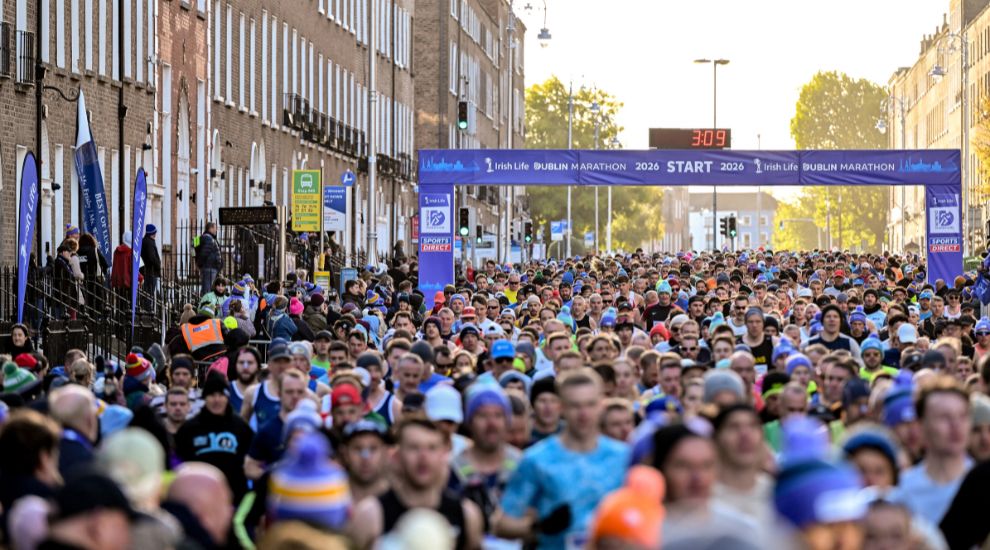
The 45th Irish Life Dublin Marathon surpassed the previous finisher record set just 12 months earlier, further strengthening the Marathon’s position as one of Ireland’s most important mass participation sporting events and a major annual occasion for Dublin.
With thousands of spectators lining the 26.2-mile route, the event once again showed sport’s ability to bring a city together, while raising more than €5.6 million for charitable causes through its official fundraising campaign.
The Marathon represents a powerful connection between title sponsor Irish Life’s commitment to health and wellbeing and a sporting event that engages people of every age, background and athletic ability.
Ethiopian Success and Irish National Champions
The elite races delivered strong international performances, with Ethiopia’s Abay Alemu Lesa winning the men’s event in 2:10:28.
At just 22, Lesa was the youngest competitor in the international field and posted a season’s best to claim the Noel Carroll Cup, named in honour of one of the Marathon’s founders.
Fellow Ethiopian Zenebu Fikdau Jebesa won the women’s race in 2:24:26, improving her personal best by 17 seconds and collecting the Mary Nolan Hickey Perpetual Cup.
Home supporters also had plenty to celebrate.
Hugh Armstrong of Ballina AC claimed the men’s national marathon title in 2:14:51. Judith Storm of City of Derry Spartans secured the women’s national championship in 2:35:46, improving on her 2025 Dublin Marathon time by an impressive 12 minutes. Patrick Monahan won the Wheelchair Race again in 1:46:03.
The Stories Beyond the Stopwatch
The Dublin Marathon’s enduring appeal lies in the thousands of individual journeys that unfold alongside the elite competition.
Among the most remarkable were the Marathon’s celebrated ‘Originals’, runners who have participated in every edition since the inaugural race in 1980.
Peadar Nugent, now 83, completed the distance in 6:11:50, while the youngest member of this exclusive group, 64-year-old Martin Kelly of Raheny Shamrocks AC, finished in 4:10:17.
Their continued participation powerfully illustrates the lifelong relationship that can develop between individuals and sporting events.
Brenda O’Keeffe, who has completed more than 600 marathons, received the Lord Mayor’s Medal from Dublin’s Lord Mayor, Daryl Bannon, before the race and went on to finish in 6:43:56.
Other stories captured the event’s charitable and community spirit.
Brian Ellison completed a remarkable 125-kilometre challenge involving seven races alongside his cousin Luke O’Keefe, who has spastic quadriplegia and cerebral palsy. They completed it together in 4:21:30.
Anne Lyons, aged 60 and currently undergoing chemotherapy treatment for breast cancer, completed the course in 4:10:25.
These stories give the Marathon an emotional reach that extends far beyond the finishing line.
Sporting Stars Join the Field
The event also attracted a familiar collection of sporting personalities and public figures.
Former Irish international footballer Áine O’Gorman completed the race in 4:15:41 while raising funds for the Irish Cancer Society.
Former Manchester United and Czech Republic footballer Karel Poborský finished in 4:10:39.
Olympian David Gillick ran alongside his wife, Charlotte, and they both finished in 3:35:58 in support of GOAL’s Gaza Crisis Appeal.
TG4 Return Adds to the Event’s Reach
A key development for the 2026 Marathon was the return of live television coverage, with TG4 broadcasting the event.
The coverage brought elite competition and the stories of everyday runners to audiences beyond Dublin’s streets, adding a valuable broadcast dimension to an event already capable of attracting substantial public attention.
For Dublin Marathon Group, the not-for-profit organisation responsible for staging the race, television coverage offers an opportunity to build awareness, celebrate participation and strengthen the wider profile of distance running in Ireland.
It also provides additional exposure for Irish Life and the wider group of partners and supporters whose involvement makes the event possible.
The operation is substantial, involving thousands of volunteers, extensive city-centre coordination, public services, and support from communities along the route.
That collective effort has become an important element of the Marathon’s identity.
More Than €5.6 Million Raised for Charity
The Marathon’s charitable dimension is another measure of its wider impact.
By the end of Sunday’s race, the event’s official fundraising campaign had raised more than € 5.6 million.
The total reflects the role mass-participation sport plays in linking individual sporting challenges to broader social and community benefits.
Sport for Business Perspective
The reported record number of finishers points to the continued appetite for organised endurance events in Ireland.
The Marathon also has an economic dimension, bringing runners, supporters and visitors into Dublin over the October Bank Holiday weekend and supporting hospitality, tourism and the wider visitor economy.
Perhaps the most compelling number from Sunday, alongside the record field, was the €5.6 million raised for charity.
It reminds us that a sporting event’s impact should not be measured solely in winning times, audience numbers, or commercial returns.
In its 45th edition, the Dublin Marathon continues to show that some of sport’s strongest partnerships are built around experiences where thousands of people are not simply spectators, but active participants.

 Irish Life, Dublin Marathon Group, Sports Direct, Athletics Ireland nd Dublin City Council are full members of the Sport for Business community of sporting, business and state organisations.
If you would like to join the Sport for Business community and see your organisation in our content, on our stages, and in the daily conversation around the commercial world of Irish Sport, email us today and let’s see what is possible.
Image Credit: Dublin Marathon Group and Sportsfile
ABOUT SPORT FOR BUSINESS
Sport for Business is Ireland’s leading platform focused on the commercial, strategic and societal impact of sport. It connects decision-makers across governing bodies, clubs, brands, agencies, and public institutions through high-quality content, events, and insights.
Sport for Business explores how sport drives economic value, participation, inclusion and national identity, and how your story can be part of ours.
Through analysis, storytelling and convening the sector, it helps leaders understand trends, share best practices, and make better-informed decisions. It positions sport not just as entertainment but as a vital contributor to Ireland’s social and economic fabric.
Find out more about becoming a member today.
Or sign up for our Daily Sport for Business Snapshot email bulletins to get a flavour of the material we cover.
Sign up for our News Bulletins here.