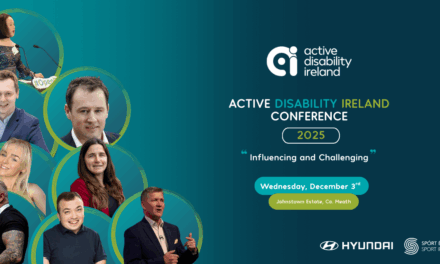
The opening session of the Active Disability Ireland Annual Conference sent a clear message that inclusion in sport is core business for government, agencies and communities alike.
Held as part of the first ever Sport Ireland National Disability in Sport Week, the morning combined a keynote address from the Minister of State for Sport, Charlie McConalogue, with a lively panel featuring Sport Ireland’s Disability Sport Lead Ger McTavish, AsIAm founder and CEO Adam Harris, the Minister, and moderator Joanne Murphy guiding a conversation that moved between policy, lived experience and practical action.
“Sport for all” as a core obligation, not an aspiration
The Minister began with the clear statement that sport is a right, not a privilege. He reminded delegates that more than one in five people in Ireland reported having a disability in the last census, and that the health and wellbeing benefits of sport and physical activity must be available to everyone.
“The inclusion of persons with a disability is an absolute priority for me in my role as Minister of State for Sport,” the Minister said, framing the government’s Sport for All approach as central to the National Sports Policy rather than an add-on.
He acknowledged that barriers to participation exist for everyone, but insisted they are “more pronounced for people living with a disability” and that an “enduring participation gap” remains between disabled and non-disabled people.
There was clear recognition of the system that has grown around disability inclusion in sport: Sport Ireland, disability-focused national governing bodies, the Local Sports Partnerships and their Sport Inclusion Disability Officers, and Active Disability Ireland itself.
The Minister pointed to increased funding, including a dedicated €1 million disability sport stream for innovative ideas, and the appointment of a Disability Sport Lead in Sport Ireland, as evidence that the State is moving from rhetoric to resourcing.
But he was equally clear that money alone will not close the gap. “We need to ensure that every person with a disability can step into a club, a pool, a pitch or a gym and feel that is a place for them,” the Minister said, stressing the importance of culture, welcome and attitude alongside facilities and programmes.
Leadership
The panel that followed humanised those system ambitions. Ger McTavish traced her path from special needs assistant in a secondary school to roles with Dublin GAA, Special Olympics, the Irish Athletic Boxing Association and equality, diversity and inclusion work at Croke Park with the GAA, before joining Sport Ireland as Outdoor Recreation Manager and then stepping into the Disability Sport Lead role earlier this year.
She described the new position as a direct outcome of sector advocacy through Sport Ireland’s disability working group, saying its mandate is rooted in implementation rather than symbolism.
“Through the inclusion policy we have 39 actions, and one of them is the assessment of the sports sector – from funding to resources to the depth of the gaps and then looking at how we can make the sector better,” she said.
Adam Harris, founder and CEO of AsIAm, located his leadership in lived experience as an autistic person in Ireland.
AsIAm is a Disabled Persons Organisation, meaning half of its staff and board are autistic at any given time, and the charity consciously places that lived experience at the centre of its work.
He explained that AsIAm approaches autism primarily through the lens of accessibility – particularly the “invisible barriers” that many sporting environments create around communication, predictability, sensory load and social judgment.
“What we are seeking to deliver for autistic people is the same chance to live, learn, work and play in their communities,” he said.
The urgency of that mission was underlined by stark statistics: autistic adults are four times more likely to experience loneliness, eight in ten autistic people will experience a mental health difficulty, and research suggests autistic people can have a life expectancy up to 16 years shorter than non-autistic peers.
None of these outcomes, he stressed, are part of an autism diagnosis; they arise from how society responds to people who think differently.
Making the jigsaw work
Asked about systemic developments to bridge the activity gap, the Minister highlighted three strands: resourcing, infrastructure and strategy. He pointed to the €1 million disability fund and Ger’s appointment as important signals, and praised the development of Disability Inclusion Officers in Local Sports Partnerships as “really, really important”.
Looking ahead, he flagged the upcoming next round of the community sports facility fund, due to open in spring, as a chance to embed accessibility from the start in club and community infrastructure.
This will dovetail with a broader review of the National Sports Policy, where he encouraged voices in the room to shape the next phase.
McTavish outlined how Sport Ireland is building the evidence base for future decisions. She has overseen the establishment of a Sports Inclusion Disability Forum bringing together NGBs, LSPs and funded bodies, and is working with Sport Ireland’s SIGMA membership database to analyse who is participating and where gaps remain.
For the first time, organisations seeking Core funding were asked to detail whether disability is included in their strategic plans and whether their websites and apps are being aligned with the European Accessibility Act.
“The sector is already doing it,” she said, referring to the volume and quality of responses.
“It’s not just a disability policy, it’s in their strategic policy. My job is to look at what’s not working, identify the gaps and resource them – and then make the jigsaw work with everyone in this room.”
She also stressed the importance of communication and visibility, explaining that Disability in Sport Week itself was conceived because “the sector is doing good work and we’re not seeing it, and we’re not showing it to other people.”
Neurodiversity and culture
From a neurodivergent perspective, Harris argued that sport can no longer treat autism as a niche issue. With around one in 20 school-age children now having an autism diagnosis, exclusion in sport has consequences for whole families and communities.
He challenged sport to move beyond the idea that inclusion is a favour to a minority. “What is essential for some can actually be good for all,” he said, referencing AsIAm’s annual attitudes polls which show that clear communication, predictability and inclusive environments are valued across the population, not just by autistic people.
Crucially, Harris said, neurodiversity inclusion requires adaptation and investment, not simply an attitude of “everyone is welcome if they can fit in”.
He cautioned against creating a “fear factor” around disability training, emphasising that while specialist knowledge is vital, it must be balanced with a simple human instinct: “You don’t need to be an expert to begin. Suspend your assumptions and get to know the person standing in front of you.”
Policy
On wider government policy, the Minister pointed to the new National Disability Strategy 2025–2030, described as a human-rights-based framework that will sit across all departments. The Taoiseach has established a Cabinet subcommittee on disability, with the Minister emphasising that “people with a disability must be central to every part of the decision-making process” and to accountability structures.
McTavish called for that leadership model – including the Taoiseach’s dedicated disability unit – to be mirrored across all 18 government departments, creating clear points of contact and responsibility.
Harris introduced the idea of allyship as a critical but underused resource in sport. Families of disabled people, he suggested, are often powerful allies who can “animate and bring inclusion to life in a way statistics never can”. Visible examples such as autism-friendly quiet spaces at football clubs create a “virtuous circle” by both meeting needs and sparking conversations in other organisations.
As the session closed, the Minister acknowledged that government does not have all the answers, and that the experience and expertise in the room – practitioners, volunteers, NGBs, LSPs, advocates and disabled people themselves – will be critical to future progress.
There was a shared conclusion that the ingredients now exist: policy frameworks, dedicated roles, funding streams, growing data, strong charities and an increasingly confident disability movement. The challenge for the years ahead, as Mctavish put it, is to “make the jigsaw work” – and to do so in partnership.
We’ll have more from the event over the coming days.
Image Credit: Sport for Business
Further Reading for Sport for Business members:
Read our Sport for Business Coverage of Inclusion
SPORT FOR BUSINESS Upcoming Events

December 9th – Our 12th Annual Women in Sport Conference in partnership with Lidl.
January – The Sporting Year Ahead 2026 in partnership with Teneo.
Sport for Business Podcasts
MEMBERSHIP AND EVENT,
Active Disability Ireland, Paralympics Ireland and Special Olympics Ireland, as well as all the leading sporting and business organisations in and around the world of sport, are among the 300+ members of the Sport for Business community.
This includes all of the leading sports and sponsors, as well as commercial and state agencies, individuals interested in our world, and an increasing number from beyond these shores taking a keen interest in Ireland.
Find out more about becoming a member today.
Or sign up for our twice-daily bulletins to get a flavour of the material we cover.
Sign up for our News Bulletins here.