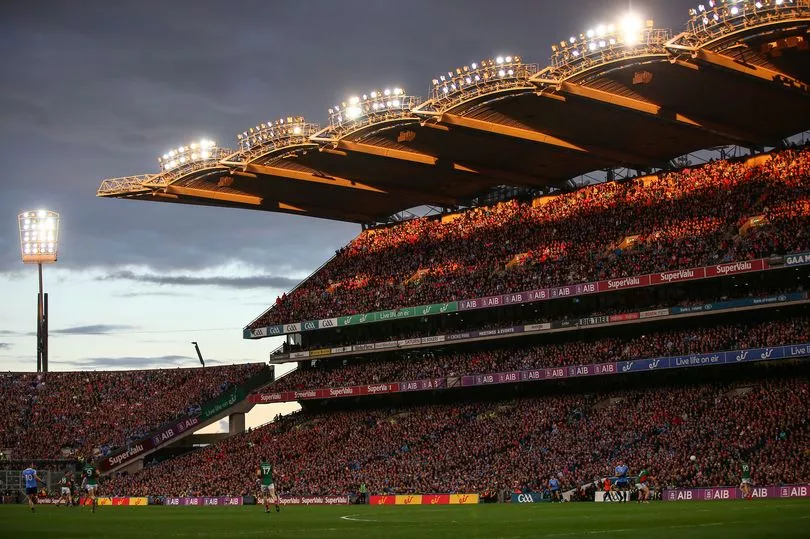


Croke Park has published its first comprehensive Annual Sustainability Report, setting out in detail how Ireland’s largest sporting venue is responding to the environmental, social and governance challenges facing the modern sports and events industry.
Titled Winning the Breaking Ball, the report marks another significant step forward in transparency for the stadium, outlining actions already delivered and practical measures underway across areas including energy, water, waste, transport, community engagement and carbon emissions.
Colin O’Brien, Sustainability Manager at Croke Park, said the move to produce a full annual report was driven by a desire to go beyond the sustainability updates the stadium had previously issued.
“We’ve been reporting on a smaller scale over the past few years,” he explained. “We’d do maybe two pages of our key highlights. We’d a discussion on how we’d expand, how we’d report, be more transparent, and tell our story in greater detail.”
Much of the groundwork was undertaken in preparation for the EU’s Corporate Sustainability Reporting Directive (CSRD), which initially looked set to apply to the stadium. Extensive stakeholder engagement was carried out, alongside deeper analysis of operational data covering energy consumption, water usage, waste management, travel and transport patterns, and the venue’s overall carbon footprint.
“The CSRD changed, the reporting requirements changed, and we fell out of that scope,” O’Brien said. “We’d actually done all of the hard work for the CSRD reporting. So, as we’d the hard work done, we said let’s just report anyway, to tell our story about the work we’ve done.”
He noted that many organisations found themselves in a similar position — having invested significant time and resources preparing for mandatory reporting, only to discover they were no longer required to do so under revised thresholds. For Croke Park, the decision was taken to proceed regardless.
“There is a lot of pressure being put on large organisations and large venues to not just reduce their carbon footprint, but to be transparent about what they’re doing,” O’Brien said. “You tell the story: this is the situation we’re in and this is how we hope to improve our carbon footprint, this is what we’re doing for local communities and society.”
The stadium’s wider leadership has also been active in promoting sustainable sport. Peter McKenna, Croke Park Stadium Director, addressed last November’s ‘Playing for the Planet’ event on sustainable sport, hosted by Sport for Business and the Department of Culture, Communications and Sport, where he outlined the role major venues must play in driving sector-wide change.
As the headquarters of the GAA and a venue that hosts major sporting, cultural, business and entertainment events, Croke Park sees itself as having a responsibility to lead within the sector.
“Big organisations like Croke Park and the GAA have to lead by example,” O’Brien said. “Hopefully, we can inspire others to do the same, to bring others on the journey with us, to help educate people who maybe don’t have the resources that we have.”
O’Brien’s role bridges sustainability and operations, giving him direct oversight of energy, water and waste management, as well as event and facility management.
“It is the perfect crossover,” he said. “You’ve a direct involvement in energy management, water management and waste management in implementing policies, procedures and practices to reduce your usage in all of those areas.”
With Winning the Breaking Ball, Croke Park has signalled that sustainability will now be reported with the same consistency and scrutiny as performance on the field — setting a benchmark for other large venues across Ireland to follow.
You can read the full Croke Park Sustainability Report 2025 here.
Image Credit: GAA
Upcoming Events

SPORT FOR BUSINESS
Sport for Business is Ireland’s leading platform focused on the commercial, strategic and societal impact of sport. It connects decision-makers across governing bodies, clubs, brands, agencies and public institutions through high-quality content, events and insight. Sport for Business explores how sport drives economic value, participation, inclusion and national identity, and how your story can be part of ours.
Through analysis, storytelling and convening the sector, it helps leaders understand trends, share best practice and make better-informed decisions. Its work positions sport not just as entertainment, but as a vital contributor to Ireland’s social and economic fabric.
Find out more about becoming a member today.
Or sign up for our twice-daily bulletins to get a flavour of the material we cover.
Sign up for our News Bulletins here.