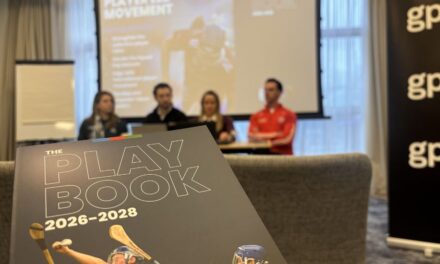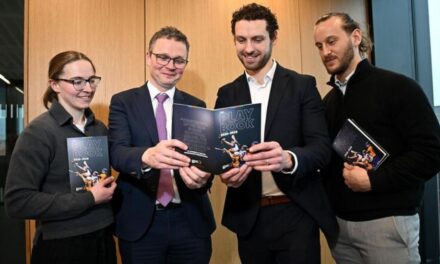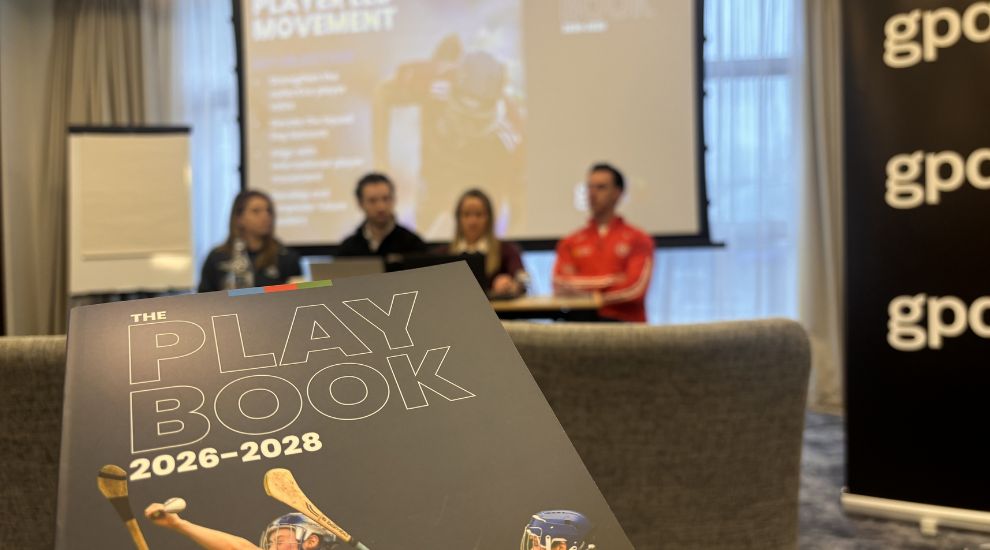
The Gaelic Players Association “Playbook 2026–2028”, setting out five strategic priorities for the next three years, was launched yesterday with the organisation positioning itself for major change across Gaelic games, including the planned integration of the GAA, LGFA and Camogie Association.
Unveiled at a media briefing, the document outlines the GPA’s key focus areas as: the elite player experience; a player-led movement; players growing the games; players powering integration; and developing players beyond the game.
Tom Parsons and Gemma Begley led out on the conversation with Co-Chairs Aisling Maher and Niall Morgan representing the active players voice.
The playbook is designed to clearly state what players want the organisation to prioritise, and to provide a framework that can adapt as Gaelic games and the wider sporting landscape evolve.
Co-chair of the GPA National Executive Committee, Aisling Meyer, said the playbook comes at a time of “change for Gaelic games at large”, with integration on the horizon and a shifting playing demographic.
As she outlined the basis for the plan, Maher said the priorities were informed by multiple data sources and consultation processes, including an annual membership survey with more than 3,600 respondents, the Indecon Economic Impact Report, motions passed at the GPA AGM in 2025, a staff development day, and one-to-one interviews with stakeholders. She said the content was also presented to player representatives at the GPA’s annual reps day and refined through that process.
Fellow NEC co-chair Niall Morgan described the playbook as reflecting the core purpose of a players’ association, stressing that it was not a direction imposed by staff but one shaped by players through qualitative and quantitative feedback. He said the NEC’s role would be to ensure it is implemented, with regular reporting through NEC meetings and annual reviews to track progress against targets.
Read More about the Government Welcome for the Playbook Strategy
GPA leadership also pointed to the importance of flexibility, noting that the playing cohort changes each year through retirements and new entrants, and that external factors can reshape priorities quickly.
Player Experience
In discussing the “elite player experience” pillar, CEO Tom Parsons reiterated its long-running call for a more sustainable inter-county season and competition structure. The briefing referenced an upcoming motion to Congress seeking a defined 30-week inter-county season window in Leinster, with the argument that player welfare and a viable club calendar cannot be achieved if the inter-county schedule continues to expand.
The playbook also flags coaching and management standards as a major influence on the day-to-day environment for players. GPA representatives suggested that proposed reforms around coach and manager licensing, including mandatory education and broader performance indicators beyond results, could be a mechanism to raise standards and embed welfare-focused practice.
Integration emerged as a central theme throughout the briefing. Parsons said they intend to keep “foot on the gas” around the move towards a single Gaelic Games Association, insisting that integration offers an opportunity to redesign structures and improve governance across fixtures, facilities and finances. They said a priority will be ensuring strong gender balance and a meaningful player voice at county, provincial and national levels in any new model.
On timelines, the GPA said it continues to work on the basis that integration will happen in 2027, arguing that members and stakeholders “won’t accept anything other than” that date. Asked about cost estimates in circulation, the GPA said it had not seen a formal report underpinning specific figures, while acknowledging that meaningful parity in facilities and access will require investment.
Player Visibility
The “players growing the games” pillar places renewed emphasis on player visibility and the modern realities of name, image and likeness. Gemma Begley said there is a need to update culture and practice so that players can engage with supporters, media and commercial partners without being treated as a distraction — while also protecting players from poor practice where they feel used or exposed.
Sport for Business will host a Members Round Table Event on Name, Image, Likeness and Personality in March. Reach out to Rob@sportforbusiness.com if you would like to be involved.
In that context, the GPA also highlighted consent as a key principle, including in relation to sponsorship backdrops and media settings.
Referencing recent sensitivities around Allianz branding, the association said its immediate focus has been to protect players by ensuring they have a clear choice about whether they appear in branded environments, reflecting broader concerns about how player images are used.
The playbook also outlines a focus on developing players beyond the pitch, including leadership programmes, education supports and social impact work. Examples referenced included the GPA’s ongoing investment in player leadership pathways and a mental health workshop programme delivered by current and former inter-county players, which the association said has reached thousands of young people and coaches.
The goal of the three-year plan is outlined to see players “united and empowered”, with stronger welfare standards, true parity across codes, greater visibility for players and games, and better long-term outcomes for players beyond their inter-county careers.
Image Credit: Sport for Business
ABOUT SPORT FOR BUSINESS
Sport for Business is Ireland’s leading platform focused on the commercial, strategic and societal impact of sport. It connects decision-makers across governing bodies, clubs, brands, agencies and public institutions through high-quality content, events and insight. Sport for Business explores how sport drives economic value, participation, inclusion and national identity, and how your story can be part of ours.
Through analysis, storytelling and convening the sector, it helps leaders understand trends, share best practice and make better-informed decisions. Its work positions sport not just as entertainment, but as a vital contributor to Ireland’s social and economic fabric.
Find out more about becoming a member today.
Or sign up for our twice-daily bulletins to get a flavour of the material we cover.
Sign up for our News Bulletins here.
Upcoming Events