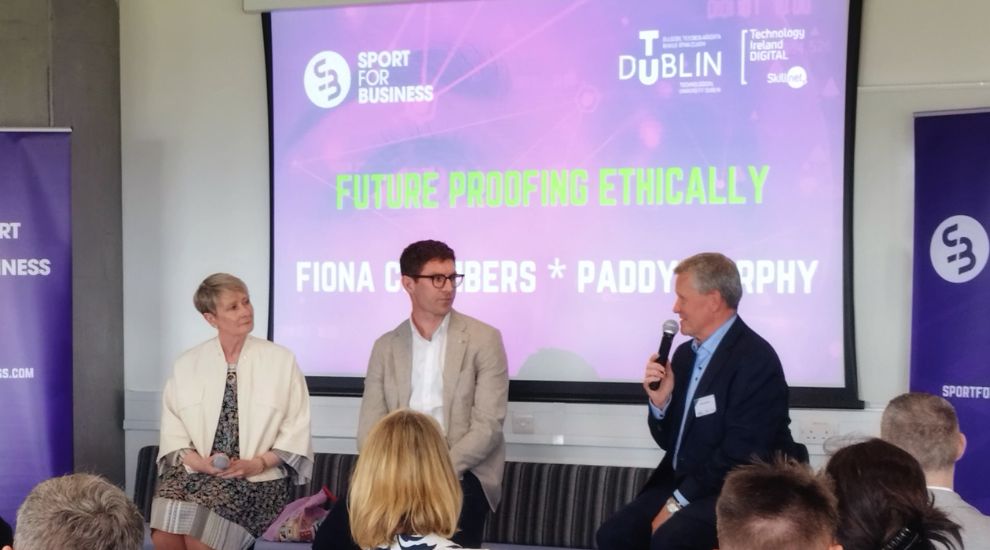
The final formal conversation at Future Proofing Sport 2026, held at Technological University Dublin on June 10th, was perhaps the one that mattered most.
Throughout the morning, we looked at data, athlete performance, artificial intelligence, health, fan engagement, and the different ways technology is already changing sport.
There was a real sense of opportunity in the room, and rightly so. But opportunity always comes with responsibility, and the closing session brought that into focus.
Professor Fiona Chambers of UCC and Paddy Murphy, Head of Sports Law at Ogier, joined Rob Hartnett of Sport for Business to explore ethics, technology, sport and the importance of keeping people at the centre of whatever comes next.
It began with a familiar enough sporting challenge.
There is a lot of data out there now. The harder part is making sense of it.
In a coaching environment, the appeal is obvious. Instead of spending an hour watching a match and another two hours trying to decipher handwritten notes, the idea of being able to ask a system, “Where did we win tonight?” is very attractive.
That is where technology can help.
But there is another side to it. The same tools that can help us better understand performance could also be used to stretch the limits of what is fair, what is legal, and what is right.
That was where the story of Icarus came into the conversation.
Sport has always been about going higher, faster, further and better. Technology feeds that instinct in very powerful ways. It can help us train smarter, recover better, understand more and connect more widely.
But Icarus also reminds us that ambition needs limits. The wings were a brilliant idea, right up to the point where they flew too close to the sun.
The question for sport is where that sun sits.
At what point does useful data become intrusive? When does performance improvement become an unfair advantage? When does engagement become surveillance? When does innovation begin to move faster than our ability to understand its consequences?
That was the starting point for a conversation that ranged from athlete data and image rights to AI regulation, consent, fairness, planet, people and the need for Ireland to lead well in this space.
Chambers was clear from the start that she is not anti-technology.
“I think that technology is fantastic,” she said. “But there is a government health warning on it.”
The words she put on the table were important ones: transparency, fairness, justice, equity, accessibility, accountability, privacy and security.
They are not always the first words used when sport talks about technology. More often we hear about speed, insight, performance, revenue and engagement.
All of those have their place. But Chambers’s point was that before we talk about value, we need to talk about values.
“When I think about technology and AI and the excitement around it and the possibility, and I think about value, more than that, I talk about values,” she said. “For me, that’s what ethics are. They’re all about, what are your values?”
That feels like a good test for any organisation in sport.
Before signing up for a new platform, taking on a new data partner, or building a new product, the question should not be only whether it works. It should be whether it fits with who we are and what we are trying to do.
There was also a wider point. Chambers reminded the room that the conversation is not only about people but also about the planet.
Sport is not separate from the world around it. The choices we make around technology, travel, infrastructure, energy use and data all have consequences.
“It’s about people, and it’s about the planet,” she said.
The danger, as she saw it, is that much of the technological world is being designed by a relatively small part of the global population.
Ireland, like much of the Western world, is part of what she described as the “WEIRD” countries: Western, Educated, Industrialised, Rich and Democratic.
That gives us an opportunity, but it also places a responsibility on us. If the future of sport is designed only by those with access to money, expertise and infrastructure, it risks widening the gaps that already exist.
There are questions here around language, gender, culture, disability, geography and access. A tool that works brilliantly for one sport, one country or one level of competition may not work for another.
It may also carry hidden costs.
Chambers made the point that when an app says it is free, it is not always free.
You may not be paying with money, but you may be paying with your data.
That is why digital education matters. Coaches, athletes, parents, volunteers, administrators and clubs all need to understand the transaction that is taking place.
Who owns the data?
Who can use it?
Where does it go?
Can consent be withdrawn?
Does the organisation behind the product share the values of the sport using it?
Those questions can feel heavy, especially for volunteers running teams on wet Wednesday evenings, but they are becoming part of the job.
Paddy Murphy brought the legal view into the discussion, and he began by acknowledging that lawyers tend to talk about risk. His role, though, is also about helping organisations understand and manage that risk.
On the question of data, he said that ownership will often rest with the rights holder. That might be a club, a league, a governing body or an event owner.
But there is an emerging tension around athlete data.
Athletes are generating information that can have real commercial value. It can be sold on to data companies, broadcasters, betting operators and other third parties. Yet the athlete may have limited ownership rights over that information.
Murphy pointed to campaigns such as Project Red Card, where athletes are beginning to ask whether they should have a greater say in how their data is used and whether they should be compensated when others profit from it.
This is not only an issue for elite sport.
At the club level, we are already dealing with data and consent every week.
Hartnett gave the example of managing a GAA team and seeing a red dot next to a new player’s name in the registration system. The player was 17, and permission had not been granted to use her image. That meant no team photograph could be taken that included her.
It was a small thing in one sense, but an important thing in another.
Consent is not just a box to be ticked. It is a person making a choice, or, in the case of a minor, a parent making it on their behalf.
Chambers welcomed that kind of reminder.
“Everybody has a right to say no,” she said.
That is worth keeping close.
In the rush to collect, measure, share and post, sport needs to remember that not every player, parent, fan or volunteer will want to be part of every system.
Murphy also spoke about GDPR, which already applies to many of the technologies now being used in sport. Where personal data is being processed, and especially where health or biometric data is involved, there are clear responsibilities.
The EU AI Act is also coming down the line and will be particularly relevant to high-risk systems, including those involving biometrics.
The law may not always move as quickly as technology, but that does not mean there is no framework.
Murphy also referenced the use of facial recognition in stadiums and the need for proportionality. Even where safety and security are the stated reasons, there are still limits on what is acceptable.
That is a useful principle for sport more generally.
Just because something can be done does not automatically mean that it should be done.
One of the strongest images of the session came from Chambers, who spoke about the need for an ethical pebble in our shoe.
It is a small but constant reminder to stop and think.
That does not mean slowing everything to a halt. It means making sure that innovation is being shaped by more than excitement, money or the desire to be first.
Chambers drew on her own experience as a researcher, where ethical approval is required before any work can begin. She suggested that sport, and the companies working in sport, would benefit from adopting a similar mindset.
“You don’t go onto a pitch to train kids or coach kids without a plan,” she said. “Equally, in this view, you really don’t go in just assuming and thinking everybody has the same values on the table.”
That is a good practical lesson.
Not every organisation needs to create a giant ethics department. But every organisation should have a way to ask the right questions before adopting new technology.
What are we collecting?
Why are we collecting it?
Who benefits?
Who might be harmed?
What happens if something goes wrong?
Can people opt out?
Are we doing this because it improves sport, or simply because we can?
Chambers suggested that the baseline should be “do no harm”.
That is a useful place to start.
The ambition, of course, should be higher than that. The best technology in sport should help people to participate, perform, belong, recover, connect and enjoy the experience more.
It should help coaches make better decisions. It should help athletes stay healthier. It should help governing bodies see where investment is needed. It should help fans get closer to the sports they love.
But it should not strip out the human element.
Towards the end of the session, Chambers introduced a different kind of AI.
Not artificial intelligence, but “Act Intentionally, Be Humankind”.
It was a lovely phrase and a good way to land the conversation.
She had created a future newspaper and a set of cards encouraging people in the room to think about what they could offer each other through expertise, connections, generosity and kindness.
After a morning full of technology, data and future systems, it was a reminder that handwritten notes, shared conversations and human relationships still matter.
That might sound simple, but perhaps that is the point.
Sport has always been about people. Players, coaches, parents, volunteers, administrators, supporters and communities. Technology can make sport better, but only if it serves those people.
The future will bring more data, more AI, more automation and more powerful systems.
That is certain.
Less certain is whether we will build that future with enough care.
The answer, on the evidence of this conversation, is that we can.
But only if we remember Icarus, keep the ethical pebble in our shoe, understand the legal guardrails, and make sure the best version of future sport is not only smarter.
It is more human.
We will host a special members event looking at this issue of Ethics and Sport in Q4 of 2026. Would you be interested in being part of it?
 TUD, Ogier and Future Sport Forum are full members of Sport for Business
If you would like to be part of the Sport for Business community and see your organisation in our content, on our stages, and in the conversation happening every day around the commercial world of Irish Sport, email us today and let’s see what is possible.
Image Credit: Sport for Business
ABOUT SPORT FOR BUSINESS
Sport for Business is Ireland’s leading platform focused on the commercial, strategic and societal impact of sport. It connects decision-makers across governing bodies, clubs, brands, agencies, and public institutions through high-quality content, events, and insights.
Sport for Business explores how sport drives economic value, participation, inclusion and national identity, and how your story can be part of ours.
Through analysis, storytelling and convening the sector, it helps leaders understand trends, share best practices, and make better-informed decisions. It positions sport not just as entertainment but as a vital contributor to Ireland’s social and economic fabric.
Find out more about becoming a member today.
Or sign up for our twice-daily bulletins to get a flavour of the material we cover.
Sign up for our News Bulletins here.