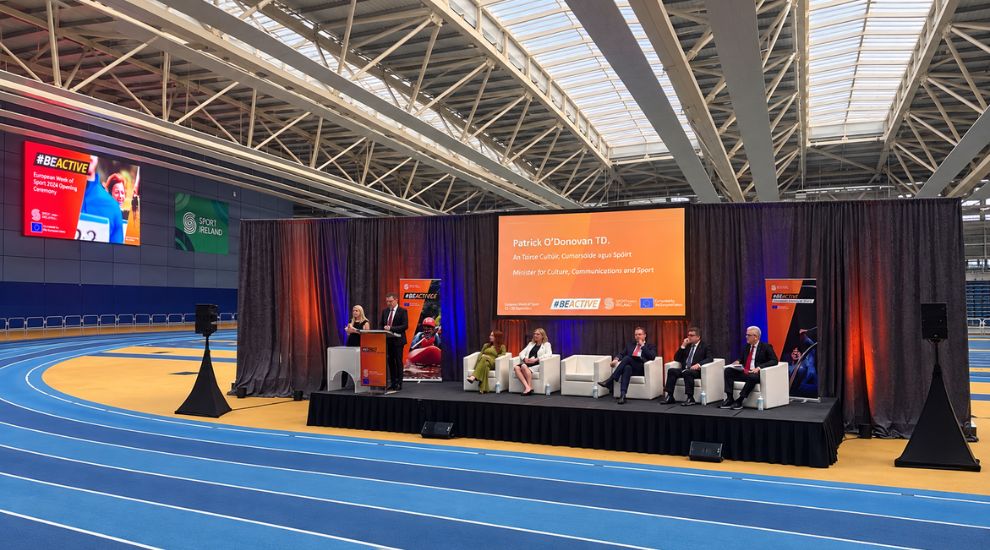
Ireland placed participation, inclusion, and the continued development of sporting infrastructure at the heart of the European sporting agenda yesterday, as the European Week of Sport officially opened at the Sport Ireland Campus.
Minister for Culture, Communications and Sport Patrick O’Donovan and Minister of State for Sport and Postal Policy Charlie McConalogue hosted the opening at the National Indoor Arena, in cooperation with the European Commission and Sport Ireland.
We were among more than 100 guests, including 70 European delegates representing 24 countries, as well as representatives from UEFA, FIFA, the European Olympic Committees EU Office, the European Paralympic Committee, EUSA, European Aquatics, ENGSO, EuropeActive, and Special Olympics Europe Eurasia.
It gave Ireland another opportunity during its Presidency of the Council of the European Union to showcase the development of the Sport Ireland Campus and, importantly, how high-performance facilities are increasingly being used alongside programmes designed to broaden participation.
The European Week of Sport runs from September 23rd to 30th under the theme #BeActive Your Way, encouraging people of every age and ability to find their own route into physical activity. Sport Ireland has built a national programme involving hundreds of events, alongside an open week at the Campus offering free opportunities to try different sports.
Five-time Paralympic swimmer and Paralympic champion Ellen Keane, who acted as an ambassador and host for the launch, set the tone by reflecting on what sport had given her beyond high-performance success.
“Sport has given me a safe place,” she said, describing how it enabled her to learn about and embrace her disabled body and gave her confidence moving into adulthood.
She said that since retiring after Paris 2024, she had enjoyed discovering sport from a different perspective, simply as a participant.
“That’s what this whole week is about,” she told delegates.
Minister O’Donovan used the launch to link the participation challenge to wider concerns about increasingly sedentary lifestyles, particularly among young people.
He said encouraging people to spend less time on screens had to involve more than simply telling them what not to do; it also required giving them sporting, cultural and community alternatives.
Investment in facilities, he argued, therefore extended well beyond elite sport.
“The last time that I was in this Department none of this infrastructure was here,” he said, pointing to the transformation of the Campus and the wider investment in local facilities, National Governing Bodies and Local Sports Partnerships.
The Minister highlighted the National Velodrome and Badminton Centre, now under construction, as well as plans to develop cricket facilities on the Campus, as examples of how Ireland’s sporting landscape has changed.
He also pointed to sport as a way to build connections at a time of increasing division.
“There is definitely a need for opportunities and places for people of difference to be brought together to discuss the things that unite them as opposed to the things that divide them,” he said.
Minister McConalogue similarly focused on participation and accessibility, noting that the latest Irish Sports Monitor recorded 2.16 million people participating in sport each week and record participation among people with disabilities.
He highlighted activity during the week, including #BeActive Night events around the country and free Campus opportunities spanning pickleball, gymnastics, archery and other sports.
“It’s not about deleting apps or abandoning our digital lives,” he said of the campaign. “It’s just about moving more and scrolling less.”
He said a particular priority was ensuring opportunities existed for groups traditionally facing greater barriers to participation, including people with disabilities.
That combination of high performance and broad-based participation was also picked up by European Commission Director for Culture, Creativity and Sport Georg Häusler, who said delegates had been impressed by seeing elite athletes training alongside older people, children and participants from different backgrounds.
“This is really the symbol of what the European Week of Sport is all about,” he said, describing sport as a way to integrate people and build stronger societies.
The European Commission says the initiative has grown substantially since its launch in 2015, with #BeActive now extending across 40 countries and encompassing hundreds of thousands of activities.
For Sport Ireland CEO Dr Úna May and Chair John Foley, the week offers an opportunity to help those who are not currently active discover something that might work for them.
“There is something out there for everyone, and they may not have discovered this opportunity yet,” she told the gathering.
May also pointed to one of Ireland’s advantages as a relatively small sporting system: the close connections between Sport Ireland, National Governing Bodies, Local Sports Partnerships, Government departments and community organisations.
That network, added Foley, enables sport to reach well beyond the traditional structures of clubs and competitions.
The Sport Ireland Campus itself will be one of the focal points over the coming days, with more than 150 free activities available during its #BeActive Open Week.
This was an opportunity to put participation alongside performance, and to demonstrate to European sporting leaders how investment in facilities, governing bodies and local delivery can connect an Olympic or Paralympic ambition at one end of the spectrum with the simple encouragement to move more at the other.
That is the space in which the European Week of Sport is seeking to make its impact.
 Sport Ireland and the Department of Culture, Communications and Sport are full members of Sport for Business.
If you would like to be part of the Sport for Business community and see your organisation in our content, on our stages, and in the conversation happening every day around the commercial world of Irish Sport, email us today and let’s see what is possible.
Image Credit: Special Olympics Ireland
ABOUT SPORT FOR BUSINESS
Sport for Business is Ireland’s leading platform focused on the commercial, strategic and societal impact of sport. It connects decision-makers across governing bodies, clubs, brands, agencies, and public institutions through high-quality content, events, and insights.
Sport for Business explores how sport drives economic value, participation, inclusion and national identity, and how your story can be part of ours.
Through analysis, storytelling and convening the sector, it helps leaders understand trends, share best practices, and make better-informed decisions. It positions sport not just as entertainment but as a vital contributor to Ireland’s social and economic fabric.
Find out more about becoming a member today.
Or sign up for our Daily Sport for Business Snapshot email bulletins to get a flavour of the material we cover.
Sign up for our News Bulletins here.