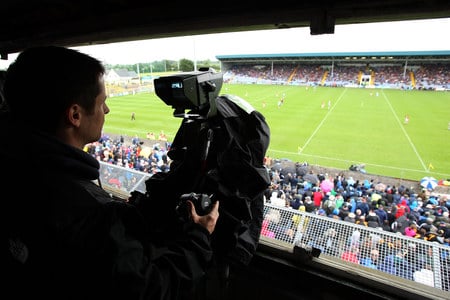
 It is widely expected that within the next two weeks the GAA will announce the latest three year round of media rights and that Sky Sports’ name will be on the list for the first time.
There will likely be much wailing and gnashing of teeth over the fact that for the first time a Championship match will be on pay per view television.
Is that a response though that bears scrutiny in a world where the value of sport to broadcasters is escalating rapidly because of the hold it has over a ‘live’ audience that is one of the last that will not time shift their viewing habits and fast forward through the advertising?
Firstly it should be noted that big games in the National League have been on pay per view for many years. The clash between Dublin and Mayo on Saturday night drew 22,000 to Croke Park on the same evening as 50,000 went to the Aviva Stadium to watch Leinster and Munster. Those who stayed at home had the choice of watching both games with the gaelic football on Setanta as it has been for nearly ten years in the Allianz Leagues.
Secondly, many forget that all television is in fact paid for through the TV license system. Every home in the country that wants to watch the All Ireland Final on RTE Sport will have to be in possession of a license that has cost €160.
Thirdly there is the question of inevitability. Major events such as the World Cup this summer, the Olympic Games, the Six Nations and indeed the All Ireland Finals are protected for terrestrial television broadcast so as to maximise the number of people that can watch them.
The magic of sport is often best expressed through how it’s highest moments of drama wrap us up in a collective conversation and mainstream television is still the best medium for doing that among the largest audiences.
There is no question that the All Ireland Finals, and Semi Finals will remain ‘free to air’ though the latest round of media rights and for many more to come. That is as it should be.
But for matches on the way there will be a greater fragmentation, and a greater reward for the sport in financial terms from selling the live rights to an organisation that will promote and deliver coverage as one option for fans.
There are of course other options.
You can go to the game. Very few if any of the matches that are likely to be on Sky Sports will be sold out and the appeal of seeing the best sport live is one that has been universally promoted and accepted as the best way to keep engagement in the sport at its highest.
You can listen to the commentary on radio, as many already do when dropping children to various other sporting matches, doing the shopping or generally living our busy lives. And there will always be a highlights programme to catch up on later in the evening so you can comment about the main talking points.
Increasingly you can be part of the conversation through social media. A popular ‘vine’ post yesterday showed Setanta coverage of Stephen Cluxton’s sending off on a loop that showed everything in six seconds and will enable everyone to have an expert opinion. There will be the same today around the closing stages of the Tipperary Cork hurling match yesterday.
If Sky Sports does emerge as a secondary broadcast partner over the next three years it will be good for the broader sport in that it will make games more readily accessible to the growing number of fans spread across Britain and the rest of the world.
It will also be good for Ireland in terms of deepening the attachment for a company that already employs almost 1,000 people here and which has identified Dublin as one of it’s central hubs for developing the business over the coming years.
Much has been written about the fact that a pay per view Championship match will take the sport away from the people. Reasoned analysis though will show that if anything, it can be the spark to get people more involved by going to matches or watching it collectively again and not just having it on in the background while flicking through the Sunday papers.
GAA Championships on Sky – The Reality