The full financial impact of the dispute that meant no greyhound racing in Dublin during the first half of 2017 can be clearly seen in the Irish Greyhound Board Annual Report published yesterday.
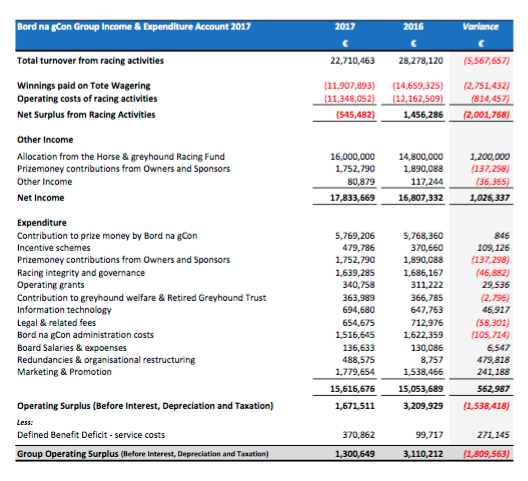
A reduction of attendance from 636,914 in 2016 to 514,546 in the most recent calendar year had a significant downward effect on other streams as well with tote betting revenue down from €19.5 million to €15.9 million.
Nevertheless, the Group still recorded a net operating surplus of €1.67 million and the sale of Harolds Cross Stadium, which had triggered the 22-week dispute in Dublin, will now mean the long-term debt, which stood at €16.2 million at the end of the year, will now be erased.
Investment plans have been laid out in the Strategic Plan published earlier this year, including a €3 million upgrade for Shelbourne Park.
“The disruption to racing at our premier stadium Shelbourne Park, had a very significant impact across all operations in 2017,” said CEO Gerard Dollard.
“The IGB together with the greyhound sector has been working to return the industry to growth, the early signs of which had been evident in recent years.”
“The IGB has been focused on increasing prize money and reducing our cost base which is evident in 2017. The significant debt burden had acted as a financial strait-jacket on our industry in recent years.”
“The disposal of the Harold’s Cross Greyhound Stadium has enabled IGB to set aside some €6m for investment in the industry. Proposals include a major upgrade at Shelbourne Park (€3m), other stadia improvements (€2m) and significant improvements in information and communications technology (€1m).”
“Our recently launched Strategic Plan 2018 – 2022 offers a platform to build for the future. The allocation from the Horse & Greyhound Fund supports 5,000 jobs and 7,000 greyhound owners, the vast majority of which are based around our 15 tracks outside Dublin.”
“The Fund, which places a levy on off-course bookmakers, has been essential to sustain this employment since the economic recession. The greyhound sector contributes €300 million in additional economic activity. The Department of Agriculture, Food and the Marine and Minister Andrew Doyle TD must be acknowledged for their support in this regard.”
Key financial data 2017
· There were 15,610 races held in 2017 (2016 – 16,573) spread over 1,566 race meetings ( 2016 – 1,675)
· The period of closure of Shelbourne Park resulted in the loss of 123 race meetings affecting 1,147 individual races.
· Attendance was reduced by circa 122,000 customers directly reducing consolidated track profit by €1.225m. Overall attendance for 2017 was 514,546. (2016 – 636,914)
· The Board’s long-term bank debt stood at €16.2m at year end with a further €5.8m on overdraft facility. The imminent sale of Harold’s Cross greyhound stadium will enable the Board to deal with its long-term bank debt.
· Exchequer support through allocations from the Horse & Greyhound Fund increased to €16m (2016 – €14.8m)
· Staff remuneration costs reduced from €10.1m to €9.6m with the number of employees (FTEs) reducing from 243 in 2016 to 225 in 2017.
· The deficit on the defined benefit pension scheme stood at €3.6m on 31st December 2017 which represents a reduction of €4.6m following the implementation of a restructuring programme in 2016.
· Total prize money in 2017 was €8m including a general 25% increase in prize money payments from 1st October 2017.


Sign up today for our free daily news digest covering the commercial world of sport or discover the benefits of becoming a full member alongside the many leading organisations whom we serve.