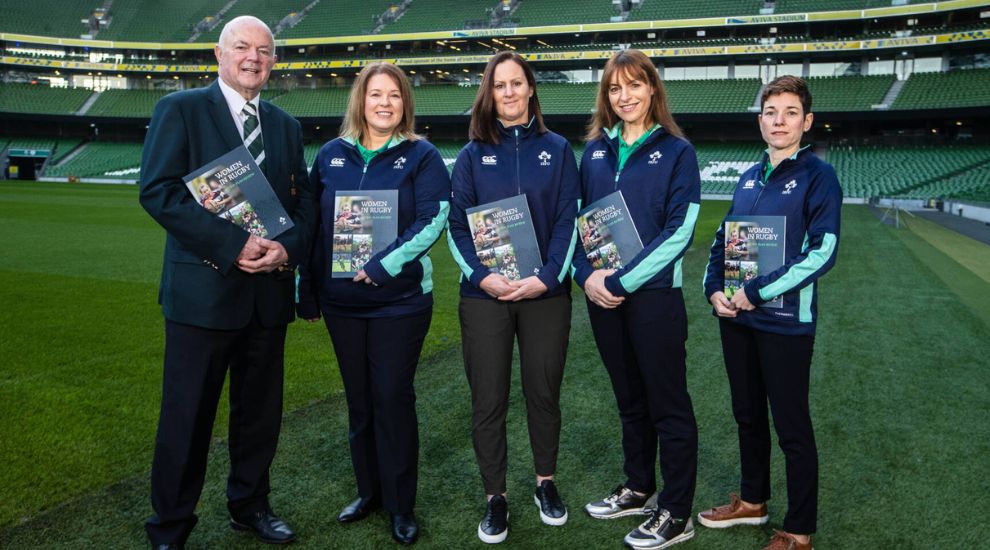
The IRFU Committee has today approved a commitment to reaching a level of 40 percent gender representation on itself by the end of 2023.
There are currently three members of the 23-strong committee that are female, Su Carty, Fiona Steed, and Yvonne Comer.
A proposal on how this will be achieved in technical terms will be put to the Annual IRFU Council meeting in July.
The Council elects the Committee on an annual basis to act as the lead organisational body in running the sport. It is made up of officers of the union, a number that might be co-opted, and four representatives put forward by each of the provinces.
Sport for Business understands that within the proposals will be a temporary expansion of the number of committee members, a mechanic that World Rugby used to increase female representation on its governing council in 2020.
That might mean that each of the provinces would be allowed to put forward say seven nominees so long as three of them were women and the officer and co-opted contingent could also be expanded on the basis that half of those nominations were female. That could mean a committee of 44 instead of 23, of which a minimum of 17 would be women.
If that is deemed to be too unwieldy, even on a temporary basis, then the absolute number might be less but the ratio would be the same.
Obviously, the proposals need to be finessed over the coming weeks and months but making the commitment publicly well in advance allows for any lobbying that might be required, or preconceived objections overcome so that they will be passed.
It will be well received at the Government level. Ministers have been steadfast in pushing all sporting bodies toward the 40 percent threshold, with threats of financial consequences if not met by the end of the year.
The FAI are similarly moving in the right direction, albeit with the stepping down of Chair Roy Barrett and fellow independent Gary Twohig to create space for female independent candidates.
The GAA is currently at 20 percent with the added complexity of representing only the male side of Gaelic games. Doubtless that issue will be raised at the publication of the GAA Annual Report in Croke Park tomorrow.
A Sport Ireland survey of female representation we reported on in December showed the following of sports beyond the ‘big three’:
The Gold star for full balance goes to American Football Ireland, Badminton Ireland, Basketball Ireland, Canoeing Ireland, Cycling Ireland, Diving Ireland, Federation of Irish Sport, Fencing Ireland, Golf Ireland, Gymnastics IrelandHockey Ireland, Horse Sport Ireland, Irish Squash, Irish Surfing, Irish Tenpin Bowling, Irish Waterski and Wakeboard, The Ladies Gaelic Football Association, Mountaineering Ireland, Raquetball Association, Special Olympics Ireland, Speleological Union, Student Sport Ireland, Swim Ireland, Table Tennis Ireland, Irish Taekwondo Union, Olympic Federation of Ireland, Paralympics Ireland and Sport Ireland.
The six that need to rebalance with additional male Board members are Baton Twirling, Irish Wheelchair Association, National Community Games, The Camogie Association, and Volleyball Ireland.
10 Bodies are getting close with gender balance of between 30 and 40 percent. They are the Angling Council of Ireland, Athletics Ireland, Croquet Association, Deaf Sports Ireland, Irish Martial Arts Association, Irish Sailing, Rowing Ireland, Triathlon Ireland, Vision Sports Ireland, and Weightlifting Ireland.
Archery Ireland, Cricket Ireland, Irish Ice Hockey, Irish Judo, Motor Cycling Ireland, Motor Sport Ireland, Olympic Handball Ireland, Rugby League Ireland, and Tennis Ireland are the ten that have between 20 and 29 percent balance.
The Bowling League of Ireland, GAA Handball, Irish Amateur Wrestling, Irish Amateur Boxing, Irish Clay Target Shooting, Onaakio, Orienteering, Pitch and Putt, and Tug of War have yet to hit 20 percent.
Snooker and Billiards Ireland has a Board of 12 and not a single woman among them.
This is a really positive day for the representation of equality in Irish sport. There are many who felt that the IRFU would not be ready but this is the latest step in a momentum that has been accelerating since the appointment of Kevin Potts as CEO in December 2021.