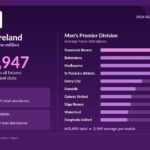
Attendances at fixtures involving League of Ireland clubs exceeded one million for the third successive season in 2026, with a total of 1,053,947 recorded across domestic and European competitions.
While the figure represents a decline on 2025, the absence of league-phase fixtures in the UEFA Conference League and UEFA Women’s Champions League that contributed to last year’s total provides important context.
The numbers suggest that the transformation in the popularity of domestic football over recent years is becoming embedded, though there are areas where further growth will need to be worked for.
The SSE Airtricity Men’s Premier Division attracted 645,694 spectators, with an average attendance of 3,569. That was down five per cent on 2025 but remains 2.7 per cent ahead of 2024. The presence or absence of Cork City from the top flight has a material impact on the figures for both the Premier and the First Divisions.
Shamrock Rovers led the way with an average home attendance of 5,921, followed by Bohemians on 5,165, Shelbourne on 4,561 and St Patrick’s Athletic on 4,462.
The strength of those numbers across the four Dublin clubs is particularly encouraging given the significant stadium investment being planned and delivered across the capital.
Derry City averaged 3,376 at the Ryan McBride Brandywell Stadium, with all ten Premier Division clubs averaging more than 2,000 spectators per game.
The challenge next year will be for UCD to get close to that figure, after their promotion.
First Division Growth
A total of 167,091 attended matches in the SSE Airtricity Men’s First Division, up from 155,259 in 2025.
Cork City were comfortably the biggest draw, averaging 2,831, a figure that would have placed them seventh in the Premier Division attendance table.
Their return to the top flight in 2027 will bring another well-supported club into the Premier Division and should boost next year’s overall figures.
Bray Wanderers averaged 1,079, with Cobh Ramblers, Treaty United and Finn Harps all attracting average crowds of more than 700.
Building the Women’s Audience
Attendances in the SSE Airtricity Women’s Premier Division fell from 36,045 to 34,292, a decline of just under five per cent, with an average of 260 per match.
Bohemians led the way with an average of 521, ahead of Shelbourne on 424 and Athlone Town on 411.
The gap between the leading clubs and the overall league average shows both the potential and the work that remains to be done.
Converting the increased visibility of women’s football at international level into regular attendance at domestic matches remains one of the League’s most important commercial challenges.
There were encouraging signs in individual showpiece fixtures, including an attendance of 1,368 at the All-Island Cup Final between Shelbourne and Galway United.
The Big Occasions
The Club Orange Men’s FAI Cup Final between Derry City and Waterford attracted 36,093 to the Aviva Stadium, once again demonstrating the appeal of the biggest occasion in the domestic football calendar.
Almost 21,000 attended the quarter-finals and semi-finals combined, while European club fixtures generated a further 50,686 attendances despite the absence of league phase football.
The potential for Irish clubs to return to that stage of European competition remains one of the biggest opportunities to lift overall attendance and commercial revenues in future seasons.
Sport for Business Perspective
Breaking the one million barrier for the first time was a statement. Doing so for three consecutive seasons shows something more sustainable.
There will inevitably be fluctuations from year to year depending on promotion and relegation, European qualification and stadium availability.
The next phase of growth will be closely linked to infrastructure. Developments at Dalymount Park and elsewhere will be central to the League’s ability to accommodate more supporters, improve the matchday experience and generate additional commercial revenue.
The numbers also provide a strong platform for SSE Airtricity, Club Orange and the growing number of commercial partners investing in individual clubs.
We wrote yesterday about the sense of anticipation surrounding the release of the 2027 fixture dates. These figures reinforce why there is so much to look forward to.



 The FAI, the League of Ireland and SSE Airtricity, as well as Shamrock Rovers, Drogheda United and Shelbourne, are full members of the Sport for Business Community. If you would like to join them and see your organisation in our content, on our stages, and in the daily conversation around the commercial world of Irish Sport, email us today and let’s see what is possible.
Image Credit: Sport for Business
ABOUT SPORT FOR BUSINESS
Sport for Business is Ireland’s leading platform focused on the commercial, strategic and societal impact of sport. It connects decision-makers across governing bodies, clubs, brands, agencies, and public institutions through high-quality content, events, and insights.
Sport for Business explores how sport drives economic value, participation, inclusion and national identity, and how your story can be part of ours.
Through analysis, storytelling and convening the sector, it helps leaders understand trends, share best practices, and make better-informed decisions. It positions sport not just as entertainment but as a vital contributor to Ireland’s social and economic fabric.
Find out more about becoming a member today.
Or sign up for our Daily Sport for Business Snapshot email bulletins to get a flavour of the material we cover.
Sign up for our News Bulletins here.