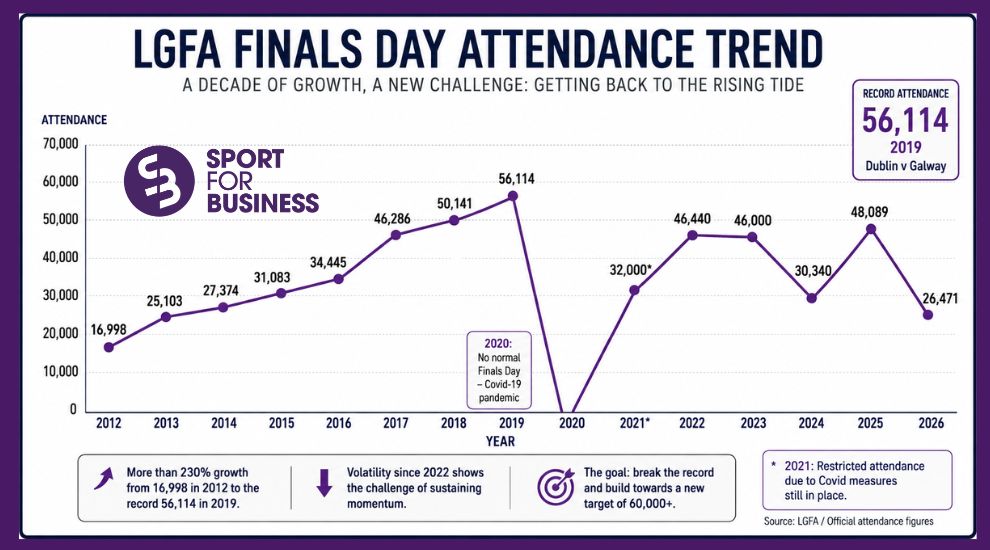
The attendance of 26,471 at Sunday’s TG4 All-Ireland Ladies Football Finals should prompt serious reflection within the LGFA, but it should not be interpreted as evidence that the growth potential of the occasion has disappeared.
It was the lowest unrestricted attendance at the Finals Day since 25,103 watched Cork defeat Monaghan in 2013.
It was also almost 45 per cent down on the 48,089 recorded in 2025 and 52.8 per cent below the record crowd of 56,114 achieved when Dublin faced Galway in 2019.
The scale of the fall matters. So too does the increasingly volatile pattern that has emerged since the pandemic.
There were 32,000 spectators present for the 2021 Finals, when Covid measures and restricted capacity were still in place. Attendances then climbed to 46,440 in 2022 and 46,000 in 2023, before falling to 30,340 in 2024.
Last year’s recovery to 48,089 suggested the event had recaptured much of its former momentum. Sunday’s figure has interrupted that narrative and underlined how dependent the crowd can still be on the finalists, the calendar, and the effectiveness of the advance-sales campaign.
Across the five unrestricted Finals Days from 2022 to 2026, the average attendance was 39,468. Sunday’s crowd was almost one-third below that level.
From sustained growth to volatility
That contrasts sharply with the sustained upward trajectory achieved before the pandemic.
There were 16,998 spectators at the 2012 Finals Day. The crowd rose to 25,103 in 2013, 27,374 in 2014, 31,083 in 2015 and 34,445 in 2016.
The presence of Mayo alongside Dublin in the 2017 Senior Final helped push attendance to 46,286. It rose again to 50,141 for Dublin against Cork in 2018 and then to the record 56,114 for Dublin against Galway in 2019.
From 2012 to 2019, the crowd grew by more than 230 per cent.
That was not an accidental surge. Attendance became part of the LGFA’s public story, supported by affordable family tickets, club mobilisation, national campaigns and a sense that Finals Day represented a celebration of the entire game rather than simply three championship deciders.
It has also been a key part of Lidl’s messaging behind its sustained partnership with the sport. That has succeeded in terms of the sport’s place in the national sporting conversation, and in the growth towards parity in the number of teams fielded at club level and the number of players taking part.
The current challenge is to recreate the sense of collective mission around attendance.
Has the August date played a part?
The changing inter-county calendar deserves to be part of the discussion.
For much of the period in which the LGFA Finals Day attendance was growing strongly, the event was staged in September. It occupied a familiar place in the sporting calendar and came after the men’s senior football and hurling championships had reached their conclusion.
The condensed split-season model has moved the ladies football finals into early August. This year’s event fell on the Sunday of the August Bank Holiday weekend, one of the busiest leisure and travel weekends of the year.
Families may already be away. Clubs are returning to domestic competition. Festivals, race meetings, holidays and other sporting events compete for attention. Supporters travelling from counties such as Galway, Kerry, Antrim, Carlow, Fermanagh and Roscommon also face increased accommodation costs and congested Bank Holiday transport.
It would be reasonable to conclude that these factors make the sales task more difficult.
They cannot, however, provide a complete explanation.
The equivalent calendar shift has not damaged the status or attendance of the men’s All-Ireland hurling and football finals. Those occasions have moved from their traditional September dates to July and continue to operate at full Croke Park capacity.
The men’s finals benefit from generations of tradition, deeply embedded county habits, scarce-ticket demand and a sense that attendance is an annual obligation for supporters of the competing teams.
Ladies football does not yet possess that same automatic demand. That means the date matters more, because the event must actively persuade a large proportion of its audience to attend.
The Bank Holiday weekend may therefore be a contributing factor rather than an excuse. It increases the need for earlier selling, organised transport and a stronger reason to choose Croke Park over competing plans.
A revealing comparison with camogie
The recent attendance trend in camogie offers a useful comparison.
Camogie Finals Day attracted 15,900 in 2012 and 15,063 in 2013, before falling to 12,476 in 2014. It then began a largely sustained climb: 16,610 in 2015, 20,037 in 2016, 20,438 in 2017, 21,467 in 2018 and 24,730 in 2019.
After the pandemic, the crowd reached 23,426 in August 2022 and climbed to a record 30,191 in 2023. It remained at 27,811 in 2024 and 28,795 last year.
Camogie has therefore moved from roughly 12,500 spectators in 2014 to a settled range of 28,000-30,000.
The LGFA’s position is different. It reached a much higher ceiling and has demonstrated the capacity to draw crowds of between 46,000 and 56,000. But its recent attendances have fluctuated much more sharply.
In 2023, ladies football attracted 46,000 compared with just over 30,000 for camogie. This year, the LGFA crowd of 26,471 has fallen below each of the past three completed Camogie Finals Days.
That should sharpen the analysis.
Camogie is not yet close to the LGFA record, but it has established greater recent consistency.
Ladies football has already proved that such crowds are possible. Its task is not to imagine a market from scratch, but to reconnect with one that has previously turned up in exceptional numbers.
Finalists matter, but the event must become bigger than the finalists
The identity and geography of the Senior finalists clearly influence attendance.
Dublin’s population, proximity to Croke Park and supporter base contributed significantly to the record years. Mayo’s appearance in 2017 also brought a large and energised travelling support.
But the finalist argument should not be overstated.
Meath and Kerry attracted 46,440 in 2022, with Dublin not involved. Conversely, Kerry and Galway drew 30,340 in 2024 and 26,471 for Sunday’s return meeting.
The objective must be to build a committed Finals Day audience before the finalists are known.
That means selling the occasion as the national celebration of ladies football, with Junior, Intermediate and Senior counties adding the final layers of demand rather than carrying almost the entire sales burden.
Start selling before the finalists are known
A renewed campaign should begin when the Championship is launched rather than after the semi-finals.
An early-bird family ticket could be offered in spring. Previous purchasers could be encouraged to renew. Every club could be given an allocation target, supported by a simple group-booking and transport system.
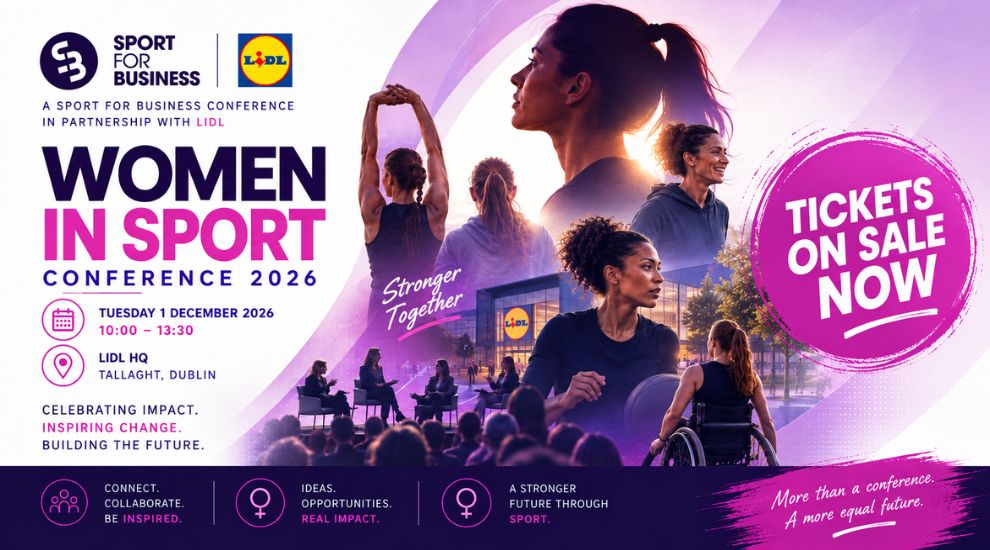
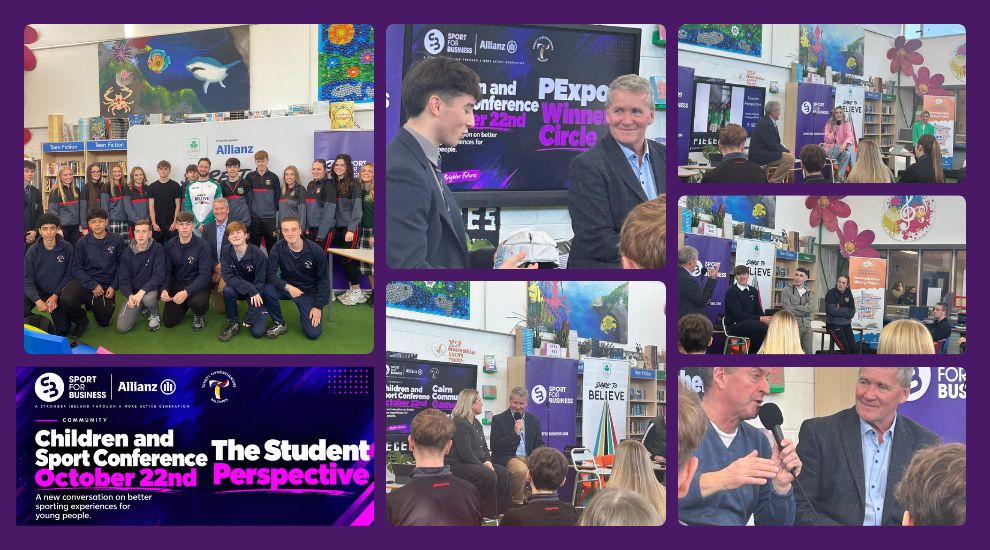
The LGFA and its commercial partners could establish ticket and travel funds for juvenile clubs, schools and community groups, particularly outside Leinster. At the Sport for Business Conference on Sustainable Sport last year, the Department of Transport announced a pilot programme to encourage a return to group travel for major sporting events. That should be investigated.
A public target would help. The earlier “Change the Record” ambition made the crowd itself part of the occasion. A new “Road to 60,000” campaign could recreate that focus without diminishing the importance of what has already been achieved.
The 2019 record should be treated as a platform rather than a distant high-water mark.
Make the Bank Holiday location work
The August Bank Holiday does bring challenges, but it also offers possibilities.
It gives families an additional day for travel and recovery. Dublin has a large number of visitors over the weekend. County associations and sponsors could create organised overnight packages, city-centre activity and supporter gatherings. Better still, could we tap into the ‘Féile’ tradition of Dublin teams reaching out to others with an offer to host families for the night before the final and make a collective adventure of the weekend.
Seven in 10 (70%) people believe a summer day out for a family should cost less than €100, research from Lidl published ahead of the All-Ireland Ladies Football Finals shows. A family ticket for Sunday cost €70, bringing it in that band, so the pricing is not a major barrier
The study conducted through the Lidl Plus app shows that 63% rated attending a live sporting event as their ideal way to spend a summer’s day, with 46% citing the excitement of being part of a live crowd as the biggest attraction. That’s a very solid base to build on.
The Lidl fan zone, county gathering areas, player appearances, skills activities and more visible food and music options would strengthen the proposition for families attending all three games.
The event should feel like the biggest annual gathering of the LGFA community, not simply a day when three matches happen to be held at the same venue.
A challenge, not a crisis
Sunday’s attendance was disappointing, especially after last year’s rebound.
The calendar shift and Bank Holiday timing probably made the task harder. The absence of Dublin and the long travel required of many competing counties also played a part.
But those factors should inform the response rather than define it.
The men’s finals show that a major sporting occasion can retain its demand despite moving away from September. Camogie’s recent figures show that an August Finals Day can build and sustain an audience.
The LGFA’s own history provides the strongest evidence of all.
The rise from 16,998 to 56,114 was driven by clear ambition, coordinated promotion, club mobilisation, and a belief that attendance mattered.
Getting back on that rising tide will require the same commitment again.

 The LGFA, TG4 and Lidl are full members of Sport for Business.
If you would like to be part of the Sport for Business community and see your organisation in our content, on our stages, and in the conversation happening every day around the commercial world of Irish Sport, email us today and let’s see what is possible.
Image Credit: Sport for Business
ABOUT SPORT FOR BUSINESS
Sport for Business is Ireland’s leading platform focused on the commercial, strategic and societal impact of sport. It connects decision-makers across governing bodies, clubs, brands, agencies, and public institutions through high-quality content, events, and insights.
Sport for Business explores how sport drives economic value, participation, inclusion and national identity, and how your story can be part of ours.
Through analysis, storytelling and convening the sector, it helps leaders understand trends, share best practices, and make better-informed decisions. It positions sport not just as entertainment but as a vital contributor to Ireland’s social and economic fabric.
Find out more about becoming a member today.
Or sign up for our Daily Sport for Business Snapshot email bulletins to get a flavour of the material we cover.
Sign up for our News Bulletins here.