 The Government has sought input from those with an interest in Irish Sport on how to frame a new national Sports policy for the next decade.
This is the first time in 20 years that such a framework will be adopted at Government level and it is a crucial opportunity to put sport into its important context as part of overall Government thinking.
Over the coming days Sport for Business will publish a series looking at each of the fifteen areas in which contributions have been sought.
The closing date for making your views known has been extended to January 16th. Details on the Consultation process and how to make a submission can be found here.
The Key Areas of interest and the Sport for Business views on each as they are published over the next week are as follows:
- Contribution of sport
- Participation – Today below
- High Performance
- Local and Regional Facilities – Monday
- National Sports Campus – Monday
- Governance -Tuesday
- Coaching – Tuesday
- Volunteer engagement – Tuesday
- Safety in sport – Wednesday
- Integrity of sport and international influence – Wednesday
- Sport in a cross-sectorial context – Thursday
- Outdoor recreation – Thursday
- Sports Tourism – Thursday
- Financing Irish sport – Friday
- Measuring the impact of sport – Friday
Questions for consideration on Participation
Who should the Government target to increase participation levels in sport – e.g. get the inactive to start participating; get the active more active; or other targets?
It should always be easier to keep a customer than win a new one. That business maxim can similarly apply to sport with the majority of those taking part in any particular code generally having a family or community connection to it. Parents play a sport themselves then hand that on to their children and a bond beyond home and school is formed, hopefully for life.
Government’s role in that can be to make participation as easy as possible through assistance with providing facilities, as in the Sports Capital Programme and potentially through making it financially easier to run clubs through tax breaks.
Enabling advocates of wider community programmes through funding the local sports partnership network of Sport Ireland is a third arm of government assistance and perhaps the most visible in terms of participation. LSP’s were to the fore this weekend in putting on walks under the banner of RTE’s Operation Transformation.
They succeed in getting people moving and while there is always a heavy attrition rate on those getting active for the first time in a long time at this time of year it is still worth persevering with.
One thought might be to work with a partner like RTÉ to develop a similar approach but at a time of year, say in April or May when the weather was more conducive to outdoor physical exercise.
There has to be a target to measure and have an impact. The National Physical Activity Plan has targeted those who are sedentary or inactive with a view to reducing this number by one percentage point a year.
We would suggest however that there be a number of targets, based on age and gender so that the Government approach to physical activity is multi generational with each group within the community encouraging others.
It is how society works best and drawing a line from childhood play to a more active and social approach to physical activity in the elderly can yield benefits beyond a healthier population.
Introducing pilot programmes, evaluating them in quick time and rolling out the most effective can be easier achieved in a digital world and should be part of the overall approach.
How can the reach and influence of the sports sector be used to get more people active, especially those who have been inactive for a long time?
In a celebrity driven world, use of role models both within and beyond sport can be the most effective way of reaching out to people.
A Simon Zebo, Aidan O’Mahoney or Annalise Murphy might not reach much beyond their own fan base but by encouraging that base to reach out to its own peer group it serves a strong purpose.
How about a mass physical exercise ‘stunt’ at a Six Nations Rugby Match where stretching allied to a public awareness campaign on good foods to eat could be tried as an alternative to sitting and watching.
A stretching exercise led by a player or coach would perhaps be most enthusiastically taken up by young fans who would then encourage those who have brought them. The cost would be minimal and any movement is better than none.
How should under-represented groups be targeted in order to narrow the existing gradients in participation levels across the lifecycle, in particular disability, gender and social gradients?
It may be that the traditional mass participation sports are not the best way to tackle these groups. If they were would they still be under-represented?
The gender gap between boys and girls widens in secondary school and this has to be a key area of focus to encourage girls to get more involved.
The success of Irish Paralympic athletes has opened up a world of sport and physical exercise for people with a physical disability. The same is the case with Special Olympics on the intellectual disability side.
Talent identification days can broaden the overall reach of sport but should be backed up by secondary programmes for those who are keen to play but might not be among the elite. ‘Yes I Can’ is a powerful statement of self belief and self determination and bearing in mind we are only five years into a cycle of growth since the London 2012 Paralympics, the growth in participation and involvement is likely to be still in the early stages.
In terms of social groups, the challenge will often lie in terms of facilities. Inner City areas have limited space and the pressure to build housing as opposed to pitches can never be underestimated.
Focusing on activities that can make use of shared or better still public facilities such as existing parks should be encouraged and supports put in place to ‘seed’ the kind of volunteer ethic that drives sport in the higher social gradients.
What is the scope for collaboration between different sports to promote greater participation in sport at all levels?
Sport is by nature competitive and a player or participant is often seen as an ‘asset’ to be protected. In youth the reality is that better sports people emerge from a broad mix of sporting activities.
The physical literacy that is so important to all sports can often best be taught through different forms of play than are most obvious. Gaelic football skills benefit from a grounding in Basketball, before passing those skills on in turn to rugby. Gymnastics is recognised by leading MMA and other coaches as the best form of exercise to encourage flexibility and there are connections that can be drawn in many more.
Whether encouraging greater collaboration is the role of Government, in an area where the major sports are primarily self funding and self governing is another question but there should be a way to highlight self interest for them in developing players who love ‘sport’ rather than just one particular form.
How can support for traditional sports and new emerging sports be balanced with increasing participation levels?
Traditional sports will always provide the bigger numbers because they have the history, the infrastructure and the facilities.
They will maintain the core base of physical involvement in sport but perhaps the greater gains in terms of those not engaged will come in new sports or new variants of those traditional ones.
Rugby Sevens, Five -a- side soccer and social or pop-up versions of Gaelic Games, Hockey, 3×3 Basketball and more will all emerge stronger with changing trends towards less formal engagement with organised sport.
As stated previously the main role of Government here may be to remove barriers rather than play an active role in promotion with facility provision and lower cost being the obvious hurdles over which some control might be exercised.
Can the sports sector provide more support in the delivery of sport in schools?
Schools are a critical area for developing a lifelong engagement with sport.
The major sports tend to be strongest in terms of coaching, programme and organisational support and that is likely to continue though programmes like those undertaken by Rowing Ireland are worthy of analysis and possible replication.
Providing a greater level of access to top venues events for school groups will also serve to fire the mind as well as the muscles.
How should the drop-off points in participation by children and young people be addressed?
The Irish Sports Monitor is restricted to over 16’s at present and expanding this to get a clearer picture of school and youth sport is essential prior to spending money on addressing what are instinctively known as the drop off points.
Going further and asking children, parents, teachers and clubs why they believe sport becomes less important will also be critical.
How should participation in sport be measured?
Back to the Irish Sports Monitor. This is a valuable resource though not without its flaws. Expanding its reach from once every two years and taking seasonality into approach will be important ways to learn more about what we are doing in physical sport from an objective point of view.
The sample size is large enough to be valid but when sliced and diced to take account of regional and other differences it can give some distorted findings.
We would suggest asking the Research experts to come together to design the best possible means of knowing the full sporting landscape and back that. It can be easier done in our digital world than previously and there are easy gains to be made from better knowledge.
How should investment in participation be measured?
Over a longer term than is currently the case.
The ultimate benefit in terms of society as well as financial return is in a nation of people that are physically fitter. The cost of treating preventable illness can be reduced by having people take better care of themselves throughout their lives though that reward has a longer life cycle than any one Government.
In the short term though regular active participation is the ultimate end goal. How that is divided between investment in high performance to inspire activity and the activity itself is perhaps the most important issue to address in this whole exercise.
How can traditional and social media be more effective in promoting sport?
Encouragement of up skilling in the tools which social media now makes possible for less popular sports would yield a strong return in visibility and awareness.
The media landscape is constantly evolving and changing. Across the world broadcasters are seeing niche events as worth investing in but at national level, where Government can have some influence, the most important metric will be the greatest number of people that will be interested in watching, or consuming.
How can the potential of new technology be maximised to increase participation in sport?
The advance of wearable technology has been led through sport but will have its ultimate payback in terms of healthcare and health insurance.
Technology companies like Fitbit have already located EMEA Headquarters in Ireland and a greater collaboration between Government and business as well as sporting bodies should be encouraged.
Perhaps the rising cost of health insurance could be offset by monitoring of physical activity. Bring insurance companies into the mix to encourage pilot projects whereby greater data about an individual can lead to benefits in terms of the cost of healthcare.
We appreciate there is a ‘big brother’ tint to this but self awareness and self improvement need to be actively encouraged and what better way that through a financial reward open to anyone willing to participate.
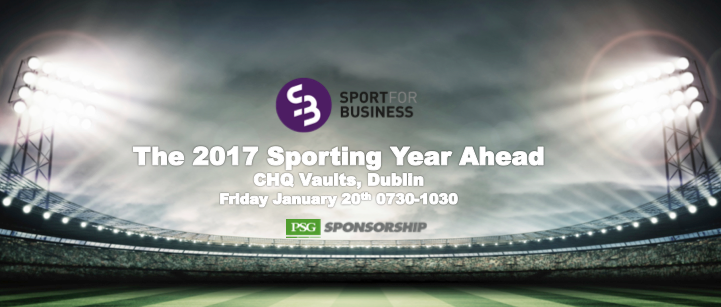
Join us for a morning of learning, networking and insight on the sporting year ahead and the sponsorship trends that will impact upon us on January 20th. Reserve your place now.