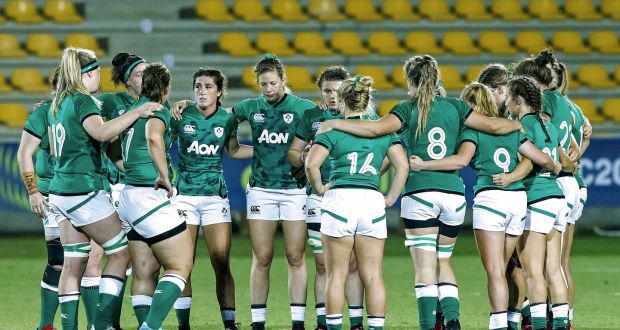
This weekend in Toulouse The Irish Women’s Rugby 7’s, as well as the men’s will lok to seal automatic qualification for the Paris Olympic Games of 2024.
There will be a celebration of a notable milestone in the development of a variant of Rugby that was often dismissed by traditionalists but in which we are now working away at the elite end of the sport.
The fact that we have a relatively small adult player base of just over 3,000 means that trying to compete in both codes of sevens and 15’s is challenging. There are more adult women registered to play Ladies Football in Dublin alone.
Players like Aimee Leigh Murphy Crowe, Beibhinn Parsons, Lucy Mulhall and Stacey Flood would make a significant impact had they been available to play in this year’s TikTok Six Nations but an Olympic qualification likely means they are gone for at least another year.
The growth of Talent ID and Pathways coaching staff announced yesterday is a very positive step forward. The enthusiasm of coaches like Larissa Muldoon who we heard from yesterday, Niamh Briggs, Matt Gill and others, as well as their presence within the system means that the number and the quality of players coming through will increase but it will take time.
And there will be many more bumps along the road. We still hear on too regular a basis that games are being called off because of teams’ inability to field, that players are left scrambling for the scraps of pitch allocations and that the headline numbers of players are not reflected in reality.
But we have to take the IRFU at their word. That 3,000 number is up by more than double on where it was in 2018, and that was after a period of sustained success. There are over 5,000 playing at youth level, again a number that is more than double what it was last year.
Genuine
Kevin Potts as CEO is genuine in his desire to prioritise Women’s Rugby. The appointments of Gillian McDarby and others in the High-Performance and Participation side of the game is positive.
Potts asked us yesterday to look forward and that is the right thing to do but in order to understand the pitfalls of not getting it right again we have to look back for perspective.
In 2002 Ireland played England in Worcester, with Fiona Steed and Lynne Cantwell in the line-up. They lost by what was at the time a record 79-0.
This year’s 48-0 defeat in Cork looks better by comparison. It took eleven years to bounce back so that by 2013 Ireland were winning a Grand Slam and getting to the semi-final of a World Cup.
That was a platform to build a sustainable level of number of players and achievement on a world stage but it did not happen and we have to look at why.
In 2013, according to IRB (the predecessor of World Rugby), data Ireland had 3,277 registered adult players and 9,854 registered youth players. England in that year only had 7,001 and 14,241 registered players by comparison.
Ireland did the right thing at a global level and successfully bid to stage the Women’s Rugby World Cup Finals. It was a well-organised tournament played in Dublin and Belfast but by that time the team performance had been overtaken.
From 2022 to 2013 we somehow created a solid foundation but within four years it had failed. This year’s Six Nations was the low point of this cycle.
Grab Hold
In that period to 2017, when Women’s Rugby had an opportunity to grab hold of more players and build on a successful team, we only managed to get to 21 percent of clubs across the country fielding in the Women’s game.
Imagine if in four years’ time, that 80 percent of football clubs did not cater for girls wanting to play after the Vera Pauw era. It’s impossible.
We reap what we sow and the fact that the number of players now is still below what it was ten years ago is an indictment of what happened, or more pertinently perhaps did not.
There was no lack of effort on the part of those who were trying. But they were clearly banging their heads against an intransigence within the sport that failed to recognise the Women’s game as a priority.
Former CEO Philip Browne told an Oireachtas Committee in 2017 that the reason there were hardly any women in positions of authority within the sport was that they had “not yet accumulated the rugby wisdom and the right skill set to fit any quotas that might be imposed.”
Is it any wonder that good people were unwilling to step into that kind of thinking?
But let us take the new regime as being one where the lessons of the past have been learned.
The structures announced yesterday, the number of children being introduced to the sport, the fact that now 59 per cent of clubs are fielding a Women’s team are all positives.
Sevens Olympic qualification would provide a boost and a positive story and there is hope that winning the inaugural bottom level on the new WXV Tier 3 in the Autumn will allow for promotion straight away and a more positive outlook going into 2024.
Tomorrow morning we will look in detail at the struggles facing the Energia AIL Women’s League as it tries to expand