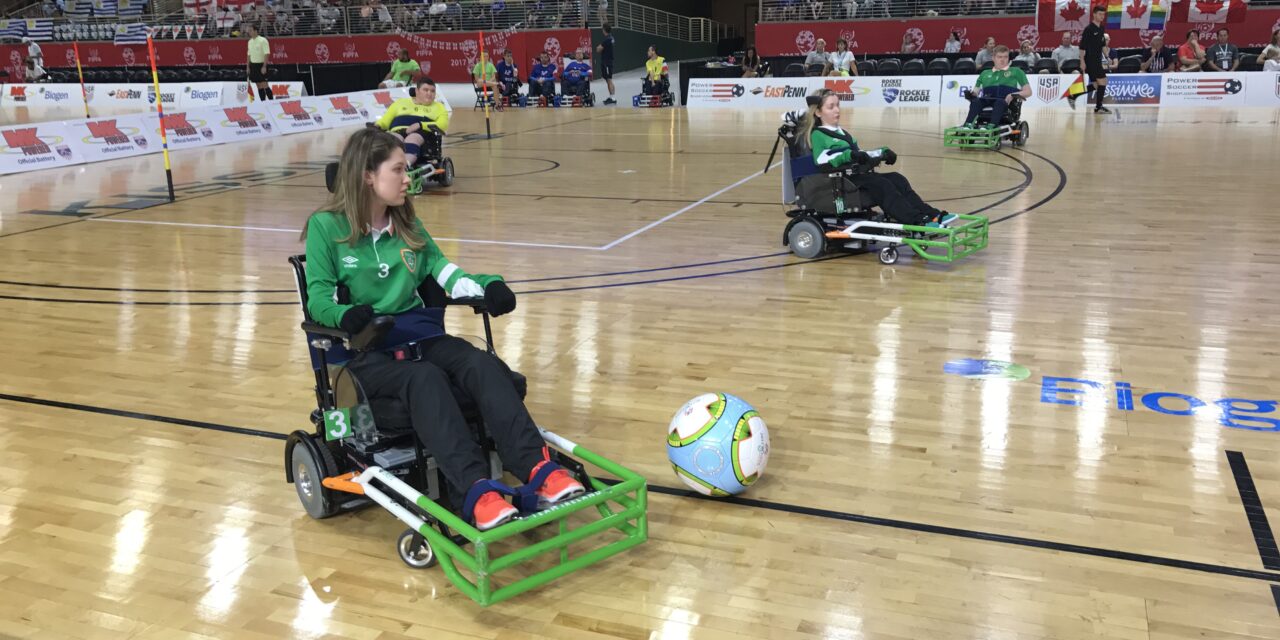

Ireland’s Powerchair Footballers finished sixth at the World Cup in Florida which completed at the weekend and also came away with the tournament’s Fair Play Award.
A tough group campaign against against eventual winners France and the United States was turned around with wins over Uruguay and Canada before eventually going down 2-1 to Japan in the play off game to determine a top five finish.
Thomas Donagher, at age 16 was the star of the Irish team scoring six goals through the tournament.
While Ireland competed on invitation in the World Cup in 2011, this was the first time the Irish team has had to qualify for the World Cup, and follows on from the squad’s participation in the European Championships which were hosted in Limerick in 2014.
Nine players travelled to Kissimmee, along with a team of carers, coaches and back-up staff.
Powerchair football has existed since the 1970s in some form or another, but it was not until 2005 that representatives from France, the United States, Canada, Japan, England and Portugal met in Paris to discuss formalising the sport and develop a set of international rules. This led to the establishment of the Federation Internationale De Football Association (FIPFA), and the first World Cup took place two years later.
The Association of Irish Powerchair Football was established in 2008 and oversees the growth and development of the sport in Ireland, in partnership with the Football Association of Ireland and Muscular Dystrophy Ireland.
Powerchair football is played indoors between teams of four players with men and women competing on the same team. Players use customised motorised sports powerchairs to move a size 10 football around the court. Players are classified based on level of impairment, and a classification process will take place prior to the first games.
It is an inspiring example of how sport can help to overcome the greatest challenges you can have thrown at you.
The World Cup tournament was sponsored by Biogen one of the worl’s largest drugs companies. They have an operation in Ireland and if the World Cup was deemed to be a success which it undoubtedly appears to be it may be that they will be able to find some way of supporting the Irish team into the future as well.
 Sport for Business works with over 220 of Ireland’s leading organisations in sport and business. We regularly feature in depth looks at how members like the FAI, GAA, Sport Ireland, AIB, PwC, Liberty Insurance, Allianz and many more bring the relationship between sport and business to life. Here is a look at what we do…
___________________
Find out more about our next major event looking at the impact of Sport for Social Good in September 2017.
___________________