Welcome to the sixth article in our Sports Economy series.
The Significant and Unequal Impact of Covid
Both Irish sport and the wider economy began 2020 in a good place. Irish Sport had experienced a prolonged period of growth and from 2012 to 2019 employment in the sector, according to the Eurostat definition of ‘sport’, increased by 35.6% and constituted a relatively important source of employment for Ireland versus EU peers.
However, as the Covid-19 crisis began to spiral, the wider economy went from near full employment at the beginning of the year to unprecedented levels of unemployment.
In September senior officials from the three largest sporting bodies in Ireland, the GAA, IRFU and FAI, stood in front of the responsible Oireachtas Committee outlining the devastating impact of the pandemic.
This article will show how the Covid-19 health crisis and the related safety measures have had an unequal impact across the Irish economy.
Given that the Irish economic consequences of the pandemic have been most visible in the labour market this article will show the number of those within sport that have lost their jobs and sport’s employment performance since the beginning of the crisis relative to the rest of the economy.
The duality of the Irish Economy
Despite the scale of the global pandemic, the economic impact on Ireland’s macroeconomy when measured by Gross Domestic Product was relatively mild in Q1 and Q2 of 2020.
According to the Economic and Social Research Institute (ESRI) despite having the third-largest consumption fall across European countries, Ireland’s GDP decline was the sixth smallest, mainly due to robust export growth.

The economic impact of the pandemic, as measured by ‘value added’ for the first six months of 2020, has not been equally distributed across sectors with ‘industry’ +11% and ‘arts, entertainment and recreation’ -72%.
Furthermore, the cross-sectional performance of these sectors versus EU countries has also varied greatly. In summary, the unique structure of the composition of Irish exports due to the prevalence of big-tech and pharma masked large economic adjustments in other sectors.
The Impact of Covid on Sport
While there is wide appreciation of the social, health and wellbeing benefits of sport there has been limited public discussion of its economic contribution and of the substantial economic loss associated with Covid restrictions unlike other sectors such as hotels, pubs, arts, entertainment and aviation. Thousands of sports jobs are threatened or already lost.
The Labour Force Survey (LFS)we discussed previously is a survey of 32,500 households who are asked to self-identify their employment circumstances.
One person answers for all the individuals in the household. The LFS numbers are available at the end of each quarter and are classified by economic sector thus providing up to date employment statistics for sport, recreation and amusement. Hereafter within this article ‘recreation and amusement’ will be referred to as ‘recreation.’)
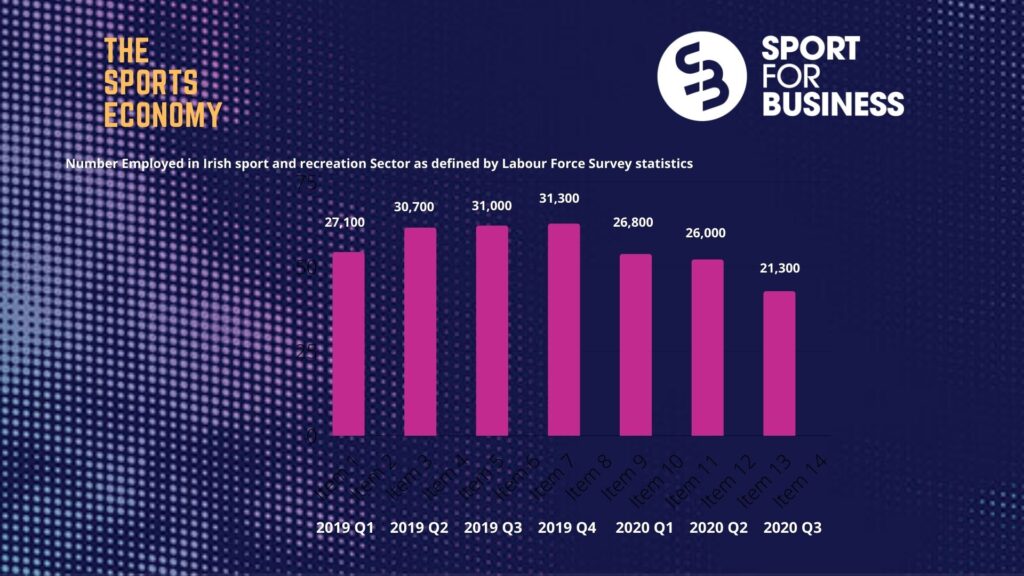
From Q4 2019 to Q3 2020 the number of people employed in sport and recreation activities in Ireland decreased by 32%. To put this number into context, The LFS reported total employment of 2.36M at the end of 2019, if the whole economy had been hit as severely as sports and recreation we would currently be talking about the loss of 750,000 Irish jobs.
The major drawback of the LFS for our purposes is that an individual sports activities figure is not published. However, we can back out an approximation of the share of sport alone, using another source of data compiled according to the Nace code, the Annual Services Inquiry.
The ASI is a survey of 17,500 enterprises which complete employment information on behalf of their employees. The ASI does not provide any data fresher than 2018 but because it breaks down sport (93.1) and recreation (93.2) into individual reporting categories we can compute the average relative share of each and apply this rate to the up-to-date wider LFS sport and recreation number to get a fresh, sport-only, figure for number employed.
According to the ASI, sport employment as a percentage of total sport and recreation employment has been fairly constant between 2008 and 2018. The highest share was 89.21% in 2010 and the lowest 87.45% in 2014, a range of under 2%, thereby confirming that sport (93.1) represents the lion’s share of sport and recreation (93).
Combining the fresh Q3 2020 LFS data with the average share of sport observed from the ASI 2008-2018 we can estimate that over 9,000 people in Irish sport have lost their jobs since the end of 2019.
I must acknowledge a measurement difficulty in definitively estimating the impact of Covid on employment levels. Not only does survey data always carry with it a margin of error but there are currently issues interpreting the LFS data. For example, someone who is temporarily not employed due to Covid closure could still consider her/his self as employed but just temporarily not in that job. Hence the figures are subject to interpretation as opposed to an unambiguous statement of trend. For example, the Central Statistics Office currently give two national totals reflecting the different definitions of employed versus unemployed. Overall, the actual decline in sport job opportunities due to Covid is possibly higher than the already high 32% decline noted above.
These numbers confirm what is intuitively to be expected from the prohibition of crowds at elite sports and the cessation of most non-elite sports activities that sport, given its unique characteristics, is one of the sectors most susceptible to the negative effects of the pandemic.
To investigate this further we can look at how has sport has fared vs other sub-sectors.
Of the 99 NACE sub-categories (numbered in a two-digit style 01 to 99) the LFS reported Q3 employment numbers for fifty-seven sectors. Twenty-five of these sectors actually had a positive gain during the period of Q4 2019 to Q3 2020, one experienced no change and thirty-one saw declines showing the uneven impact of the Covid-19 crisis as some sectors of the economy have been able to return to work sooner than others and some have done quite well.
Sport and recreation has been hit the hardest of all economic sub-sectors measured by the Labour Force Survey from Q4 2019 to Q3 2020.
It has declined by 32 per cent.
The ESRI has provided some commentary that is relevant to understanding why sport was so severely affected.
They note that ‘despite the national unemployment rate likely to be approximately 17 per cent for the year as a whole, income tax receipts were down by just 1.4 per cent for the year to August. This suggests that in the main, the labour market impact of COVID-19 appears to be concentrated in relatively low paid jobs’. We showed within Article 2 of this series that average wages within sport were less then €25K (as of 2018).
The ESRI have also shown that of those claiming the pandemic unemployment payment a relatively high proportion were young. The demographics of sport employment warrants investigation and will be further explored in a future article within this series.
Sport employment badly hit
In summary, as of now, we can identify from official statistics that sport has been among the worst, if not the worst, sectors in terms of employment decline due to Covid and the associated measures. Consequently, the degree of support from Government should reflect this.
 Conor Foley has a business degree from Trinity College Dublin, an MSc in finance from DCU and is a Chartered Financial Analyst. Over a 12-year professional career, Conor has experience of advising clients such as institutions, charities and bodies in the areas of global strategy, project management, asset allocation and financial structure. Conor will be working with Sport For Business to produce The Sport Economy, a regular piece, offering insights from the domestic and international sporting worlds of finance, economics and business, aims to bring Sport For Business members lessons and information from around the world to aid you in your strategy, financial affairs and business decisions. Conor has worked in leading financial institutions both at home and abroad and is committed to the growth and development of professional and amateur sport in Ireland.
Sport for Business Partners
[logo_carousel_pro id=”51608″]