There are lies, damned lies and statistics but major population based surveys into behaviour do tend to reveal facts rather than assumptions. The latest Sports Monitor from Sport Ireland reveals a series of uncomfortable facts that will have caused an uneasy nights sleep within a number of sporting bodies.
The survey is conducted every two years and looks at how people engage in sport. The good news first, which was to the fore in the press statement released yesterday, is that sedentarism, or people doing no physical activity at all is down in the period May to October 2015 from 11.4% to 10.8%. That is a significant improvement and on target to hit the National Physical Activity Plan to reduce that number by 1% point each year over the next four years.
There is also good news in that those who are active are becoming more so. there are now 33.4% of the population achieving the national guideline number of five periods of sporting or physical activity in a week, up from 32.6%.
The problems start to emerge though in relation to the overall number of people participating in sport as opposed to activity, the number of which is down for the first time in six years, from 47.5% in 2011 and 48% in 2013 to 46.3% in 2015.
This is the absolute number who said they had participated in sport over the last seven days. The figures are comparable though they do only take in the first six months of the cycle, from May to October and could yet change. They are up from a low point of 32.9% in 2007 when the Monitor was started but the falling back will cause alarms among sports and officials charged with producing ever greater participation numbers to justify investment and improve the health and wellbeing of the nation.
The breakdown of the ten most popular forms of sporting or physical activity points toward a longer term trend of individual as opposed to team based participation, at least among the adult population and that could have implications for how capital investment is planned.
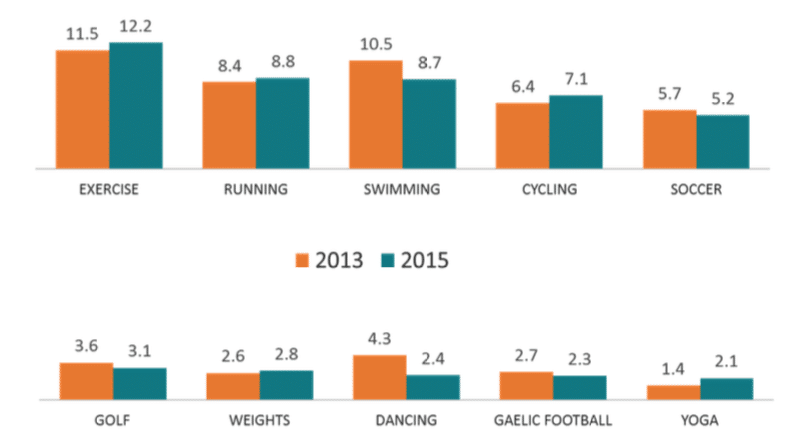 Swimming has benefitted from substantial upgrading of the national stock of swimming pools and remains in the top 3 of activities but a drop from 10.5% of people swimming in the last seven days to 8.7% means it has been overtaken by running and is not a number to take for granted.
Soccer remains the largest of the major field sports but it’s numbers are also down, from 5.7% to 5.2%. Gaelic Football is also down 2.7% to 2.3%, again among the 16+ adult population. Hurling or Camogie adds another 1.7% to the overall Gaelic Games total but is treated separately in this survey enabling yoga to burst into the top ten for the first time with a participation rate up from 1.4% to 2.1% over the past two years.
Golf will be concerned at the fall from 3.6% to 3.1% which would not have been expected at a time when the economic situation blamed for previous falls was actually improving.
Of those other sports outside the top ten the most notable include Rugby at 1.0% and Tennis at 0.9% participation.
Gym based exercise continues to rise as does running, no doubt boosted by Park Runs and the biggest relative rise has been achieved by cycling up from 6.4% to 7.1%.
The question of why these numbers are shifting, and how, is being pored over now and some evidence can be gleaned from other areas of the report.
The most obvious is that as economic circumstances have improved, peoples ability to devote time to sport and physical activity is lessening.
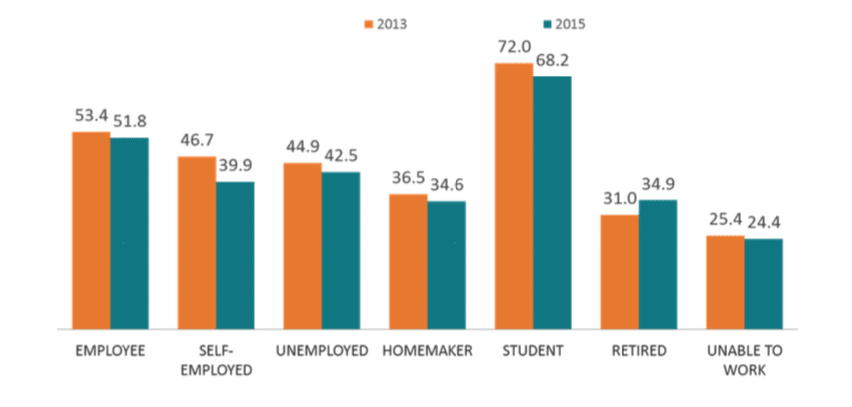
The biggest single drop across the different demographics is in the self employed of whom only 39.9% are now active over a week as opposed to 46.7% two years previously.
Does this mean that a rising tide of financial wellbeing is incompatible with the same in the physical wellbeing that exercise and sport generates? Acceptance of that would be to admit to failure in an area that is too important and so should be challenged.
The shift towards individual and informal as opposed to team based activities is more complex. It reflects the trend towards personalisation and away from broader community that has been driven by entertainment, communication and other areas. The formation of running and cycling groups though is also, more anecdotally on the rise so this is an area that may warrant further exploration on how to encourage activity through the peer exhortation that being part of a team would always have done naturally.
Is it a case that the main field sports, which continue to attract the lions share of viewership, sponsorship and engagement are becoming more and more skewed towards the elite players and the kids for whom organised activity is still more accepted as being the norm.
Perhaps adapted versions of tag rugby, five a side soccer and social gaelic football need to have more of a push from national level as opposed to more commercial operators, to shift the trend from watching back towards playing.
This report is not a comfortable one as they have been more recently where everybody could pat themselves on the back and say ‘it’s working’.
Better though to have the information and act to change the behavioural shift than to ignore it. As ever the hardest work starts now.