The Irish Sports Monitor is an annual survey of more than 8,000 adults into their sporting and physical activity habits and engagement.
There is a wealth of data to absorb. We thought it would be useful to run a series over the coming days looking in specific detail at how the data relates to specific population cohorts and what it might mean for future policy development.
Today we start with a focus on age.
Spotlight on age – Sports participation
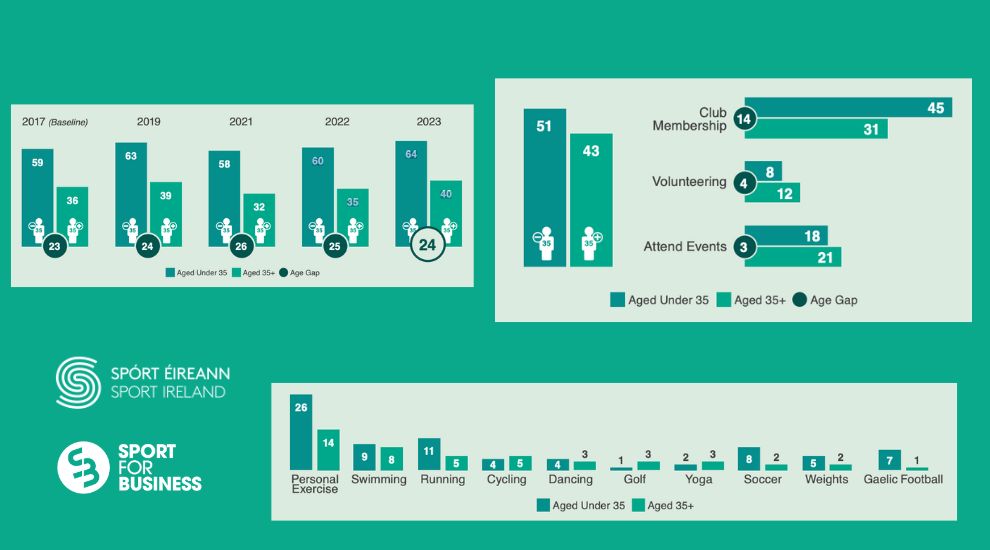
• Levels of sports participation increased among both the younger and older age groups during 2023, with 64% of those aged under 35 and 40% of those aged 35 and over playing sport regularly (2022, 60% and 35% respectively). This follows similar increases in the previous year meaning that sports participation levels for both groups are now aligned with pre-pandemic levels from 2019 (Aged under 35 63%, 35 and over 39%).
• A consistent feature of the ISM has been a sharper decline in participation among men as they age. This is reflected in the 2023 results with the higher levels of participation among men aged under 35 (men 68%, women 60%), eliminated in those aged 35 and over as 40% of both men and women were regular sports participants.
• The age gradient in sports participation has remained remarkably consistent over the duration of the ISM series with the existing 24 percentage point gap in participation broadly the same as that measured in 2017 (23 percentage points).
• Personal exercise was the most popular activity among both age groups although there were much higher levels of participation among those aged under 35 (26%) than among those aged 35 and over (14%). Strong age gradients were also evident in running (Aged under 35 11%, 35 and over 5%) and
soccer (Aged under 35 8%, 35 and over 2%).
• Among sports participants, younger people were more likely to play multiple sports with 41% of those aged under 35 and 32% of those aged 35 and over playing more than one sport.
Spotlight on age – Social participation
• A 5 percentage point increase in social participation among both age groups meant that the 8 percentage point age gradient in social participation was unchanged since 2022. Just over half (51%) of those aged under 35 participated socially in sport, compared with 43% of those aged 35 and over.
• The age gradient in social participation was entirely due to the higher levels of club membership among those aged under 35, with a 14 percentage point gap in club membership between the two age groups (aged under 35 45%, aged 35 and over 31%).
• For both volunteering and event attendance participation was higher among those aged 35 and over, albeit there was a narrower gap in both cases (volunteering 4 percentage points, event attendance 3 percentage points).
• While social participation across most age groups was broadly aligned with that measured in 2019, participation levels have not yet recovered among those aged between 25 and 34 (43%). Prior to the pandemic, in 2019, 49% of those aged 25 to 34 had a regular social participation in sport, 6 percentage
points higher than in 2023.
• The pattern of volunteering and event attendance across the life course was aligned with previous waves. Volunteering levels were highest among those aged between 35 and 54 (16%), and lowest among those aged 20 to 24 (7%) and aged 65 and over (5%).
• Event attendance followed a similar pattern, although is unique in that higher levels of attendance are seen among those aged 16 and 19 (27%) before a decline between the ages of 20 to 34 (14%), followed by a rise again aged 35 to 54 (25%).
Spotlight on age – Broader physical activity
• Unlike many forms of sports participation, the incidence of recreational walking increases across the life course. However, changes in the nature of recreational walking over the past number of years means that the gradient across the life course is not as steep as it once was.
• Over two thirds of both those aged 16 to 19 (69%) and aged 20 to 24 (67%) walked regularly for recreation, rising to 73% of those aged 55 to 64 and declining again to 66% of those aged 65 and over.
• It is worth noting that the proportion of younger people walking for recreation has increased substantially in the past few years. ISM 2019 found that 60% of those aged 16 to 24 walked for recreation, increasing to 69% in 2023. The proportion of older people walking recreationally has remained broadly unchanged.
• Both forms of active travel showed strong age gradients, with 63% of those aged under 35 walking for transport on a regular basis compared with 39% of those aged 35 and over. The proportion of those aged under 35 cycling for transport was also substantially higher than it was among the group aged 35 and over (12% and 7% respectively). This gradient has remained broadly consistent over time.
• Cycling for transport was highest among those aged between 16 and 19 with 18% in this age group regularly cycling for transport. This declines to 9% of those aged between 20 and 24, and remains at that level until the 45 to 54 age group before a further decline occurs.
• Among people aged 16 and 34, 45% met the National Physical Activity Guidelines, compared to 37% of those aged 35 and over. Additionally, the proportion that were inactive was notably higher among those aged 35 and over (14%) compared to those aged under 35 (6%).
• There was no age group where the majority of people were categorised as highly active. Almost half (49%) of those aged between 16 and 19 achieve this level of activity, and this declines gradually over the life course to 32% of people aged 65 and over.
• Equally, the proportion that is inactive rises across the life course, increasing from 3% of those aged between 16 to 19 to 23% of those aged 65 and over.
Tomorrow’s spotlight will be on Gender
Sport Ireland are full members of the Sport for Business Community.
The Sport for Business Membership comprises nearly 300 organisations including all the leading sports and sponsors, commercial and state agencies.
Find out more about joining us today.

Be part of the biggest community of sporting and business organisations in Ireland by becoming a member of Sport for Business and enjoying a host of benefits.
Check out our upcoming events to discover ways of connecting in person with our membership.