Ireland’s emergence as a genuine force in European athletics was emphatically reinforced in Birmingham, where a four-medal haul matched the record total achieved in Rome two years ago and came with a breadth of performance that was arguably even more impressive.
Two gold medals, one silver and one bronze left Ireland ninth on the medal table. More importantly, all four medals came in individual events and across four very different disciplines: Mark English in the 800 metres, Kate O’Connor in the heptathlon, Rhasidat Adeleke in the 200 metres and Andrew Coscoran in the 1500 metres.
English provided one of the great moments of the week. At 33, and after five previous European medals indoors and outdoors, he finally reached the top step with a superbly judged victory in the 800 metres in 1:45.26. It made him the first Irish man to win an outdoor European Championships title and was a fitting reward for an athlete whose consistency at this level stretches back more than a decade.
Only minutes later, Adeleke produced another significant performance in the women’s 200 metres. Her 22.28 seconds for silver behind Britain’s Amy Hunt was a new Irish record and particularly impressive given the disrupted season that preceded Birmingham. Adeleke had only secured the qualifying standard at the National Championships after injury had interrupted much of her summer. To arrive at a major championship and produce the fastest 200 metres ever run by an Irish woman was an important reminder of her ability to deliver when it matters.
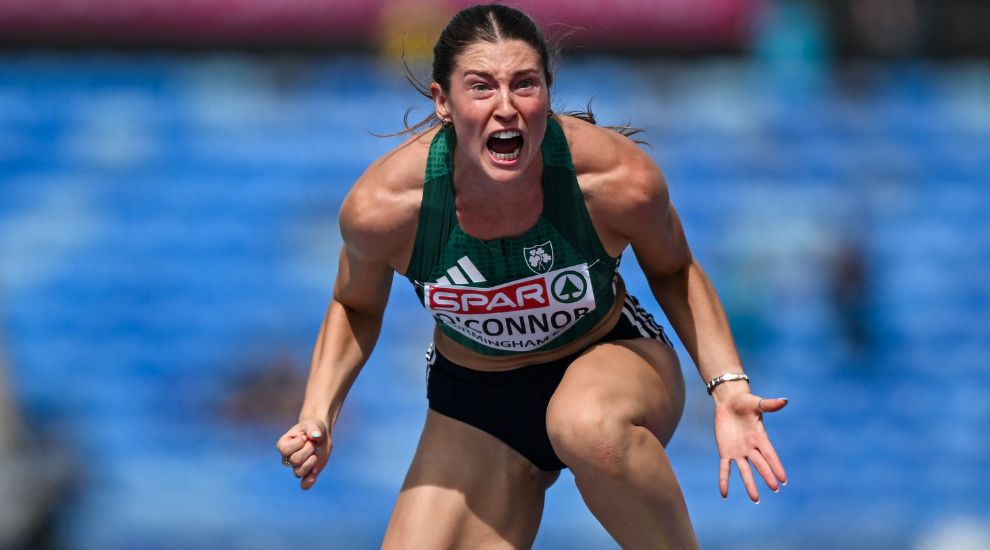
The second Irish gold came from Kate O’Connor, who accumulated an Irish-record 6,751 points to take the heptathlon title, adding European gold to the World Championship silver she won in 2025 and her Commonwealth title earlier this summer. A personal best in the long jump and a 50.16-metre javelin were central to a performance which demonstrated both her extraordinary consistency across seven events and her growing ability to control a major championship.
Andrew Coscoran then provided perhaps the most dramatic medal of the four. He was back in seventh with 200 metres remaining in the men’s 1500 metres before committing to a gap on the inside and producing a powerful finish to take bronze in 3:36.24. At 30, and after years spent on the margins of global and European finals, it represented a first senior outdoor championship medal and another demonstration of the depth now evident in Irish middle-distance running.
There was plenty beyond the podium to suggest that this was more than a championship illuminated by four individuals.
Sarah Healy came within three-tenths of a second of bronze in the 5000 metres, finishing fourth in 15:40.95 in only her second serious outing over the distance. She then returned to finish fifth in the 1500 metres, with Sophie O’Sullivan eighth in the same final. Two top-five finishes across two events made Healy one of Ireland’s strongest performers of the week even without a medal.
Nicola Tuthill continued her rapid progress in the hammer, improving from ninth at the 2024 Europeans to fifth in Birmingham with 70.33 metres. The women’s 4×100 metres quartet of Lucy-May Sleeman, Ciara Neville, Sarah Leahy and Lauren Roy lowered the Irish record to 43.13 seconds in qualifying before finishing seventh in the final.
Nick Griggs also reached the top eight in the 5000 metres, while sprinting performances across the programme showed a greater Irish presence at championship level than would have been imaginable a decade ago.
Not everything went to plan. The absence through injury of Sharlene Mawdsley removed one of Ireland’s strongest individual 400 metres prospects and inevitably weakened the relay challenge. The marathons produced a difficult final morning, while Sarah Lavin and some of the younger members of the team will have left Birmingham believing there was more available to them.
That, though, is almost part of what made the championship significant.
Ireland did not require every major medal hope to fire in order to win four medals. Neither did it depend on one discipline or one exceptional generation. The medals came from a sprint, two middle-distance events and the most demanding combined event in athletics, while leading Irish athletes were contesting European finals in throws, distance running and relays.
For Irish athletics and its high-performance programme, the ambition heading towards Los Angeles 2028 is no longer simply to produce isolated athletes capable of making global finals. Ireland now has an increasingly broad group for whom making finals and challenging for medals at European level has become the expectation.

 Athletics Ireland and 123.ie are full members of Sport for Business.
If you would like to be part of the Sport for Business community and see your organisation in our content, on our stages, and in the conversation happening every day around the commercial world of Irish Sport, email us today and let’s see what is possible.
Image Credit: Athletics Ireland and Sportsfile
ABOUT SPORT FOR BUSINESS
Sport for Business is Ireland’s leading platform focused on the commercial, strategic and societal impact of sport. It connects decision-makers across governing bodies, clubs, brands, agencies, and public institutions through high-quality content, events, and insights.
Sport for Business explores how sport drives economic value, participation, inclusion and national identity, and how your story can be part of ours.
Through analysis, storytelling and convening the sector, it helps leaders understand trends, share best practices, and make better-informed decisions. It positions sport not just as entertainment but as a vital contributor to Ireland’s social and economic fabric.
Find out more about becoming a member today.
Or sign up for our Daily Sport for Business Snapshot email bulletins to get a flavour of the material we cover.
Sign up for our News Bulletins here.