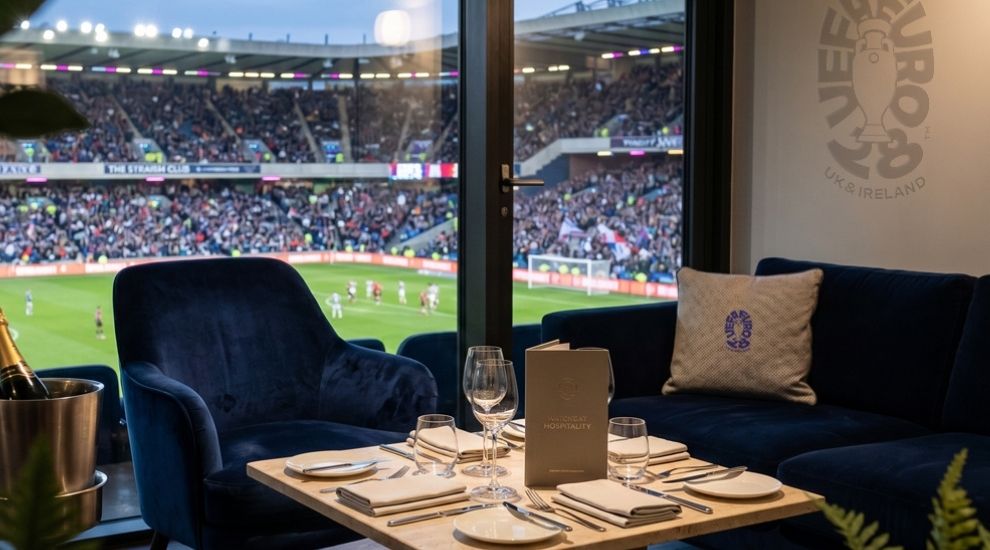
With elite corporate hospitality for UEFA EURO 2028 set to go on sale, Sport for Business spoke with Jaime Byrom, Executive Chair of BEYOND Hospitality, about the scale of the opportunity, the changing premium sports market and why Dublin could prove one of the tournament’s strongest hospitality destinations.
UEFA EURO 2028 will bring one of world sport’s biggest events to the UK and Ireland, with the Aviva Stadium in Dublin set to host seven matches and create a major opportunity for Irish business, tourism and the wider sports economy.
The opening of sales for the tournament’s Official Hospitality programme next week marks one of the first major commercial milestones on the road to 2028.
BEYOND Hospitality has been entrusted with delivering the programme across a tournament that will bring together 24 teams and 51 matches, with a range of products stretching from supporter-focused shared environments through to private Skyboxes and elite corporate entertainment.
For Dublin, the opportunity goes beyond the action on the pitch.
The city’s reputation as an international destination, its connectivity to the UK, Europe, North America, and Ireland, and Ireland’s growing track record of attracting international visitors to major sporting events all provide the foundations for what could be a significant hospitality market.
On the eve of sales opening, we spoke with Jaime Byrom, Executive Chair of BEYOND Hospitality, about what lies ahead.
How significant is UEFA EURO 2028 for the sports hospitality market across the UK and Ireland, and how does it compare with other major events you have worked on?
UEFA EURO 2028™ is an unprecedented opportunity for the sports hospitality market across the UK and Ireland, given its scale, geographic breadth and profile. It will span 51 matches, 24 teams and nine stadiums across four host nations, taking premium hospitality beyond London and into multiple markets. It also combines the global appeal of a major international football tournament with domestic and regional (Europe) relevance, to be staged in an extremely mature and established football market (the UK and Ireland).
The prospect of having four host nations for a tournament driven by team allegiance, featuring 51 matches played in established, well-equipped venues, presents our project realisation team with a tantalising opportunity to deliver at our very best!
What have you learned from delivering hospitality around events such as the Champions League that will shape the experience being created for EURO 2028?
Our experience has shown us the importance of strategic planning around the specific advantages and conditions of each host nation(s). Everyone is different. Consider how compact the 2022 World Cup in Qatar was compared to the sprawling FIFA Club World Cup 2025 in the USA. Additionally, it’s key to ensure hospitality feels like an integral part of the event rather than a separate layer. That means connecting the lounges and venues, guest services, food, seating and matchday atmosphere into one coherent tournament brand and sense of occasion, with clear product differentiation for different customer needs.
How has demand for premium sports hospitality changed in recent years? Are you seeing growth primarily from corporate buyers, individual supporters, international visitors or a combination of all three?
Demand is broadening across the market, with corporate buyers remaining an important driver while affluent individuals, as well as general groups and passionate fans are increasingly willing to invest in premium experiences themselves. Customers are also looking for more than a premium seat, with food and beverage, atmosphere, service and the overall sense of occasion all contributing to the value. International visitors are another important growth opportunity, particularly as major sporting events become part of wider travel plans, while domestic fans remain a substantial part of the market.
What will distinguish the EURO 2028 hospitality experience from simply buying one of the best seats in the stadium?
It is the whole experience, not just the seat: premium food and beverage, high-quality surroundings, dedicated service and welcome desks, and an experience that starts before the match and continues afterwards. Just as importantly, it provides certainty: everything is organised in advance, including access, seating, F&B and, crucially, guaranteed tickets to the matches guests want to see. The seat remains important, but it is a part of a complete offering, allowing guests to focus on entertaining, socialising and enjoying the football. For many guests there is also a networking and hosting element, in varying degrees of privacy. This is of particular interest to high-profile guests and corporate teams. The Official Hospitality programme is a massive undertaking that includes entertainment, interactive features, special guests, and surprises. We aim to delight our guests and create lasting positive memories.
There is a very wide potential customer base, from major companies entertaining clients to groups of supporters marking a special occasion. How are you designing packages to appeal across that spectrum?
The portfolio is designed to span from accessible, fan-focused hospitality to ultra-premium private Skyboxes, rather than treating hospitality as a single product. Each level offers a different expression of the experience, from atmosphere, food, drink and great seats, through to more refined F&B, service, comfort and exclusivity. This gives individual supporters, groups, and corporate buyers the flexibility to choose a product that suits their needs, while ticket-inclusivity (available in all our product tiers) provides certainty about the core matchday experience. We have family-friendly spaces and sophisticated business-class spaces. One of our product tiers – Supporters Club – will be themed around the participating teams at each match, so super fans can watch and celebrate together, with the venues decked out in team colours.
Dublin will be one of the host cities. What level of demand do you anticipate for matches at the Aviva Stadium, particularly from overseas visitors as well as Irish supporters and businesses?
Dublin has strong potential for both domestic and international demand, with five group matches, a Round of 16 and a quarter-final providing multiple opportunities for Irish businesses and supporters as well as overseas visitors. Its accessibility from the UK and the wider European market is a further advantage, while Ireland’s strong international visitor base further enhances the opportunity. The 2025 NFL game in Dublin, which attracted more than 50,000 international visitors and generated €104.5 million in economic impact, also demonstrates the significant international travel demand that major sporting events can generate (BDO economic impact study commissioned by Fáilte Ireland).
Could Dublin punch above its weight in the tournament hospitality market because of its reputation as a destination and its proximity to the UK, Europe, and North America?
Yes, Dublin has the potential to punch above its weight, with a strong international reputation, a compact city experience and an established visitor economy making it more than simply a matchday destination. Its proximity and connectivity to the UK, Europe and North America are significant advantages, with extensive air links and ESTA access making it particularly accessible to US visitors.
How important is hospitality revenue now to the overall commercial model of major sporting events, and has its importance increased as the cost of staging events has risen?
Hospitality has become a significant slice of the overall commercial pie, sitting alongside media rights, sponsorship, ticketing, and other revenue streams, and its importance has increased as the cost of staging major events has risen and service-level expectations have grown over the last 20 years in particular. It provides additional revenue by monetising premium inventory, rather than replacing the general admission offer, allowing tournaments to maintain broad access for supporters while capturing additional value.
Premium hospitality inevitably comes at a significant price. How do you balance exclusivity and luxury with ensuring the experience still feels authentically connected to the atmosphere of a major football tournament?
There is a market for everything from bespoke suits to off-the-rack to fast fashion, and hospitality is no different – some customers want a highly elevated experience for themselves, their guests or to mark a historic moment. But whatever the level of hospitality, everyone also experiences the same 90 minutes of football, and that shared connection is what keeps the experience authentic to the tournament.
We also benchmark pricing against comparable and previous events, offer fixed rather than dynamic pricing to give both individual and corporate buyers certainty, and are working hard to absorb rising labour, food and energy costs where possible to keep pricing stable and predictable.
Are customers increasingly looking for experiences beyond food, drink and premium seating, for example player appearances, behind-the-scenes access or more personalised experiences?
Yes, customers are increasingly looking for more around the football, and we are actively developing opportunities across the entertainment programme, including potential access to recognised names and additional experiences. Food is also an important part of this, with local flavours, cultural connections and a developing chef programme, including opportunities to work with recognised chefs, helping to give the F&B offer a stronger sense of place.
With packages going on sale two years before the tournament, what does early demand tell you about confidence in the premium sports and live-events market?
Following an exceptionally competitive international tender process, BEYOND has appointed a sales agent network covering around 45 national territories, with the network collectively making record financial commitments to the UEFA EURO 2028™ Official Hospitality programme. That level of early commitment, two years out, is a strong signal of the interest and demand expected for the tournament.
The sales window opens on Tuesday, September 1st, with more details available here. UEFA EURO 2028™ Official Hospitality | BEYOND Hospitality

 If you would like to be part of the Sport for Business community and see your organisation in our content, on our stages, and in the conversation happening every day around the commercial world of Irish Sport, email us today and let’s see what is possible.
Image Credit: Beyond Hospitality
ABOUT SPORT FOR BUSINESS
Sport for Business is Ireland’s leading platform focused on the commercial, strategic and societal impact of sport. It connects decision-makers across governing bodies, clubs, brands, agencies, and public institutions through high-quality content, events, and insights.
Sport for Business explores how sport drives economic value, participation, inclusion and national identity, and how your story can be part of ours.
Through analysis, storytelling and convening the sector, it helps leaders understand trends, share best practices, and make better-informed decisions. It positions sport not just as entertainment but as a vital contributor to Ireland’s social and economic fabric.
Find out more about becoming a member today.
Or sign up for our Daily Sport for Business Snapshot email bulletins to get a flavour of the material we cover.
Sign up for our News Bulletins here.